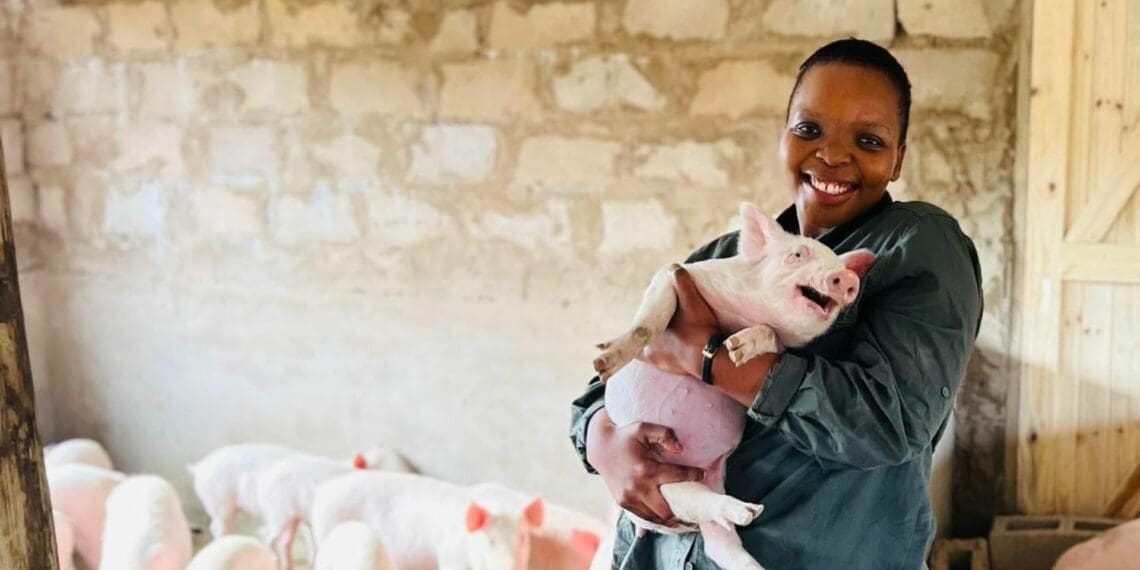
Raised in rural northern KwaZulu-Natal, unemployment among the youth inspired start-up pig farmer Siphelele Siyaya, also known as ‘Titi’, to start farming and create jobs. With just a few years to her name in the farming world, much can be expected from this enthusiastic young farmer.
“I love farming and I love pigs!” she says. “That is why I started farming because I wanted to make use of the knowledge that I have, and also the rural areas have land available.”
Siyaya grew up between the two small towns of Mthubathuba where her parents lived, and KwaNongoma in the arid northern regions of KwaZulu-Natal where she lived with her grandmother. With a memory of seeing pigs in her backyard, she recalls her grandmother raising them and only using them for domestic purposes.
“We had pigs at home, my grandmother used them for other things though, but I’ve always loved them since then,” she says.
How it all began
Siyaya’s farming journey started in 2020 after she completed two years in the USA as part of an exchange student programme. When she came back to South Africa, she was unemployed for a short while, which inspired her into getting her PGCA certificate in education.
“I then studied as a teacher for a while, but my mind was really into starting a business. This was when I saw a lot about the South African youth as a teacher,” she says.
The realities were obvious and quite difficult to take in. Youth unemployment was on the rise and the rejection of the uneducated was a rather harsh thing to take note of. This was enough to get her onto her feet and do something about it.
Siyaya started her farm at the end of 2021 with the few pigs that her grandmother owned. Progress was steady, but everything soon took off as word of her high-quality produce spread.
“I make sure my pigs drink clean and fresh water and we feed them three times a day,” she explains.

Pillar of strength
When the pigs multiplied, so did the work and the chance of employing the youth became a reality. Since then, she has been able to permanently employ three young women on the farm who assist her with day-to-day duties.
It all started mainly with the help of one who she calls her “pillar of strength”, her father, Thokozani Siyaya. There was not a single day without him behind her, supporting her every move. He was the first person to react to her dream of starting a farming business.
“I remember I just called him, and we spoke. I said to him ‘Dad, I want to start a business in farming. I’ll start with the pigs.’ And I just let the conversation slide. He called me a few days later telling me that he had spoken to the village chief and asked for land, and he secured it for me!
“I was so impressed. But that’s not all. He has always been there for me and it’s so nice to know that I have somebody like him to support me. My family supports me, but not like how my dad does.”
Alleviating unemployment
With her three employees on track with the business plan, Siyaya managed to increase her customer base to neighbours and people outside of KwaNongoma, and even residents of Mthubathuba. She managed to make deals with organisations in the area to help secure employment for women in her community.
“I had a relative who didn’t finish school and had to sit at home and not really do anything. That memory really drove me into wanting to make a difference for women in my community, “she says.
“Because December was the festive season, the orders for pork hit the roof and I sold more than 60 pigs. In that busy time, I was able to bring in young people from my area to come help around the farm and that made me very happy.
“December was very busy,” she says with a sigh.
Bridging the gender gap
Although December was a huge success, Siyaya will not forget the mundane but very noticeable challenges she faces as a female farmer in a rural area. For her, it has always been a gender problem where most still look down on her because she is a woman.
“Sometimes when I get a call from a potential client who wants to maybe make an order, when I answer the phone and they hear my voice, I get comments like ‘oh, I thought you would be a man’. I don’t really like that because I know what I am doing even though I am a woman.”
She owes most of her time to research and readings about pig farming and how to run a farm. Not only that but reaching out to people with more expertise has helped her gain more knowledge and develop her skill set.
“Someone told me, ‘Market yourself by networking with other people in the industry’,” she says. “That really worked because it got me where I am today.”
Challenges and victories
As a start-up farmer, Siyaya still encounters challenges with proper infrastructure on her farm. She says the need for an abattoir and built-in slaughterhouse are her biggest needs, ones she hopes to meet within the next three to five years. While that may be the case, the biggest challenge is the lack of water in the area.
“KwaNongoma is a fairly dry area and water is not very consistent, so sometimes we get water cuts. There is a river nearby, yes, but I always have to give my pigs clean and fresh water to drink so that they can grow.
“The farm is not too far from my grandmother’s house and there we have a borehole, so I gather water from there when needed,” she says.

Load shedding woes
Her current challenge would be what most farmers are faced with, the continuous rolling blackouts which have in most cases kept her fridges warm, placing her produce at a risk.
“In December we had a lot of load shedding, and I reached a point where I felt that it was getting very difficult. But what do you do? You don’t give up! So I came up with a plan B and borrowed a generator from someone and used it to keep my fridges on.”
Despite the ups and downs of the journey, Siyaya says her love for the pigs and farming keeps her going. She believes that just with the right amount of perseverance and strength, the youth of South Africa can do absolutely whatever they want, especially those who want to branch into farming.
“It’s not easy starting up, but if you want to do it, then just do it! That’s all there really is to it,” she says.
ALSO READ: Plaatjie comes out fighting after bruising battles
Get Stories of Change: Inspirational stories from the people that feed Mzansi.