Saturday, September 5, 2026
SUBSCRIBE
22 GLOBAL MEDIA AWARDS
Food For Mzansi
  • News
  • Changemakers
  • Lifestyle
  • Farmer’s Inside Track
  • Food for Thought
No Result
View All Result
  • News
  • Changemakers
  • Lifestyle
  • Farmer’s Inside Track
  • Food for Thought
No Result
View All Result
Food For Mzansi
No Result
View All Result
in News

‘It’s raining cats and dogs,’ yes, but snakes?

by Noluthando Ngcakani
23rd November 2020
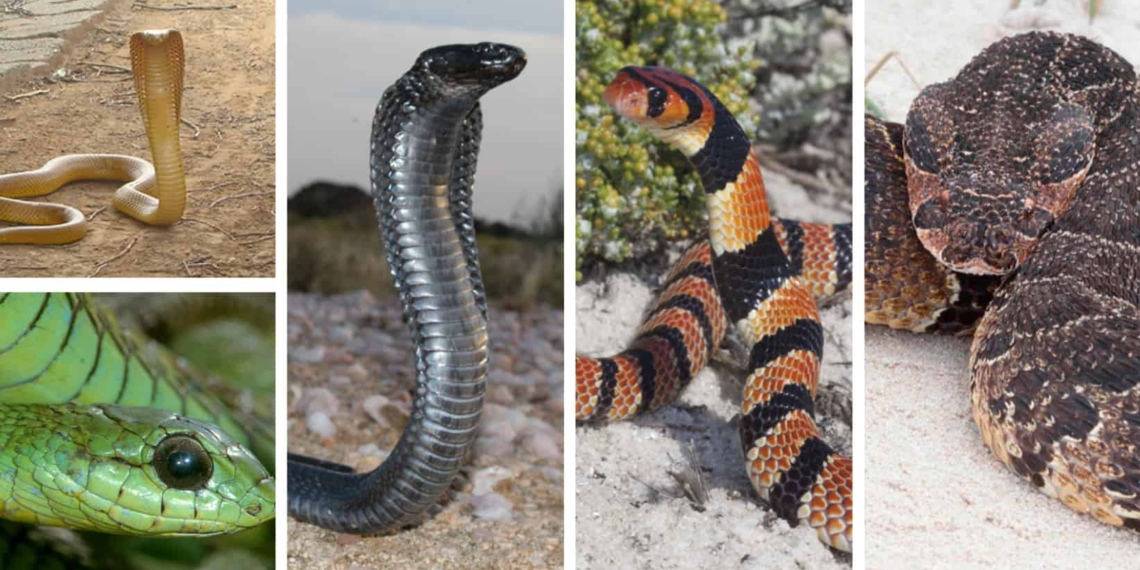
Most snakes pose no threat to humans. For instance, only five of the 55 snake species found in the Northern Cape are considered dangerous. They are (from left)  Cape Cobra (top), Boomslang (bottom), Black Spitting Cobra, Cape Coral Snake and Puff Adder. Photo's: African Snake Bite Institution

Most snakes pose no threat to humans. For instance, only five of the 55 snake species found in the Northern Cape are considered dangerous. They are (from left) Cape Cobra (top), Boomslang (bottom), Black Spitting Cobra, Cape Coral Snake and Puff Adder. Photo's: African Snake Bite Institution

Share on FacebookShare on TwitterShare on WhatsApp

The Northern Cape department of agriculture has welcomed recent rains, but cautions farmers and communities to be on high alert for increased snake activity across the province.

In a media release, agriculture MEC Mase Manopole says recent heavy rains and improved weather conditions in the province could be linked to the high prevalence of snakes. Both venomous and less harmful snakes are more plentiful due to an upsurge in prey and the flooding of their shelters.

Mase Manopole, Northern Cape MEC for agriculture, environmental affairs, land reform and rural development. Photo: Soraya Crowie/Supplied

Springtime is moulting season for various snake species, Manopole further clarified. During this time snakes could be encountered in populated areas in gardens and houses closest to open veld. This has become common occurrence in Kimberley.

Households with rubble in the yard are likely to attract snakes as the shelter attracts mice and rats, which are staples to the slithering predator.

“The increase in frogs, lizards and newborn birds after rains will result in more snake encounters since snakes in our province are mostly inactive during winter and therefore need to obtain food as it becomes warmer,” she said.

Eep! There is a snake in my house, what should I do?

In the Northern Cape, it is estimated that snakes and scorpion bites are fatal in at least five people per year.

The conflict between humans and snakes has been concerning due to the increase of the human population and the shrinking of natural habitat for the animals to survive in.

In southern Africa a total of 175 snake species exist, with 55 of these present in the Northern Cape.

Only five are considered dangerous: the Puff Adder (Bitis arietans), Cape Cobra (Naja nivea), Cape Coral Snake (Aspidelaps lubricus lubricus), Black Spitting Cobra (Naja nigricollis woodi) and Boomslang (Dispholidus typus typus).

Despite your own terror and shock in your encounter of the misunderstood visitor, Manopole warns that it is illegal to kill snakes in the province without the necessary permit to do so.

“Snakes play an important role in our ecosystems since they control animal species such as mice and rats, which can spread diseases to humans.

“If you encounter a snake in your home or garden the best thing to do is to retreat at least five paces. At this distance you cannot get bitten by a snake. Observe the snake from a safe distance while calling a snake handler,” Manopole cautioned.

She added that the province boasted several qualified and trained experts who were willing to catch and release the misplaced serpents.

“It must be noted that even if a person obtained the necessary training to be able to handle snakes, in the Northern Cape Province they are also required to have a valid permit from our department, to be able to remove snake species from areas and to translocate them to a safe place.”

Manopole added, “It is necessary for the communities to familiarise themselves with the snake species which can occur in their area and to know what to do when they encounter a snake. Educational resources are freely available from the Department offices.”

Noluthando Ngcakani

With roots in the Northern Cape, this Kimberley Diamond has had a passion for telling human interest stories since she could speak her first words. A foodie by heart, she began her journalistic career as an intern at the SABC where she discovered her love for telling agricultural, community and nature related stories. Not a stranger to a challenge Ngcakani will go above and beyond to tell your truth.

Tags: Mase ManopoleNorthern Cape Department of AgricultureSnake seasonsnakes
News

Aucamp outlines strategy for biosecurity, trade, and infrastructure

by Tiisetso Manoko
2nd September 2026

In an exclusive interview with Food For Mzansi, agriculture minister Willie Aucamp outlines his vision to accelerate the AAMP, tackle...

Read moreDetails
Tobias Doyer, CEO of Grain SA. Photo: Supplied/Grain SA Facebook

Rising costs, climate risk push Swartland wheat farmers to the brink

2nd September 2026
Sick spuds: No need to panic as SA’s potatoes are banned in Zim

Potato turning point ahead as onions double in price year-on-year

1st September 2026
Early calf care: Key growth targets every cattle farmer must track

Early calf care: Key growth targets every cattle farmer must track

1st September 2026

How to align your farming cycles with long-term financial success

1st September 2026

Water rights alone won’t fix inequality in SA commercial farming

Government hikes sugar import price, but industry warns of gap

Strategic support sparks record-breaking growth at WC grape farm

Dragon fruit thrives in KZN valley despite tough national season

This week’s agri events: 31 August – 03 September

Join Food For Mzansi's WhatsApp channel for the latest updates!

JOIN NOW!
Next Post
Meet the shareholders of Farmer Angus EGGS. From the top left are Phello Ntlati, Neliswa Mbengana, Thobelani Mngomezulu, Menzi Khoza, Angus McIntosh and Mawethu Xamle. From the front left are Thabani Lamula, Zanele Hlabisa and Mbhekiseni Khoza. Photo: Supplied

Farmer Angus sells 85% of his egg business to farmworkers

THE NEW FACE OF SOUTH AFRICAN AGRICULTURE

With 21 global awards in the first six years of its existence, Food For Mzansi is much more than an agriculture publication. It is a movement, unashamedly saluting the unsung heroes of South African agriculture. We believe in the power of agriculture to promote nation building and social cohesion by telling stories that are often overlooked by broader society.

Honoured roots: A father’s legacy, a daughter’s farming dream

Gauteng farmers urged to harness massive urban market

Foot-and-mouth crisis hits SA dairy industry with R1-billion loss

Tough times, hardy cattle: Why Mzansi farmers are choosing Nguni

Dragon fruit thrives in KZN valley despite tough national season

Government hikes sugar import price, but industry warns of gap

  • Awards & Global Impact
  • Our Story
  • Contact Us
  • Cookie Policy
  • Privacy Policy
  • Copyright

Contact us
Office: +27 21 879 1824
News: info@foodformzansi.co.za
Advertising: sales@foodformzansi.co.za

Contact us
Office: +27 21 879 1824
News: info@foodformzansi.co.za
Advertising: sales@foodformzansi.co.za

  • Awards & Global Impact
  • Our Story
  • Contact Us
  • Cookie Policy
  • Privacy Policy
  • Copyright

Chat Options

I'm Lerato, your AI assistant!
No Result
View All Result
  • News
  • Changemakers
  • Lifestyle
  • Farmer’s Inside Track
  • Food for Thought

Copyright © 2024 Food for Mzansi

This website uses cookies. By continuing to use this website you are giving consent to cookies being used. Visit our Privacy and Cookie Policy.