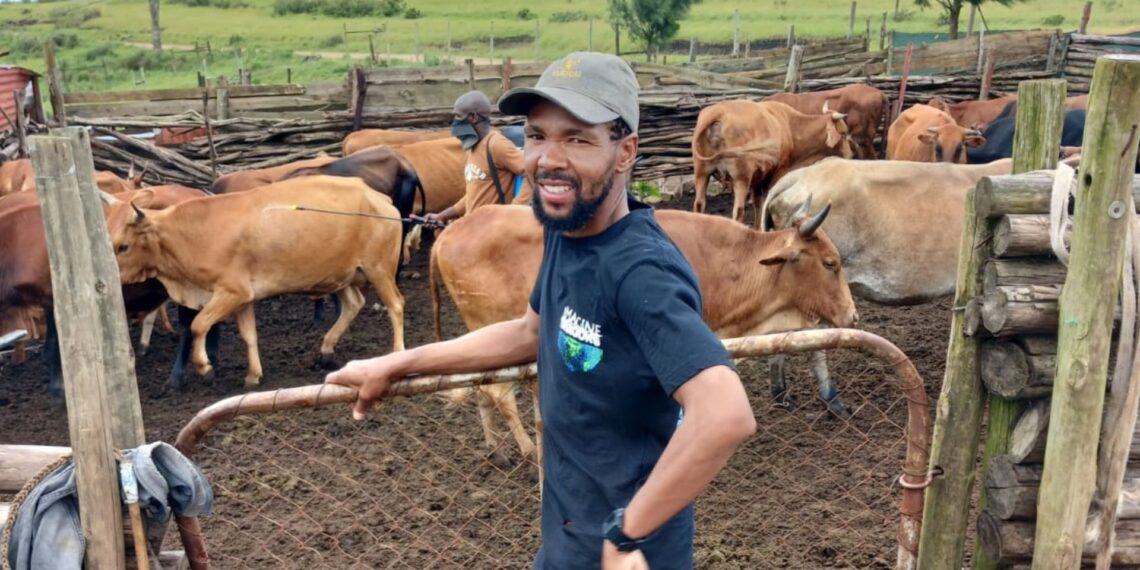
Farming has become a way out of unemployment for many South Africans. This was the case for Anda Zaku from KuGatyane in the Eastern Cape. Today, Zaku is involved in multiple farming ventures, including cattle and sheep rearing, vegetable production, peanut butter processing, and mentoring other aspiring farmers in the region.
While unemployment is often linked to a lack of skills, Zaku shows that even with qualifications, finding work in South Africa can be a struggle. He holds a diploma in industrial relations from Tshwane University of Technology (TUT), yet farming has become his way of creating opportunities and building a future for himself.
Farming dreams take root
Zaku graduated from TUT in 2010 and had hoped to secure a job after completing his internship at the National Nuclear Regulator. Things, however, did not work out as he had anticipated.
He returned home with no money, little hope, and only his qualification in hand. Back in the Eastern Cape, the land reminded him of its value. This was once a homestead where food was grown, and livestock could be sold to cover family needs such as clothing or furniture.
By 2013, Zaku decided to go back to these roots. He started small in his home garden with potatoes and cabbage. Over time, he expanded, and today he farms on 1.2 hectares of land in Mfula village under Mbhashe Municipality, about 30 kilometres from his home town, Dutywa.

Using traditional knowledge, he has grown his work from subsistence farming into structured agri-business ventures in crops, livestock, and agro-processing.
Zaku explains that farming has shown him that rural agriculture can be both commercially viable and community-driven. In livestock, he manages a herd of cattle using a Boran stud bull to improve genetics, focusing on adaptability and meat quality.
“I chose Boran because in this soil type the heat is extreme, yet the breed copes well with the climate and even with challenges like blue ticks.”
Alongside his cattle, Zaku also keeps goats and breeds Dohne Merino sheep, prized for their dual-purpose wool and meat traits. He adds that indigenous goats remain part of his operation, being well-suited to the local environment.
Related stories
- Former teacher plants knowledge, harvests success in Limpopo
- Limpopo teen farmer finds purpose and passion in the fields
- The farmer’s guide to supplying fresh produce to markets
- Taleni Farmers Co-op grows hope in rural Eastern Cape
Farming with grit
Zaku has grown through the challenges and earned recognition for his hard work, including becoming the co-founder of Nondobo Cooperative Limited. Yet, limited resources, especially irrigation, remain a struggle while they grow sorghum and speckled beans for the beer industry.
Between 2017 and 2020, he was part of an initiative that established a sorghum belt with Mbhashe Local Municipality, in partnership with LM Holdings and United National Breweries through Diageo South Africa.
“The initiative created over 100 job opportunities around Chizele and Amngwevu villages in Dutywa,” he says.
He is also the founder of Iyana Farming Hub and co-founder of Mbhashe Gold, where he works with a group of women in the community. His family and the surrounding community have shown strong support, both in crop production and in livestock operations.
His potatoes, though sold informally, move well through local shops and households. His cabbages find a steady market in schools and feed families in the area.

“My wife is actively involved, especially in our livestock and crop production operations, from day-to-day planning to hands-on work during peak farming seasons,” he says.
“We work together as a team, managing cattle, sheep, goats, and our vegetable fields. These crops support household nutrition, strengthen local food security, and bring income directly into our rural community.”
Farming with purpose
He tells Food For Mzansi that his farming methods are primarily conventional, but he also integrates sustainable and regenerative practices where possible.
“In my livestock operations, I use natural grazing systems and rotate animals to prevent overgrazing and allow the veld to recover.
“ I also supplement with locally sourced feed and use manure from the livestock to enrich my crop fields, reducing reliance on synthetic fertilisers.”

In crop production, he focuses on low-input methods suited to the rural environment while maintaining soil health and avoiding overuse of chemicals.
“I’m not certified organic, but I am conscious of the long-term health of the soil, water, and environment because my goal is to build a farm that can sustain future generations in my community.”
Zaku adds that his operation has grown steadily, though progress took time to show. His clientele, especially for his livestock and crops, is supported by the neighbouring towns such as Xhorha, Gcuea, Gatyaba, and Centane.
For both businesses, Zaku’s goal is to create opportunities and share the power of homesteading. “With a little support, we can return to food gardens, something everyone who grew up in rural areas knows well.”
He also notes that Mbhashe Gold, which produces peanut butter, is new but already showing potential. “If it gains recognition and a formal market, it can create jobs and opportunities while processing at scale,” he says.
ALSO READ: Ditch store-bought and make your own healthier peanut butter