Monday, September 7, 2026
SUBSCRIBE
22 GLOBAL MEDIA AWARDS
Food For Mzansi
  • News
  • Changemakers
  • Lifestyle
  • Farmer’s Inside Track
  • Food for Thought
No Result
View All Result
  • News
  • Changemakers
  • Lifestyle
  • Farmer’s Inside Track
  • Food for Thought
No Result
View All Result
Food For Mzansi
No Result
View All Result
in News

Locusts continue to plague Northern Cape farmers

by Noluthando Ngcakani
21st February 2021
More brown locust swarms are expected to make their way to the interior of the Northern Cape this season. Photo: Supplied/Food For Mzansi

More brown locust swarms are expected to make their way to the Free State. Photo: Supplied/Food For Mzansi

Share on FacebookShare on TwitterShare on WhatsApp

For five years, farmers in the Northern Cape looked to the heavens and prayed for rain as they battled the drought. What they did not bet on though, was the swarms of brown locusts who, some say, seem to have hijacked their answered prayers.

Mase Manopole, the MEC for agriculture, environmental affairs, rural development and land reform, confirms that the province experienced the highest locust outbreak in the country.

Mase Manopole, Northern Cape MEC for agriculture, environmental affairs, land reform and rural development. Photo: Soraya Crowie/Supplied

Even more swarms are expected to make their way to the interior of the province this season.

The MEC recently visited several farms near Vosberg to assess the locusts have caused on land being used by up-and-coming farmers in the province.

The areas with the largest number of swarm outbreaks include, Hopetown, Prieska, Carnarvon and Vosburg.

Manopole says, “The national department of agriculture is using ground control teams. They’ve sent an aircraft to assist with the aerial spraying and a team of experts to keep the spread under control.”

Help for affected areas

She confirms that departmental officials have inspected areas that were hit. They distributed insecticides, protective clothing and spray pumps.

Since the outbreak, the provincial government has been in talks with organised agriculture to nominate farmers in the area to be trained and appointed as locust control contractors.

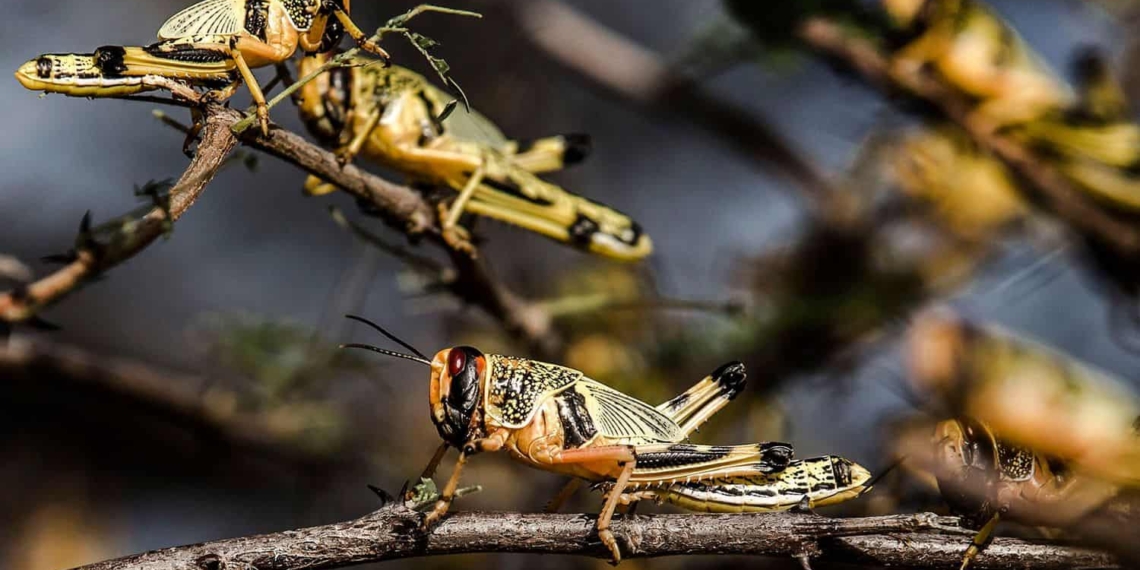
The brown locust is mostly found in the semi-arid Karoo region of the Northern Cape. Photo: Supplied/Food For Mzansi

An agricultural pest, the brown locust is mostly found in the semi-arid Karoo region of the Northern Cape. Migrating swarms move over large areas and in some instances may even darken the sky.

“The team has been quick to respond when landowners and members of the public report the outbreak of locust to the nearest office of the department. Officials continue to inspect reported outbreaks and distribute insecticides, protective clothing and spray pumps for outbreaks control.”

Worst hit areas

Recently, new districts in central parts of the Northern Cape have been experiencing the outbreaks.

Flying adult swarms that have recently reached Upington are believed to have originated from Prieska. The farming town is home to several unoccupied and vacant farms, conditions that enhance breeding.  

The locust control contractors have been activated to control the outbreak in the new districts.

Manopole explains, “The control and monitoring of the locust outbreaks will continue, however, due to large areas of unoccupied land in the Karoo, some of the swarms grow unnoticed and continue to lay eggs which hatch in numbers. 

“The locusts have impacted land which is supposed to be grazed by the livestock and the crops that could be harvested for food security.”

Manopole further calls on the farming community to notify the department when they see any potential outbreak in their respective areas.

Meanwhile the Agricultural Research Council recommends that South Africa maps out the seasonal breeding areas of the brown locusts. This will entail engaging experts in this field with a better understanding of the locust’s life cycle, breeding behaviour as well as the geography of the affected and/or the surrounding provinces in question.

ALSO READ: ‘Cultivate under-utilised land to boost food security’

Noluthando Ngcakani

With roots in the Northern Cape, this Kimberley Diamond has had a passion for telling human interest stories since she could speak her first words. A foodie by heart, she began her journalistic career as an intern at the SABC where she discovered her love for telling agricultural, community and nature related stories. Not a stranger to a challenge Ngcakani will go above and beyond to tell your truth.

Tags: Brown locustsMase Manopolepest control
Tough times, hardy cattle: Why Mzansi farmers are choosing Nguni
News

Tough times, hardy cattle: Why Mzansi farmers are choosing Nguni

by Vateka Halile
3rd September 2026

Nguni cattle are known for their hardiness and low-maintenance needs, making them ideal for Mzansi's harsh conditions. However, market prejudice...

Read moreDetails
Dragon fruit thrives in KZN valley despite tough national season

Dragon fruit thrives in KZN valley despite tough national season

3rd September 2026
The future of Mzansi's sugar industry hangs in the balance

Government hikes sugar import price, but industry warns of gap

3rd September 2026

Chicken is booming, but the real money is in the supply chain

2nd September 2026
How Tebogo beat post-harvest losses with smart agro-processing

How Tebogo beat post-harvest losses with smart agro-processing

2nd September 2026

RSVP now: Emerging farmers’ programme at Nampo Cape

Gauteng farmers urged to harness massive urban market

Dragon fruit thrives in KZN valley despite tough national season

This week’s agri events: 31 August – 03 September

Foot-and-mouth crisis hits SA dairy industry with R1-billion loss

Join Food For Mzansi's WhatsApp channel for the latest updates!

JOIN NOW!
Next Post
agriculture news

This week in agri: 22 to 28 February 2021

THE NEW FACE OF SOUTH AFRICAN AGRICULTURE

With 21 global awards in the first six years of its existence, Food For Mzansi is much more than an agriculture publication. It is a movement, unashamedly saluting the unsung heroes of South African agriculture. We believe in the power of agriculture to promote nation building and social cohesion by telling stories that are often overlooked by broader society.

Tiger Brands CEO calls for stronger food value chain

Plant, pick, protect: The rising potential of urban foraging in SA

RSVP now: Emerging farmers’ programme at Nampo Cape

Community-led farms boost food security and incomes in Limpopo

Farmers rethink water use as shortages threaten food production

Honoured roots: A father’s legacy, a daughter’s farming dream

  • Awards & Global Impact
  • Our Story
  • Contact Us
  • Cookie Policy
  • Privacy Policy
  • Copyright

Contact us
Office: +27 21 879 1824
News: info@foodformzansi.co.za
Advertising: sales@foodformzansi.co.za

Contact us
Office: +27 21 879 1824
News: info@foodformzansi.co.za
Advertising: sales@foodformzansi.co.za

  • Awards & Global Impact
  • Our Story
  • Contact Us
  • Cookie Policy
  • Privacy Policy
  • Copyright

Chat Options

I'm Lerato, your AI assistant!
No Result
View All Result
  • News
  • Changemakers
  • Lifestyle
  • Farmer’s Inside Track
  • Food for Thought

Copyright © 2024 Food for Mzansi

This website uses cookies. By continuing to use this website you are giving consent to cookies being used. Visit our Privacy and Cookie Policy.