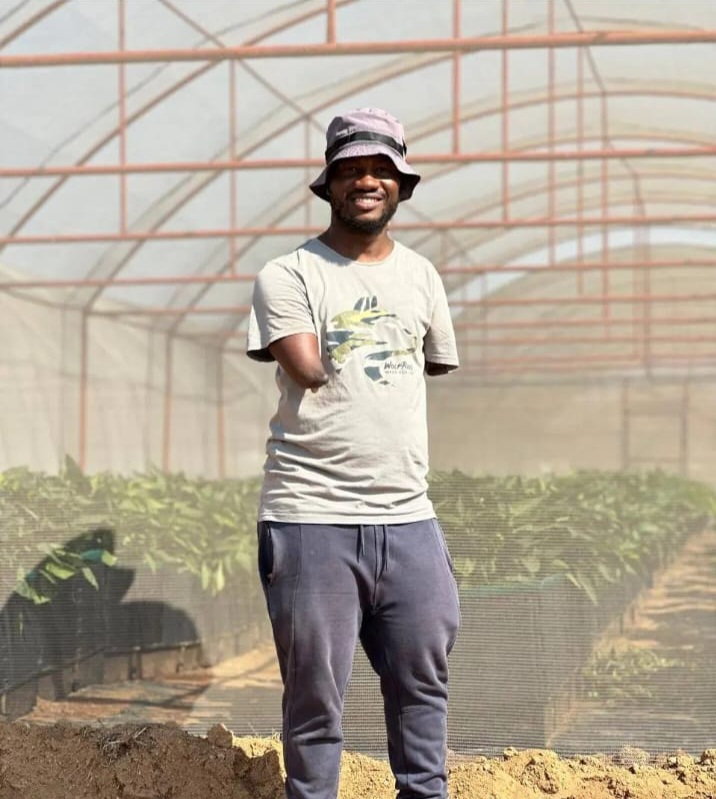
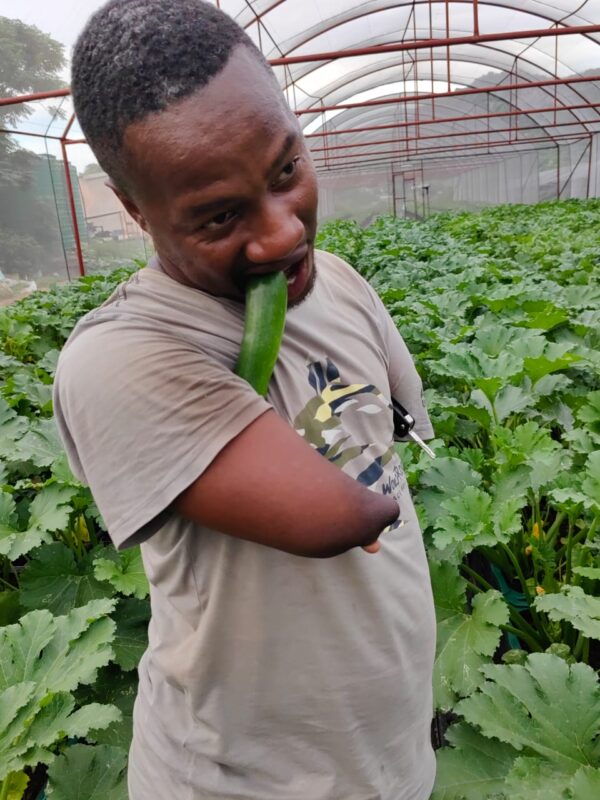
Born with a condition that left him with underdeveloped upper limbs, Sibusiso Mogale could have easily been defined by the limitations of his disability. Instead, he has become a highly regarded crop and livestock farmer in Mpumalanga.
Unfortunately, many still focus on his condition, framing his achievements through the lens of his disability, rather than recognising the hard work and determination that have led to his success.
For most of his career, Mogale, who was born with phocomelia, has experienced discrimination. “People still don’t think someone like myself can farm. And look, I get it but nonetheless, it’s still some sort of discrimination,” he tells Food For Mzansi.
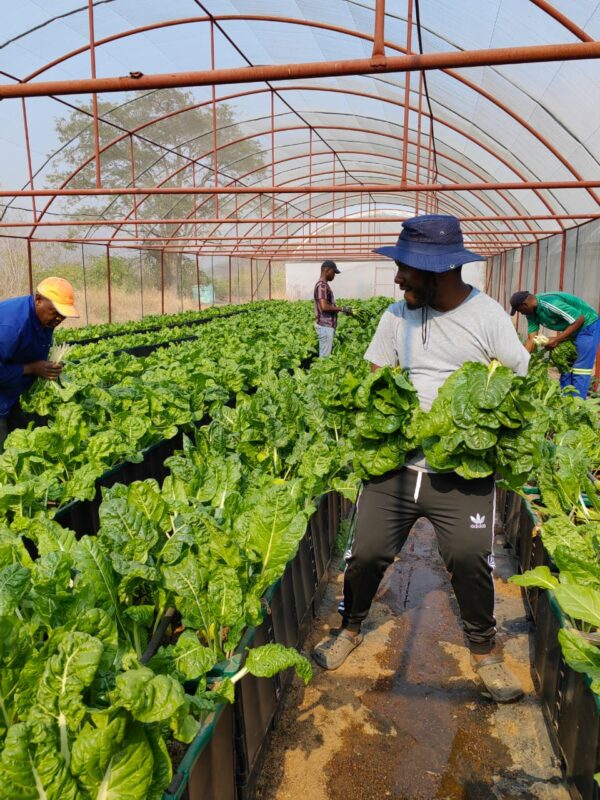
As a crop farmer cultivating cabbage, tomatoes, bell peppers, chillies, spinach, and baby marrow, he no longer allows limiting perceptions to define him. Instead, Mogale is focused on his plans for expansion and exploring how he can incorporate precision farming and technology into his operations.
“I just really want to be lethal when it comes to the space that I have,” he shares.
No limits, just possibilities
On his 24-hectare farm, Mogale works wonders with his crops, proving that his disability is no obstacle to success. As a result, his produce has drawn the eye of major retail outlets, sparking widespread interest.
“I’m supplying cabbage and spinach to Boxer stores, spinach to Spar, bell peppers to Agri-Hub, and tomatoes to street vendors,” he says.
Mogale possesses a quiet yet undeniable confidence in his identity as a farmer. While he acknowledges his physical condition, he does not let it define or limit him.
“I only have short arms from shoulder to elbow. I’m a farmer. That’s basically how I make a living. Professional farmer, I suppose,” Mogale says with quiet confidence.
He now plans on expanding into livestock farming. “I want to grow more livestock like cattle, goats, sheep, pigs, and the like.”
A few fallen mielies
Mogale’s passion for farming was nurtured by his grandmother, Joanna Nkosi. He vividly recalls spending time with her as she planted crops for family consumption.
“She used to do a lot of planting – sweet potatoes, mielies, pumpkins – but never for sale, always for family consumption,” he remembers.
One moment shaped his future: “As she planted, some mielies fell. I’d push them into the soil with my toes, and wherever I planted, they’d grow.”
At six, seeing his own results brought joy. He recalls feeling accomplished and wanting to hold onto that feeling.
Which is why, years later, after studying financial management at Boston College and working in insurance, he quickly realised he was in the wrong career. “I worked in offices and realised it’s not for me. That’s when I went into the farming space.”
Related stories
- Goat matchmaker Vuyisile finds purpose serving traditional healers
- Jacques Theron’s dairy legacy: From 6 cows to industry leader
Can we rely on you?
Building a solid clientele wasn’t easy. Mogale had to hustle, pitching his produce by going to shops, knocking on doors, and bringing samples to show.
“From what I’ve realised, markets always ask one thing: ‘Can we rely on you?’ I think that’s a huge thing for most farmers – they cannot do it,” he notes.
To stay consistent, Mogale follows a strategic planting schedule. “You have to plant your crops in different phases – either a week, two weeks, or a month apart. If you don’t, everything is ready at the same time, and you end up with produce rotting in the ground.”
Alongside door-to-door marketing, social media was key to his growth. Mogale has clear ambitions to grow. So far he has been supported with funding from Nedbank and the department of agriculture.
Pray, work hard, trust results
Mogale has faced challenges beyond people’s perceptions of his disability, with access to capital being one of the biggest hurdles.
“Farming is expensive to start. Given my condition, there’s a lot I can’t do on my own, so I need assistance. But hiring help costs money,” he says.
His solution? Side hustles. “I had side hustles, making money on the side and just making sure I have some sort of income. You pump that income into the farm, and that’s how you get started.”
With his eyes set on precision agriculture, Mogale says, “I just really want to be lethal when it comes to the space that I have.
“I want to implement a lot of technologies regarding farming: more drones, electronic systems, digital irrigation controls. I love technology… I need to make sure the systems I install are almost bulletproof. They must work like clockwork.”
Meanwhile, for those looking to enter farming, Mogale’s advice is to work hard. “It is genuinely the one ingredient that you cannot run away from when it comes to success.”
He also emphasises perseverance, discipline, patience, and to consistently challenge oneself.
And above all, Mogale says, ‘”Just pray. It doesn’t matter what religion or culture – just pray, pray, pray. Whichever way you want to pray, don’t forget that.”
READ NEXT: Dairy dynasty: Family, innovation fuel Foundation Farm success
Get Stories of Change: Inspirational stories from the people that feed Mzansi.