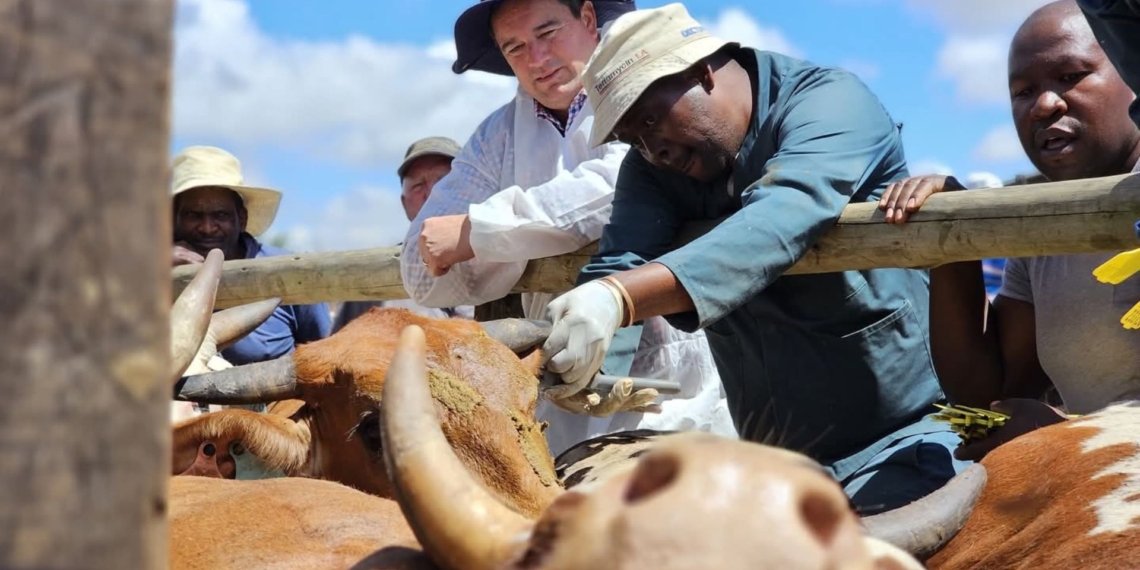
Earlier in the week, the department of agriculture lost a court case that many stakeholders hailed as a victory for farmers concerning foot-and-mouth disease (FMD), currently causing major disruption in the livestock industry.
The Gauteng High Court said the department of agriculture does have the legal authority to control and regulate South Africa’s response to FMD, including how vaccines are managed. The court did not immediately allow unrestricted private vaccination by farmers.
Francois Wilken, president of Free State Agriculture (FSA), said the order was a major step forward for farmers who have been left exposed for too long.
‘Farmers can take action, but…’
“It confirms that producers can take responsible action to protect their herds, while government delays and interference are no longer acceptable,” he said.
“This development directly addresses the long-standing position advanced by FSA, namely that there is no lawful basis to prevent responsible private-sector participation in vaccination efforts.
“The order further prohibits undue interference by the state in lawful commercial relationships within the vaccine supply chain, reinforcing the need for a functional and accessible vaccine market.”
While the order provides immediate interim relief, the matter will proceed to final determination, with further legal steps to be instituted within 20 days.
Wimpie Lambrecht, a cattle farmer from North West and a member of FMD Response SA, said the vaccination response should be designed around the biology of the disease.
Related stories
- Turkish FMD vaccines set to boost national vaccination drive
- Why SA is importing FMD vaccines from Argentina
- Free State, Gauteng unveil strategies to combat FMD crisis
- Strong biosecurity, vaccination urged as FMD threatens exports
“To stop transmission, large numbers of cattle need to be vaccinated within a tight six-to-eight-week window, and then re-vaccinated with a booster six months later. That is the biological requirement needed to create simultaneous immunity so the virus stops spreading.
“The government’s plan to vaccinate cattle until December will not stop the disease, as the virus will keep finding unvaccinated cattle to infect. Building the response around the biological requirement of simultaneous immunity is what will determine whether it succeeds,” he said.
Lambrecht stated that in some provinces, vaccines are being distributed to all, but in others, like KwaZulu-Natal, commercial farmers are not accessing vaccines. He said in order to beat the disease, vaccines need to be delivered at speed and scale to all farmers, large-scale or communal.
Industry urged to be cautious
The KwaZulu-Natal Agricultural Union (Kwanalu) has cautiously welcomed the Gauteng High Court ruling. Kwanalu emphasised that the ruling represents an important legal development in the ongoing effort to strengthen South Africa’s FMD response, particularly in KwaZulu-Natal, where producers continue to face severe pressure from vaccine shortages.
Kwanalu chairperson, PJ Hassard, said there are still many unanswered questions surrounding how the ruling will ultimately be applied in practice.
“While the judgment is a positive development in principle, it is important that the industry remains cautious in how it interprets the ruling.
“This matter is far from implementation. Government still has an opportunity within the next 20 days to submit changes or respond further to aspects of the ruling, and there are additional legislative and regulatory processes that would still need to take place before any expanded vaccine access framework becomes operational,” he said.
Traceability and control measures are key
Hassard said one of the most critical considerations remains traceability and the control measures required for a regulated animal disease such as FMD.
“In situations like this, misinformation spreads very quickly. Producers are understandably desperate for workable solutions, but it is important that communication around the ruling remains factual, responsible and grounded in the actual legal and regulatory realities,” Hassard cautioned.
Meanwhile, agriculture minister John Steenhuisen stated that the practical effect of the matter is now largely overtaken by the gazetted Section 10 Animal Health Scheme, which already provides a lawful framework for participation by private industry role players in the national vaccination effort.
“Our objective remains to vaccinate at least 80% of the national cattle population with two doses of vaccine as swiftly as possible as part of South Africa’s pathway toward achieving WOAH-recognised FMD-free with vaccination status,” Steenhuisen said.
READ NEXT: Zero-tariff breakthrough sparks new era for SA’s rooibos industry