With the launch of the Jantjies Boerdery Packhouse Project in Taung recently, the North West department of agriculture and rural development has reaffirmed its commitment to expanding agro-processing, creating jobs and strengthening farmer participation in the agricultural value chain.
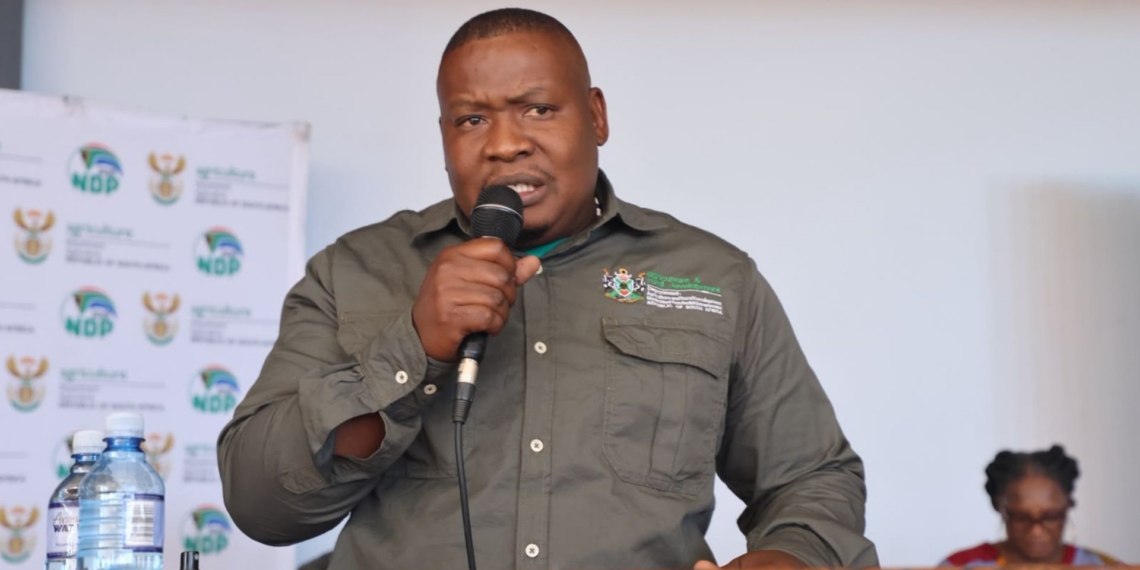
The MEC for agriculture and rural development, Madoda Sambatha, joined by the deputy minister of agriculture, Nokuzola Capa, officially unveiled the value-adding packhouse at Jantjies Boerdery, led by Tshepiso Jantjies.
The project is aimed at strengthening lucerne production and processing in Taung and forms part of the government’s broader efforts to support farmer-led enterprises that move beyond primary production and create greater value within the agricultural value chain.
Positioning Taung as a provincial lucerne hub
Sambatha said the investment should not be viewed as support for one individual enterprise, but as an intervention that will benefit the wider farming community in Taung.
“This investment is not only for Jantjies as an individual. Taung has one of the greatest concentrations of lucerne producers, which is why we are supporting lucerne aggregation. There are a number of lucerne farmers in the area, and our vision is to position Taung as a provincial lucerne hub,” he explained.
Related stories
- Professionalism pays: How Jantjies built a thriving lucerne business
- North West and Land Bank partner to boost emerging farmers
- Mechanisation boost as NW farmers receive key implements
- NW agri empowers 110 graduates to fight unemployment
He noted that the development of the lucerne value chain has the potential to increase agricultural production and employment opportunities in the municipality.
“The production of lucerne in Taung should help increase the capacity of the area to create jobs. The equipment provided to Jantjies is intended to assist not only this enterprise, but other farmers in and around Taung to produce and process lucerne.”
The department has supported the initiative with lucerne harvesting machinery, processing and value-adding equipment, as well as packaging materials. The support is intended to increase production capacity, promote agro-processing and create opportunities for farmers to participate more meaningfully in the agricultural value chain.
Moving from primary production into value addition
Sambatha encouraged farmers to collaborate and make use of opportunities presented by agro-processing. “The department is committed to assisting farmers with value-adding machinery to increase production capacity, create jobs and support the development of farmers.
“We encourage farmers to collaborate and ensure that agricultural products are processed, and value is retained within our communities,” he said.
Jantjies Boerdery is a farmer-led enterprise specialising in the production, harvesting, processing, packaging and distribution of lucerne products for the livestock feed market.
“We plant, harvest, package and supply. I specialise in lucerne. It took us more than three years to get to where we are because there are a lot of compliance procedures that we had to meet to work across the entire value chain,” Jantjies explained.
He said government support with machinery has been instrumental in enabling the enterprise to move from primary production into value addition.
“As a lucerne agro-processor, it is important to comply with industry standards, including the machinery that you use. With the lucerne pellet mill, I can process the product into pellets. Had it not been for the department’s support with the machinery, I would not have been able to produce a product such as pellets.”
Jantjies also plays a role in developing emerging farmers through mentorship and regular masterclasses aimed at equipping smallholder farmers with practical knowledge on lucerne production and processing.
READ NEXT: UCT study reveals shocking pesticide exposure in farm children