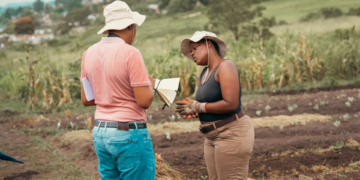
For children growing up in South Africa’s farming communities, exposure to pesticides may not end when the tractors leave the fields. A two-year study involving 533 children in three agricultural areas of the Western Cape found that household pesticide use and pesticide spray drift were consistently associated with higher levels of pesticide-related chemicals in children’s urine.
Findings from researchers at the University of Cape Town (UCT), Swiss Tropical and Public Health Institute (Swiss TPH), University of Basel and Lund University – as part of the South African–Swiss Research Chair in Global Environmental Health – suggest that children may encounter pesticides not only through helping with agricultural work but also through what happens around their homes and in their immediate environment.
The study is part of a PhD thesis of the first author, Regina Molomo, and of the Child Health Agricultural Pesticide Study in South Africa (CapSA). Published in Environmental Pollution, the study followed children aged between nine and 15 in Grabouw, Piketberg and the Hex River Valley between 2017 and 2019.
Researchers collected 1 814 urine samples across five sampling rounds and measured 14 biomarkers – chemical traces that can indicate recent exposure to different types of pesticides.
Findings: 60% of children exposed
The results suggest that what happens in and around the home can matter. Recent household pesticide use was associated with increases of up to 57% in levels of 12 pesticide biomarkers.
Recent exposure to spray drift, when pesticides move beyond the area where they were applied, was associated with increases of up to 30% in eight biomarkers.
Related stories
- Pesticide pollution in WC rivers threatens child health
- Safeguarding homes: Top tips on responsible pesticide storage
- Rising tide of illegal pesticides endangers SA
- ‘Protect farmworkers against hazardous pesticides’
These were not rare experiences among the children studied. Across the sampling rounds, more than 60% of children reported noticing pesticide spray drift from nearby application sites in the previous seven days. About 60% reported recent household pesticide use in four of the five sampling rounds.
The researchers also found evidence that drinking-water sources could influence exposure. Children in households that used open water sources had higher levels of certain pesticide biomarkers than those in households that used closed sources, such as tap water, boreholes or bottled water.
“Children become re-exposed due to persistence of these chemicals in the environment.”
Prof. Mohamed Aqiel Dalvie
“This analysis did not investigate if pesticides caused illness in the children. Instead, it identifies behaviours and environmental factors that were associated with measurable pesticide exposure,” said the study’s co-author, Professor Mohamed Aqiel Dalvie, director of UCT’s Centre for Environmental and Occupational Health Research and principal investigator of CapSA.
That distinction, said Dalvie, matters because most of the pesticides examined are eliminated from the body relatively quickly. “Urine measurements, therefore, provide a snapshot of relatively recent exposure rather than a measure of a child’s lifetime pesticide burden but children become re-exposed due to persistence of these chemicals in the environment.”
Researchers found that recent exposure factors were generally more consistently associated with pesticide biomarkers than were factors indicating whether children had ever experienced a particular exposure.
“This suggests that asking children and families about what happened in the days immediately before urine samples are collected may provide a more useful picture of exposure than relying only on questions about their past experiences,” said Molomo, a PhD student in epidemiology at Swiss TPH.
Joint action needed
The study also highlights how difficult it can be to draw a neat line between the farm and the home.
“Pesticide exposure in households can stem from multiple sources – agricultural chemicals brought indoors, household products used for pest control, or pesticides obtained through informal markets,” said Molomo.
Assistant Professor Samuel Fuhrimann, the study’s co-author and an epidemiologist at Swiss TPH, said: “Reducing children’s exposure therefore requires joint action across agriculture and the household. Understanding what families know, what they believe, and how they behave around pesticides is key to designing effective interventions – from stronger controls on spray drift to targeted education for farming communities on safer pesticide handling, particularly for insecticides used in and around the home.”
Of the children in the study, 40% lived on farms, and 80% had at least one family member who worked on a farm. This indicates that for many families, agricultural and household environments are closely intertwined.
“This evidence can help identify which pesticides pose the greatest concern, support the transition to safer alternatives for pest control in South Africa.”
The findings are significant for assessing pesticide exposure, particularly in agricultural communities in low- and middle-income countries, where detailed exposure data are often limited. Rather than treating exposure as something that happens only when a person works directly with pesticides, Assistant Professor Fuhrimann said that assessments should account for the full range of pathways through which children encounter pesticides – including recent household use, spray drift, agricultural activities and drinking water sources – as well as the timing of pesticide application periods.
“Our findings support stronger routine biomonitoring and environmental monitoring to better characterise these exposure pathways and their associated risks. This evidence can help identify which pesticides pose the greatest concern, support the transition to safer alternatives for pest control in South Africa, and ultimately inform a balanced assessment of the risks and benefits of pesticide use in agriculture and households,” he said.
- This article was first published by UCT News.
READ NEXT: SADC symposium brings plant nutrition research closer to the farm