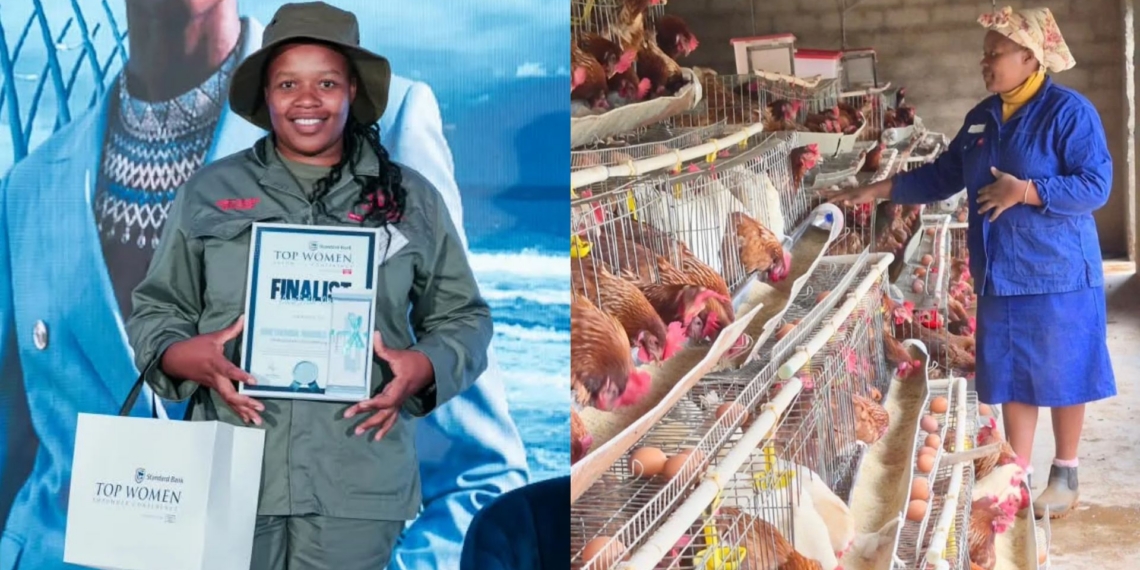
Driven by an inherited passion for food security and a determination to uplift her hometown, Sinethemba Nqobile Gebashe, the founder and managing director of Ithuba Lamahlavula Farming, is building a sustainable agricultural enterprise in KwaZulu-Natal.
Her primary inspiration came from her mother, Cabangani Gebashe, who farmed to keep the household fed.
“Her dedication to farming motivated me to fall in love with agriculture and encouraged me to start my own farming journey,” Gebashe recalls. “My mother’s farming experience taught me the importance of food security, hard work and self-reliance.”
Gebashe grew up in the Kwangwenda location under the Umzumbe Local Municipality. She completed her primary schooling at Gebers CP School before attending Bhanoyi High School, where she matriculated in 2009.
Rather than stepping straight into commercial production, Gebashe laid a strong academic foundation first. She studied primary agriculture at Coastal KZN FET College, earning her NQF Levels 2, 3, and 4 qualifications by 2012.

She then enrolled at the University of South Africa (Unisa), obtaining a national diploma in agricultural management in 2018 and culminating in a BTech degree in agricultural management in 2024.
Parallel to her studies, Gebashe gained extensive practical and community-focused work experience. Between 2019 and 2021, she participated in the Casp graduate programme at Siyavuna Abalimi Development Centre.
She later worked as an assistant extension practitioner for the department of agriculture, land reform and rural development in Umzumbe, followed by a tenure as a disability education facilitator at the Independent Electoral Commission (IEC).
Related stories
- Pivot to poultry: Jennifer Gazide swaps boardroom for broiler house
- Farming bootcamp propels Unicha Dladla’s path to growth
- Sinalo ditched his engineering degree to farm, and it paid off
- BenicaTheFarmer: The nurse who built an agricultural empire
“My background in agriculture, education and community development has helped me develop practical farming, agricultural management and professional skills, which I continue to apply in my farming business,” she says.
Turning pocket-money savings into a farm
While completing her final year at college, Gebashe’s operational journey began in October 2011.
She used savings from pocket money given by her father, Bhekisigcino Gebashe, to construct a modest mud-brick poultry house. Her parents also granted her two hectares of family land to kickstart her projects, where she began by raising 50-day-old broilers.
In 2012, she formally registered her enterprise as Ithuba Lamahlavula Farming. However, disaster struck the following year when heavy rains destroyed her mud-brick structure, and she lost her entire broiler flock.
Undeterred by the loss, Gebashe saved money from her early income to erect a sturdy 10m x 5m broiler unit.
“My aim was to establish a layer farming project, but due to insufficient funds, I initially continued with broiler production,” she explains.
Strategic expansion and government support
Gebashe’s persistence soon unlocked municipal and provincial support. Through the Umzumbe Local Municipality’s LED Asset Assist Programme, she secured funding to purchase her first 500 laying hens, officially transitioning the business into egg production.
Recognising her progress, the KZN department of agriculture and rural development subsequently backed her operation with R400 000 in funding. This capital injection allowed her to expand her flock to 1 000 layers while upgrading poultry infrastructure, feed supply, and operational equipment.
Today, Ithuba Lamahlavula Farming supplies bulk eggs directly to key commercial partners and local distributors – including Mandate Food Company, PCK Distributors, Turton Wholesale, and Mthwalume Wholesale – while also selling culls (spent layers) directly to community members.

The farm also employs two permanent and two part-time workers, while also hosting two agricultural graduates from the department of agriculture to assist with daily management, egg grading, packaging, and local deliveries.
“My greatest achievement is establishing and growing Ithuba Lamahlavula Farming from a small poultry project into an egg production business,” Gebashe reflects. “Over the years, I have gained valuable agricultural experience, developed relationships with customers, and created opportunities for growth in my rural community.”
Navigating input costs with sound management
Like many emerging poultry producers, Gebashe faces constant commercial pressure from high chicken feed prices, disease risks, limited capacity, and transport logistics.
To safeguard her margins, she prioritises biosecurity and careful operational planning.
“We mitigate these challenges by monitoring chicken health, maintaining proper hygiene, managing feed carefully, planning production, and building relationships with reliable bulk customers,” she notes.
“We also seek funding and business support to expand our layer capacity and improve our farming infrastructure.”
Scaling for long-term impact
Looking ahead, Gebashe’s roadmap for Ithuba Lamahlavula Farming focuses on scaling output and closing the loop on farm waste. Her goal is to expand her operation to 5 000 layers within the next three years.

“I want to increase egg production, supply more wholesalers and bulk customers, create employment opportunities for local people, and contribute to food security in the rural community.”
She also plans to utilise chicken litter to support local crop production and promote environmentally responsible farming.
For aspiring farmers starting in rural areas, Gebashe emphasises discipline over quick gains.
“Start small, be committed, and learn continuously,” she advises. “Farming requires patience, hard work, proper planning, and good financial management. It is important to understand your market, control production costs, maintain good animal health, and build relationships with customers.
“Do not give up when challenges arise; instead, learn from your experiences and look for opportunities to improve and grow your farming business.”
READ NEXT: Grazing shortages? Here is how Voermol protects livestock wealth