Picture walking into your favourite local restaurant and being greeted by the aroma of a perfectly grilled burger or steak. But instead of your meal being prepared by a chef, your order is prepared with mechanical precision by a sleek, metallic robot.
Around the world, restaurants are introducing artificial intelligence (AI) into various aspects of their operations to enhance efficiency, improve customer service, and drive innovation.
From digitised menus to robots flipping patties and facial recognition technology for payment processing, restaurants are leveraging AI technology to streamline operations and they’re not alone.
Growing demand for automation in food industry
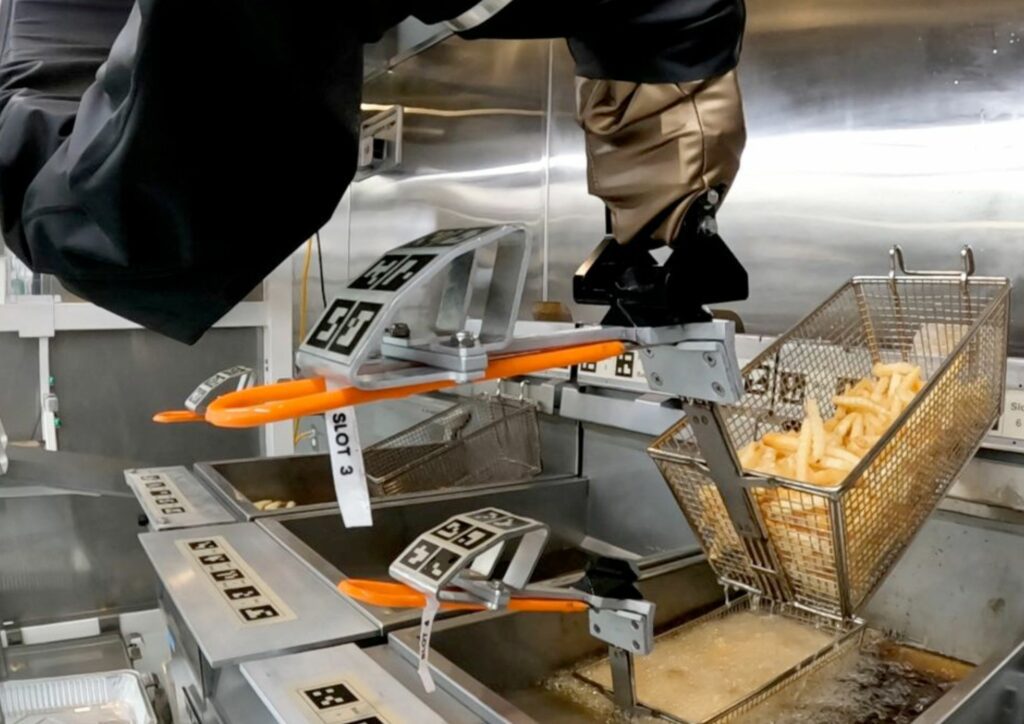
CaliExpress by Flippy is the latest restaurant to make waves in the restaurant and retail industries. Based in California, it is said to be the world’s first fully autonomous restaurant, utilising the most advanced systems in food technology.
According to Tony Lomelino, director of operations at PopID, one of the creators behind Flippy, both grill and fry stations are fully automated and powered by proprietary leading-edge artificial intelligence and robotics. The smart commercial kitchen robot fries items from french fries to chicken nuggets, and works alongside humans to enhance quality and consistency, while creating substantial, measurable cost savings for restaurants.
“Guests watch their food being cooked robotically after checking in with their PopID accounts on self-ordering kiosks to get personalised order recommendations and make easy and fast payments,” he said.
Equipped with an array of sensors, cameras, and intelligent algorithms that allow it to fry food, Flippy manages cooking times with precision.
John Miller, CEO of PopID and board member of Miso Robotics, said to their knowledge this is the world’s first operating restaurant where both ordering and every single cooking process are fully automated.
“The marriage of these various technologies to create the most autonomous restaurant in the world is the culmination of years of research, development, and investment in a family of revolutionary companies,” he said.

Related stories
- Farming robots bring risks as well as opportunities
- AI shops: Step into a bizarre cashier-less world
Overcoming challenges in adopting robotics in Mzansi
With a growing demand for food, the food industry is under immense pressure to deliver supplies faster and more efficiently. According to Linda Eales, robotics division manager at ABB South Africa, it is not surprising that automation in the food industry is growing fast.
“Food and beverage manufacturers increasingly need more flexibility on their production lines to enable them to adapt to changing consumer tastes and demands.
“At the same time, they require higher levels of productivity and efficiency, while maintaining the highest levels of product quality,” Eales said.
While globally, the uptake of robotics is growing rapidly, the South African food and beverage industry is unfortunately lagging. There are a couple of reasons for this: Robotics are seen as an expensive solution, and there’s a lingering perception that robots will take human jobs.
“Neither is true. Plants that use robotics tend to have far fewer breakdowns and far higher productivity. The cost of a plant standing still for several hours far outweighs the cost of a robot. And if anything, plants that install robots often end up creating more human jobs to cope with higher outputs.
“So, instead of a team of people manually palletising 80kg bags of material, a robot can do that job far faster and more effectively, and the people can be redeployed in jobs like forklift drivers, quality assurance controllers and maintenance operatives,” she explains.

Enhancing quality and efficiency
Meanwhile, Rich Hull, CEO of Miso Robotics, said AI-powered, robotic order-taking and cooking enables the major chains that feed America to substantially improve quality, consistency and speed.
“Miso is proud to partner with Cali Group and PopID to make CaliExpress by Flippy a reality. Flippy has been an incredible success story and now everyone in Southern California can come take a look – and a taste – for themselves.”
READ NEXT: Food For Mzansi wins big at Africa Digital Media Awards
Sign up for Mzansi Today: Your daily take on the news and happenings from the agriculture value chain.