Regenerative agriculture promises healthier soil, a healthier balance sheet and a new definition of value from farm to fork.
If one wants to see the future of farming, you need to start looking at the dirt. Not the lifeless kind that bakes into a crust under the sun, but the living soil that Spier cellar master Johan Jordaan calls a “food store”.
This is regenerative agriculture. And while it speaks the language of ecology, its real fluency may be in economics.
According to the World Economic Forum, regenerative agriculture focuses on rebuilding soil health damaged by heavy machinery, fertilisers and pesticides.
Across sub-Saharan Africa, this approach has translated into yield increases ranging from 68% to 300%, according to a report by the Africa Regenerative Agriculture Study Group. By 2040, it could add R1.2 trillion ($70 billion) in gross added value and create nearly five million jobs.
Soil: the new asset class
In the business of farming, soil is capital. Healthy soil holds carbon, retains water and supports microbial life that makes fertiliser almost redundant.
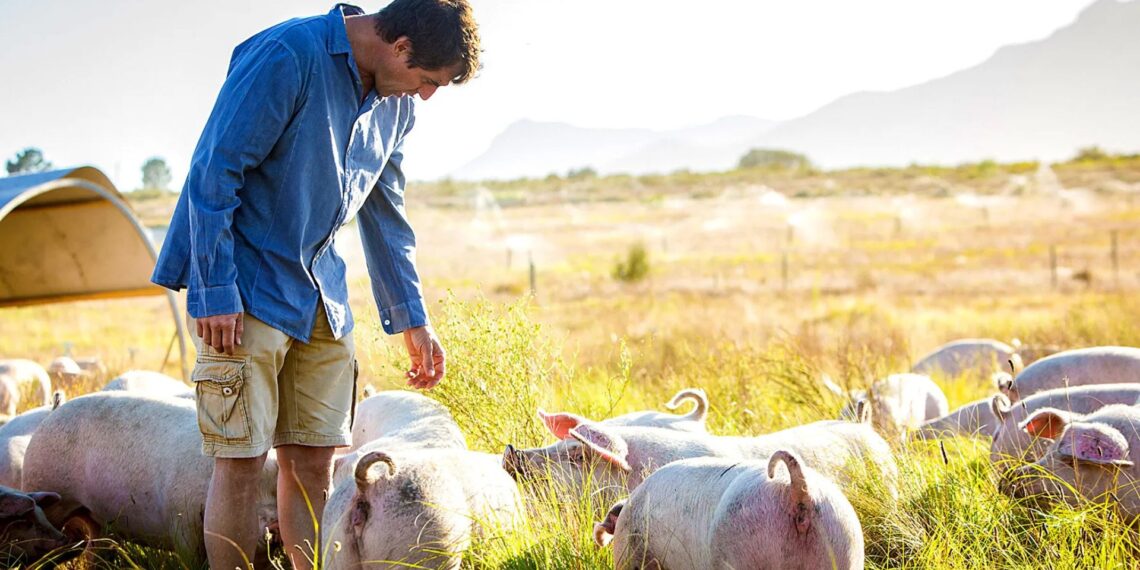
“Every gram of organic matter in your soil holds 8g of water,” said Angus McIntosh, a regenerative farmer at Spier, during a discussion on regenerative farming at Woordfees in Stellenbosch. He also mentioned that his farm is “much more resilient” and despite a dry spring, he was “probably less stressed about the upcoming summer than a lot of our neighbours”.
Improved soil health reduces chemical inputs and irrigation costs while increasing productivity – savings that could reach R295-billion ($17-billion) annually across sub-Saharan Africa by 2040, the Africa Regenerative Agriculture Study Group found.
Related stories
- Cattle and cover crops power vineyard regenerative study
- Rugby to regenerative farming: Ruhan scores with record harvest
- Soil health at the heart of regenerative agriculture
“We’ve measured the carbon in our soils. We’ve actually been paid four times for increasing the carbon in our vineyards and pastures,” McIntosh said, referring to carbon credits. “We’ve planted about 36,000 trees and shrubs… our bird species have multiplied.”
Free State regenerative farmer Danie Slabbert said his farm’s biological comeback was “phenomenal”. Within a year of transitioning to regenerative farming, erosion dropped 80% and dams ran clear. He also observed biological restoration. “Earthworms, dung beetles, birds. All the physical things you can observe were crazy.”
The human dividend
Dietitian Shelly Meltzer calls the twin crises of soil depletion and chronic disease a syndemic. “I’ve seen the difference that good nutrition can make in our country,” she said. “All of this actually mirrors the goodness of the soil.”
She said the connection between soil biology and human biology is increasingly clear. Our gut health, which is related to brain health and conditions like dementia and Alzheimer’s, should mimic the health of the soil, Meltzer said.
Jordaan links it directly to his craft. “The soil is our battery,” he said. “You’ll see grapes [grown in regenerative soil] come with a higher natural acidity and more density in their analytics. We don’t have to adjust it later.”
Gary Jackson is the founder of Jackson’s Real Food Market, a business that is part grocery store, part eatery, focused on providing nutrient-dense and sustainably sourced food.

“Without proper soil, you have no chance of reaching a nutrient-dense product,” he said. “What I really do is connect farmers to customers, and we take this responsibility very seriously. We feel like we’re going to save the world, one person at a time. We’re converting people from eating processed, toxic food.”
Their stores in Johannesburg – which once struggled to fill shelves – now serve a growing base of consumers seeking “real food”.
A true cost equation
Despite its promise, regenerative food is still perceived as expensive. Slabbert has done the maths. He said his customers eat less because his meat is more nutrient-dense, which makes it cheaper per meal.
Jackson ran his own comparison: a commercially farmed chicken versus the regeneratively raised birds sold and used in his business. Conventional producers, he said, pump water, saline, and margarine into food. “Roast both of them, and then you weigh them once they’re roasted. And nine out of 10 times, you will find that the regenerative one is 25% cheaper.”
“You think you’re saving money, and that’s a travesty. If you go home with a bag of frozen chicken, you’re wasting your salary, and you’re going to pick up the hormones and all the nasties so you might get sicker later,” Jackson said.
McIntosh believes the problem also lies in the hidden costs of commercially farmed produce.” The antibiotic resistance that you’re getting for free is not in the price. The ecological destruction from the food that the animal was fed is not in the price, either. We need to have a true cost accounting price discussion. Then we can measure nutrient density.”
Meltzer adds that long-term health economics also makes the case. “You cannot do it without looking at the cost implications of long-term health,” she says. When factoring in medical bills and supplements, regenerative food is “much cheaper in the long run,” Slabbert said.
Markets catching on
Jackson detailed how they battled to fill the shelves in the early years of his business. “In the first year, we had to look for farmers. But from the second year onwards, farmers looked for us,” he said.
If regenerative farming were adopted across half of sub-Saharan Africa’s cropland, it could cut household food costs by up to 15%, according to the Africa Regenerative Agriculture Study Group.

New markets are also sprouting around regenerative technology. A GreenCape report values South Africa’s sustainable agriculture tech market in the billions, led by solar-powered irrigation systems worth R17-billion and no-till machinery at R1.07-billion.
The startup financing for a truly regenerative operation can, however, be costly. “I should be cheaper because I’ve got the whole chain,” Slabbert said. “But in the beginning, I had to overinvest to build an abattoir, for example. I had to keep all my animals for three years, not sell to feedlots, to be sustainable. So it cost me an extraordinary amount of money to start.”
It seems that conventional farming has reached its natural limit, stripped of resilience and profitability. Regenerative agriculture offers ecological health and financial return that reinforce each other.
“We are custodians of the land,” Slabbert said. “We’ve got a great responsibility. I got a clear message that my purpose in life is to produce food for the people. But with a kick: to produce healthy food. And that is quite a challenge.”
- This article was first published by Daily Maverick.
READ NEXT: Conservation agriculture for livestock farming