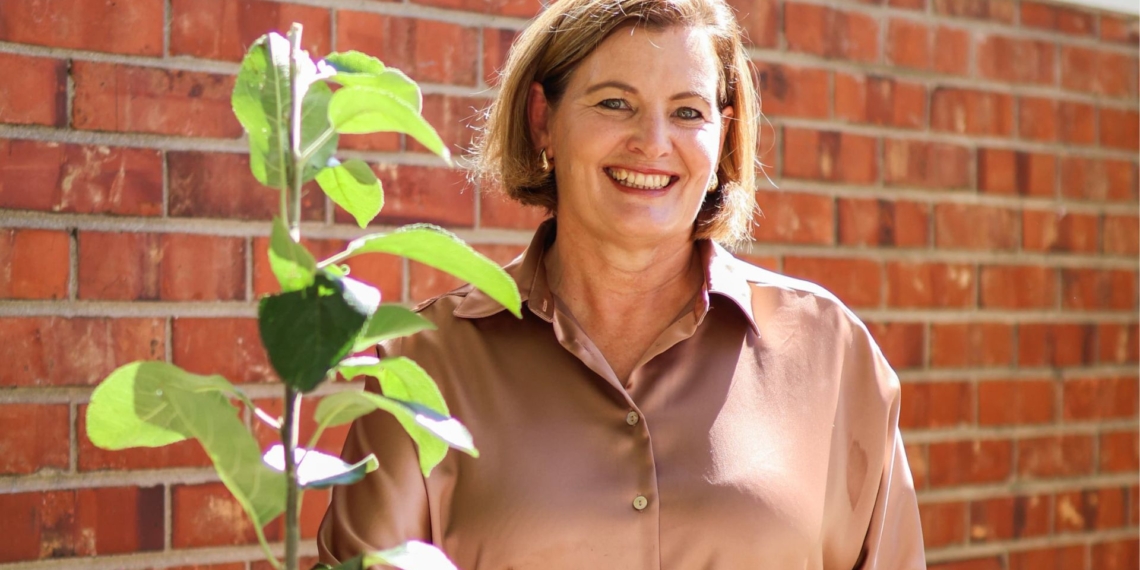
The South African apple industry marks its 364th anniversary today, 17 April, and Tru-Cape Fruit Marketing commemorated this milestone by planting only the fourth known Witte Wijnappel tree (white wine apple) in South Africa at Jan van Riebeeck High School in Cape Town. The planting also forms part of the school’s centenary celebrations.
The Witte Wijn apple cultivar holds special historical significance, as it is the very variety that Jan van Riebeeck planted in Cape Town more than three centuries ago.
On 17 April 1662, Van Riebeeck recorded in his diary that he had picked the first two Dutch apples at the Cape from a five-foot Witte Wijnappel tree.
“Today, South Africa is home to approximately 45 million apple trees and produces 1.3 million tonnes of apples annually, making us the largest apple exporter in the Southern Hemisphere. said Jeanne Fourie during the tree-planting ceremony.
South Africa exports apples to more than 100 countries, with the industry supporting more than 240 000 jobs. “The apple industry makes an extraordinary contribution to our country’s economy,” Fourie added.
Related stories
- Tru-Cape partners with Harvard on premium apple strategy
- Tru-Cape cherries target China amid bumper 2025 crop
- More than livestock: Lesedi’s legacy in the heart of the Kalahari
- AgriTrends: SA farmers adapt as global shocks reshape agriculture
On the trail of the Witte Wijnappel
The journey to reintroduce the historic Witte Wijnappel cultivar to South Africa has been years in the making. Tru-Cape’s quality assurance manager, Henk Griessel, an alumnus of Jan van Riebeeck High School, and colleague Buks Nel, undertook extensive research into the origins of South Africa’s apple industry.
Their work led them to the archives of the Vereenigde Oost-Indische Compagnie (VOC) and centuries-old illustrated pomological texts, ultimately tracing the cultivar to two surviving trees in a private garden between the Rhine and Maas rivers in the Netherlands.
“Sadly, the area was heavily bombed during the Second World War, and it is a true miracle that the apple trees survived,” Fourie said.
Despite South Africa’s strict plant import regulations, plant material was eventually brought into the country and successfully established. Prior to this latest planting, only three Witte Wijnappel trees existed locally at Tru-Cape’s heritage orchard in Grabouw, at Babylonstoren, and in the Cape Gardens.
“Planting a fourth tree at a school that is celebrating its 100th birthday, and is named after the man who planted the first apple tree at the Cape, is deeply symbolic. It reminds us how time, faith and patience can transform something small into something truly significant,” Fourie said.
It also recognises Griessel’s remarkable contribution to South Africa’s apple and pear industry.
“With experience in both academic and technical fields, he is the author of a long list of publications and the recipient of several industry awards. Planting the historic apple tree in his alma mater’s garden was truly a special celebration.”
From a single tree to a world-class industry
Roelf Pienaar, managing director of Tru-Cape, praised both the industry and the school. “The South African apple industry stands as a remarkable example of resilience, innovation, and global competitiveness.
“From a single tree to a world-leading export industry, it is a story we can all be proud of. We also extend our heartfelt congratulations to Jan van Riebeeck High School on its centenary. May this tree serve as a lasting symbol of growth, heritage, and future success,” Pienaar said.
In a further nod to history, Gwen Fagan also planted a Rosa centifolia believed to be among the first roses cultivated in South Africa on the school grounds on the same day. Over recent months, 100 shade trees have additionally been planted across the campus.
“As we celebrate 364 years of apples in South Africa, we invite everyone to take a moment on 17 April to enjoy one of our delicious locally grown apples and share in the pride of an industry that continues to grow from strength to strength,” Pienaar said.
READ NEXT: Competition Commision report: Prices drop at farm, but not at tills