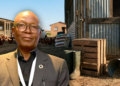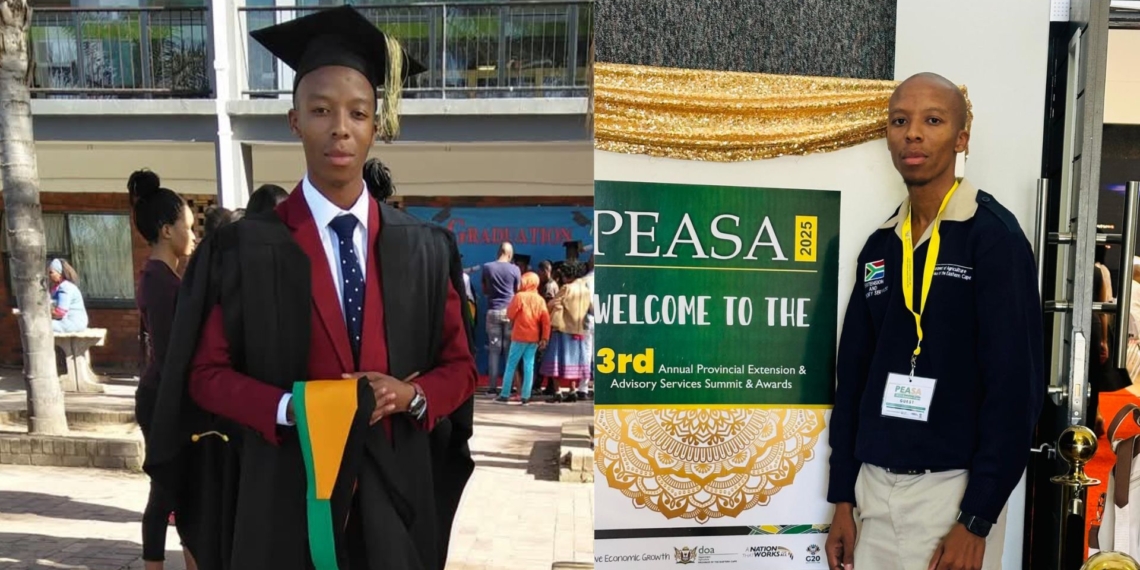
Vuyisani Qhekeka had the privilege of growing up around thriving agricultural businesses in Hombe Location, Lusikisiki, in the Eastern Cape. Being around these enterprises helped shape his path to becoming an agricultural economist.
He saw that agriculture can be a profitable business. His mother grew vegetables and maize, including spinach, cabbage, carrots and turnips, for both household use and selling.
The community he grew up in and the schools he attended, which focused on agricultural studies, were also key in shaping his journey.
The link between farming and economics
He says, “From those cultivations, my mom was selling veggies to walk-ins, and that would boost our home income and help pay school fees, taxi fare, and even buy us Christmas clothes.
“One thing I will never forget is during maize season. My mom would give me one kernel, show me how to dig and plant it, then mark the spot so I wouldn’t forget where I planted it.”
Because of these moments, even though he wanted to take commerce in high school, he found himself choosing agriculture instead. “When I applied, there was no space in commerce, so I opted for the agriculture stream.”
He adds that he was strong in economic management sciences (EMS) from primary school and was encouraged by his teacher early on.
Qhekeka enrolled at Fort Hare in 2014 to study agricultural economics and graduated in 2017. He then completed his honours degree, followed by a postgraduate certificate in education.
At university, what stood out for him was learning more advanced ways of farming and understanding that what his mother was doing was part of the informal market, with opportunities to grow into formal markets and produce higher-value crops.
“I would take what I learned and go back home to advise my mom during school holidays.”
Related stories
- Podcast: Understanding the basics of agri-economics
- From gap year to thriving as an agricultural economist
- Poultry and potatoes power Fort Hare graduate’s farming vision
- Eastern Cape scientist is breeding a better future for farmers
The business of agriculture
After graduating, Qhekeka’s first job was teaching agricultural studies at Dondashe High School in Centane on a contract basis. He then worked at Mpoloyethu Farm in Mooiplaas as an assistant manager, before joining the department of agriculture as an intern at the Zanyokwe Irrigation Scheme in Middledrift.
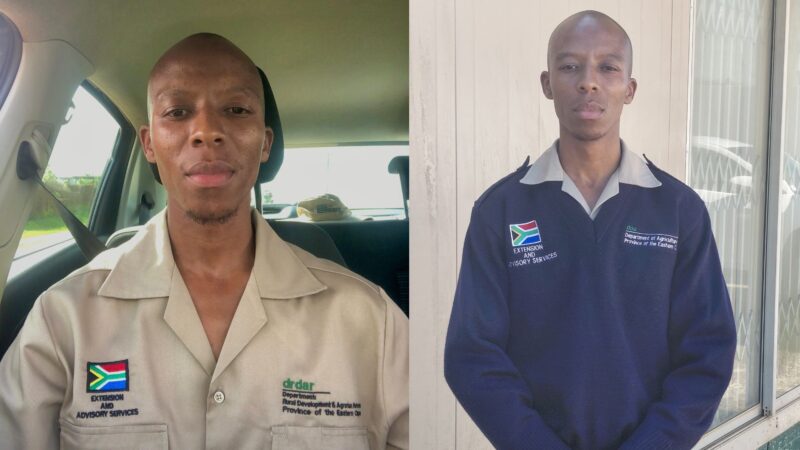
Qhekeka now works as an agricultural advisor for the Eastern Cape department of agriculture.
He tells Food For Mzansi that many people still think being an agriculturist is only about wearing gumboots and using a hand hoe in the fields, or that an agricultural economist only focuses on writing business plans.
However, he explains that agricultural economists study and recommend policies, applying economic theories, management science and statistical analysis to improve production, marketing, market access, food distribution and the overall performance of agricultural businesses.

“Agricultural economics plays a crucial role in shaping food security and land issues in South Africa,” he says. “Farmers use land capability maps to assess the suitability of land for different crops, ensuring efficient use of resources.”
Qhekeka notes that understanding import and export parity prices helps farmers set competitive prices in local markets, which has a direct impact on food security. He also highlights that infrastructure challenges affect farmers’ ability to access markets, while urbanisation continues to put pressure on land use and availability.
“Agriculture is not just about farming; it encompasses a wide range of roles that contribute to the economy and sustainability.”
He adds that whether someone is interested in science, business or practical work, there is space for them in agriculture.
Skills that help farmers grow
Over the years, Qhekeka has completed several courses, including climate-smart agriculture, red meat production, nursery establishment, advanced Microsoft Excel, poultry production, and the safe use and control of agrochemicals.

He says these courses equip him to better support farmers, giving him up-to-date knowledge and practical tools to help them plan smarter and improve production.
“It fills my heart to see farmers move from being subsistence producers to smallholder farmers, and working towards becoming commercial producers through my advisory, coaching and monitoring.”
He adds that it brings him joy to see real change in the lives of the farmers he works with, especially through the sales they are able to make with support from the department of agriculture.
“I smile alone knowing that I’m part of that change.”
READ NEXT: GPS ear tags offer hope against livestock theft