Monday, November 9, 2026
SUBSCRIBE
22 GLOBAL MEDIA AWARDS
Food For Mzansi
  • News
  • Changemakers
  • Lifestyle
  • Farmer’s Inside Track
  • Food for Thought
No Result
View All Result
  • News
  • Changemakers
  • Lifestyle
  • Farmer’s Inside Track
  • Food for Thought
No Result
View All Result
Food For Mzansi
No Result
View All Result
in News

Wheat producers, say hello to two brand-new cultivars

by Duncan Masiwa
16th March 2021
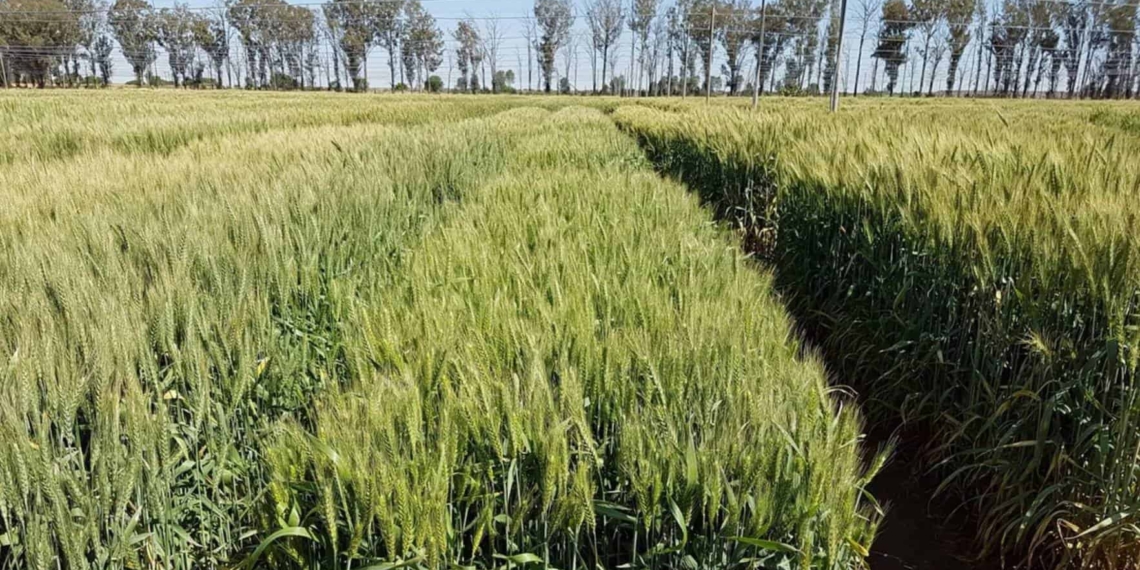
Multiplications for Usutu and Selons wheat lines were planted during 2020 amidst the fear and confusion brought on by the Covid-19 pandemic. Photo: Supplied/ARC

Multiplications for Usutu and Selons wheat lines were planted during 2020 amidst the fear and confusion brought on by the Covid-19 pandemic. Photo: Supplied/ARC

Share on FacebookShare on TwitterShare on WhatsApp

Excitement is brewing in the agricultural sector over two new advanced wheat lines that have been given the green light for release.

With the sector’s stamp of approval, wheat producers can now look forward to getting their hands on the cultivars as early as next year when it becomes available for purchase.

Multiplications for Usutu and Selons were planted during 2020 amidst the fear and confusion brought on by the Covid-19 pandemic.

During the first lockdown in March and April 2020, employees of the Agricultural Research Council’s Small Grain Institute were hard at work preparing field trials to plant in the Western and Northern Cape, explains researcher Kim Delport.

According to Delport their dedication led to the completion of a successful production cycle.

The two new advanced wheat lines were approved by industry for release in May.

What’s so different? Why the fuss?  

Delport states Usutu and Selons are both spring wheat cultivars for the irrigation areas. “While Usutu has a medium to late growth period with excellent yields and an average length of 105 cm, Selons on the other hand, has a medium growth period and slightly shorter.”

Kim Coetzee, Agricultural Research Council researcher. Photo: ARC

The average length for Selons is 95cm and shows no lodging problems. Delport says Usutu has not exhibited any lodging problems either despite its exceptional yields and large ears.

In terms of disease resistance, Usutu is moderately resistant to leaf rust and moderately susceptible to stripe rust.

Meanwhile, similarly to Usutu, Selons are moderately resistant to leaf rust, but is resistant to moderately susceptible toward stripe rust. “Over the last four years Usutu has had an average yield of 12 tons per hectare. Selons is also capable of high yields, with a four-year yield average of 11,4 tonnes per hectare.”

During 2019 Usutu produced an average yield of 13 tonnes per hectare while during the same period, Selons produced an average yield of 12,5 tonnes.  

New flagship cultivar on horizon 

Amidst the flurry of excitement, the ARC-Small Grain has announced the release of another wheat line, Umgeni. The cultivar approved by the industry earlier in 2020, Delport says will without doubt be the new flagship cultivar for the ARC in the irrigation areas.

“Large seed multiplications for commercialisation will proceed during 2021. ARC-Small Grain is hopeful that Umgeni will be available for purchase during 2023,” she states.

Unlike Usutu and Selon, Umgeni has a short growth period and exceptional yields.

During 2019, Umgeni produced an average yield of 13 tonnes per hectare and has a two-year yield average of 12,5 tonnes per hectare. Apart from its superb yield potential, Umgeni is also moderately resistant to leaf rust and resistant to stripe rust.

Delport states, “With these new cultivars, as well as the current cultivars on offer, the ARC-Small Grain has a complete package that suits the needs of all producers.”

Renoster and Koedoes are currently available for purchase and is believed to be excellent cultivars in their own right. Both have short growth periods and average yields of 11 tonnes per hectare.

During 2019 both Renoster and Koedoes realised yields of 12 tonnes per hectare.
Duncan Masiwa

DUNCAN MASIWA is the assistant editor at Food For Mzansi, South Africa’s leading digital agriculture news publication. He cut his teeth in community newspapers, writing columns for Helderberg Gazette, a Media24 publication. Today, he leads a team of journalists who strive to set the agricultural news agenda. Besides being a journalist, he is also a television presenter, podcaster and performance poet who has shared stages with leading gospel artists.

Tags: Agricultural Research Councilwheat cultivars
Protecting Bt Maize: Why farmers must maintain refuge planting
News

Protecting Bt Maize: Why farmers must maintain refuge planting

by Patricia Tembo
6th November 2026

South African maize farmers are urged to improve Bt refuge compliance as stem borers show emerging resistance. Learn how refugia...

Read moreDetails
Experts warn NC farmers of below-normal rainfall this summer

Experts warn NC farmers of below-normal rainfall this summer

6th November 2026
Commonwealth farming looks to partnerships for a stronger future

Commonwealth farming looks to partnerships for a stronger future

5th November 2026
Your Sunday lunch has a story: How red meat keeps rural SA moving

Your Sunday lunch has a story: How red meat keeps rural SA moving

5th November 2026
Fiscal gains won’t lift agriculture without logistics fixes

Life after Agoa: ‘SA’s exclusion is not the end of US trade’

5th November 2026

AgriSA backs Grain SA in fight over soybean pricing fairness

CropLife SA urges farmers to close critical training gaps

Ending Agoa access deals new blow to SA wine industry

From notebook to digital: You don’t have to digitalise your farm overnight

Experts warn NC farmers of below-normal rainfall this summer

Join Food For Mzansi's WhatsApp channel for the latest updates!

JOIN NOW!
Next Post
Citrus greening is spread by a disease-infected insect, and has already put the future of the world's citrus at risk. Photo: Supplied/Food For Mzansi

Farmers warned about devastating citrus disease

THE NEW FACE OF SOUTH AFRICAN AGRICULTURE

With 21 global awards in the first six years of its existence, Food For Mzansi is much more than an agriculture publication. It is a movement, unashamedly saluting the unsung heroes of South African agriculture. We believe in the power of agriculture to promote nation building and social cohesion by telling stories that are often overlooked by broader society.

Stop harvest fires: Simple machine checks save millions

This week’s agri events: 09 – 13 November

Kat River crisis threatens EC farming, food security, and livelihoods

SA wool and mohair take centre stage at Commonwealth gathering

Ending Agoa access deals new blow to SA wine industry

Family roots run deep: Mkhize turns family garden into agribusiness

  • Awards & Global Impact
  • Our Story
  • Contact Us
  • Cookie Policy
  • Privacy Policy
  • Copyright

Contact us
Office: +27 21 879 1824
News: info@foodformzansi.co.za
Advertising: sales@foodformzansi.co.za

Contact us
Office: +27 21 879 1824
News: info@foodformzansi.co.za
Advertising: sales@foodformzansi.co.za

  • Awards & Global Impact
  • Our Story
  • Contact Us
  • Cookie Policy
  • Privacy Policy
  • Copyright

Chat Options

About this assistant

This feature generates automated answers summarised from Food For Mzansi articles. By using it, you are interacting with an AI system (provided by Google), not a human. AI can make mistakes. Please refer to the source articles for verification and citation purposes.

Our staff do not check or moderate Lerato’s answers in advance, but may review some later. Our journalists continue to write and edit all the articles Lerato uses as sources.

To estimate unique and returning web users, we store a random browser ID in this browser. WhatsApp users are counted by phone number. The same person using both channels may be counted twice.

I'm Lerato, your AI assistant!
No Result
View All Result
  • News
  • Changemakers
  • Lifestyle
  • Farmer’s Inside Track
  • Food for Thought

Copyright © 2026 Food for Mzansi