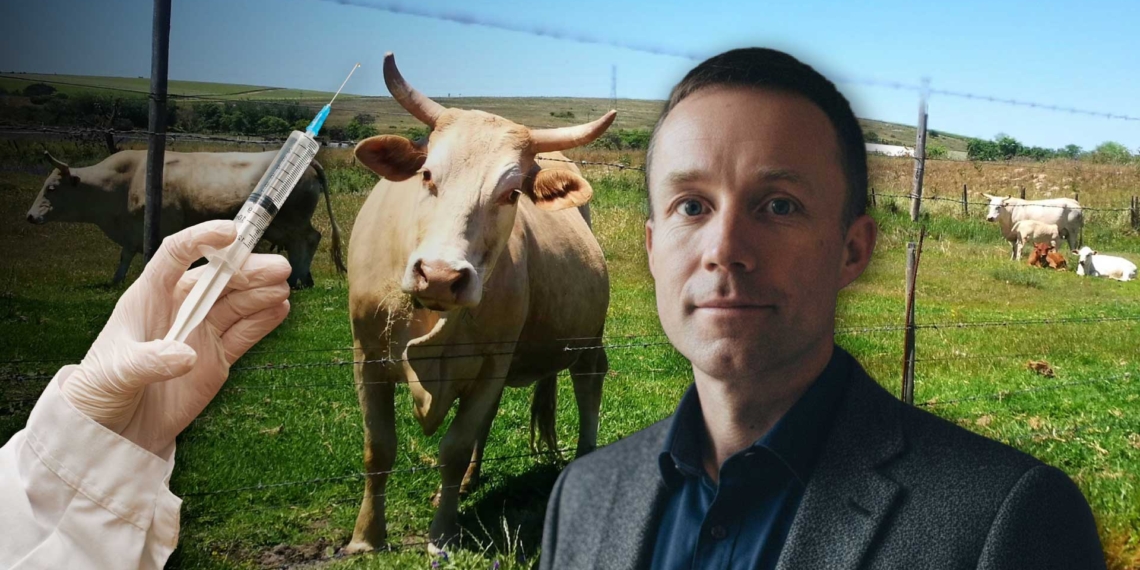
While accelerated private FMD vaccination is a huge win for agriculture, reopening beef exports requires proof that transmission is stopping. FMD Response SA spokesperson and commercial dairy farmer Andrew Morphew explains why relying on a single laboratory for all diagnostic testing creates critical delays.
The recent steps taken by agriculture minister Willie Aucamp to accelerate and expand private vaccine FMD procurement and distribution will play a significant role in strengthening the government and the private sector’s efforts to eradicate foot-and-mouth disease (FMD).
But increased vaccination alone will be insufficient to allow for recognition that will reopen export markets to South African beef.
Vaccination alone not enough for WOAH approval
To prove to international disease authorities, such as the World Organisation for Animal Health (WOAH), that the disease is being eradicated, the country also needs to measure and show how effectively the vaccination programme is working through regular, widespread testing of cattle.
To adequately assess a country’s response to FMD, the WOAH requires evidence of which strain is circulating, whether enough animals are immune at the same time to interrupt transmission, and whether the virus is retreating or advancing. Market access rests on an auditable account of disease prevalence and trends.
Testing of vaccination efforts is where South Africa faces its next challenge, one which the private sector looks forward to working with the government to tackle.
Overcoming the diagnostic backlog at Onderstepoort
The government’s own technical task team minutes, available in court papers, identify the shortage of timely diagnostics as the risk that now outranks vaccine supply as the principal obstacle to recovery.
Currently, all official FMD testing runs through a single facility, the Agricultural Research Council’s Transboundary Animal Diseases laboratory at Onderstepoort.
The laboratory is a highly regarded WOAH reference facility and secure enough to handle live virus. But whether it should serve as the sole diagnostic channel for a nationwide epidemic now needs to be carefully assessed to ensure there is sufficient capacity to conduct the scale and speed of testing required.
Testing delays leave South Africa without a reliable baseline of disease trends, including which areas may be worsening or retreating.
Provinces often have to wait months to learn which strain they are fighting, a delay that leaves outbreak response, vaccine selection and international reporting all moving at the speed of a single queue.
Related stories
- Traceability key as SA opens up FMD vaccine markets
- FMD, global price drops fuel pessimism in SA agribusiness
- Mixed reactions as court rules on private FMD vaccinations
- No market access, no future: The heavy cost of FMD
Part of the remedy is to allow routine blood tests, post-vaccination monitoring and validated screening to move to accredited provincial, university and private laboratories operating under one national quality standard, while live-virus work, confirmatory characterisation and reference functions remain at Onderstepoort, where the expertise resides.
This would reduce pressure on the lab at Onderstepoort and lead to shorter testing turnarounds.
Farmers and their vets can collect the samples they are permitted to collect; accredited laboratories, public and private, can run the tests; industry can handle the logistics and record-keeping that any credible surveillance system needs. The government’s task would include setting testing and quality standards, keeping test results, defining disease-free zones, and producing a case that WOAH and trading partners will accept without dispute.
South Africa already runs a version of this model for avian influenza, where private veterinarians collect samples and accredited laboratories test them under nationally prescribed protocols. The biosafety demands of the two diseases differ, but the underlying principle can be equally applied: centralised quality standards, distributed execution of testing functions, and reporting that reaches the state immediately rather than eventually.
A transparent scorecard to prove progress
The proof should also be visible. The government currently releases data on when FMD vaccines arrive in SA in an ad hoc manner. Instead, what is needed is a short, regular scorecard covering four areas ensuring the response is focused on the right metrics:
We believe reporting should include:
- Coverage: Meaning the share of each target cattle population vaccinated inside a defined campaign window rather than a running total for the year.
- Immunity: Testing how many animals are protected from FMD at the same time as the WOAH requires 80% of the country’s cattle to be simultaneously immune.
- Circulation: Showing where the virus persists and whether that footprint is shrinking or growing; and
- Diagnostics: Representing laboratory turnaround times and the size of the testing backlog, made public as this has to be managed and improved.
If the government commits to these measurements, and to public scrutiny of them, it can begin to better measure and adjust its response to the disease.
WOAH will require this data if we are to be permitted to export easily, freely and widely.
A country that cannot prove it has beaten FMD will keep its markets closed, regardless of how many animals it vaccinates. What the country does not measure, it cannot manage, and without proof, the world will not accept South African beef.
Given the positive progress made already under Minister Aucamp’s leadership, private producers stand ready and willing to assist in making sure that once again South African beef is exported throughout the world.
- Andrew Morphew is the FMD Response SA spokesperson and commercial dairy farmer. The views and opinions expressed in this article are those of the author and do not necessarily reflect the views or positions of Food For Mzansi.
READ NEXT: SA holds its own in fiercely competitive fruit markets