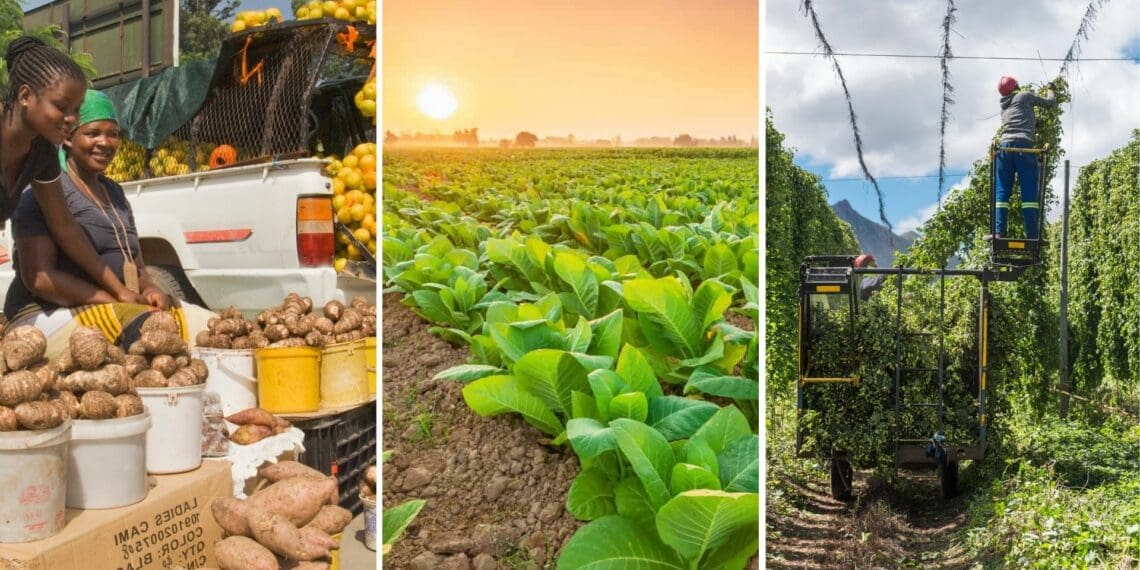
Faced with corporate price squeezes, some South African farmers are sidestepping major supermarkets to sell directly to local township traders and households.
While this direct-to-market approach offers better profit margins and affordable, fresh food for communities, farmers must navigate a tough balancing act of volatile cash flows, inconsistent demand, and systemic supply chain risks.
For many small-scale and emerging growers, the strict demands and rigid pricing structures of corporate grocery giants make formal retail access highly restrictive.
The pushback against corporate benchmarking
Angelo Marman, a crop farmer in the Western Cape, has deliberately diversified his business away from major supermarket chains to avoid being dictated to.
“I diversify my business tremendously. I do not do the big markets like Shoprite and Checkers because it puts a limit on who you can sell to, so they basically benchmark in terms of farmer to farmer and tell us what to do. Also, they can tell you what they want to pay instead of what you want them to pay,” he said.
Related stories
- New farmer? Informal markets ‘the way to go’
- Citrus sector enters uncertain season as trade shifts reshape markets
- EC women-led co-op turns communal land into retail success
- Food safety in informal markets remains a painful problem
Instead of selling through middlemen like produce agents, wholesale brokers, or big supermarkets, Marman sells his crops straight to food factories that use his produce as their main ingredient. By dealing directly with the factories, he cuts out extra handlers and keeps more profit. He also uses his organic certification and farm location to sell directly to everyday customers.
“We also have people coming into the farm, the local markets; they come and buy fresh produce, and they come and harvest as well. I do not have their labour costs as well when they harvest, and it is a sustainable cash flow.”
Community exposure builds brand recognition
Limpopo crop farmer Leshalagae Mojapelo agrees that direct trade can drastically improve a farm’s financial trajectory, provided the quality is there.
“The motive behind selling directly to consumers instead of major retailers lies mainly in the market and the quality of the produce. If the market is saturated, obviously you are not going to get a good price.
“Secondly, if the produce is of good quality, it attracts consumers, whether they are on shelves in major retailers or they move from the farm straight to the kitchen. Not forgetting a little touch of good packaging – this gives you the upper hand in competition and results in good returns,” Mojapelo said.
For Mojapelo, this direct connection helps build local brand recognition. “It lets the community learn and know about your business, which brings business exposure. Selling our produce directly has a positive impact on income, exposes the business to good financial management, and further puts the business forward in terms of financial sustainability.
“The disadvantages will be if the produce is of less quality, then no one is going to buy. Sometimes your produce can also be limited within a certain location,” he explained.
This shift to direct trading comes at a time when formal market integration remains incredibly difficult for smaller producers. According to the National Agricultural Marketing Council’s (NAMC) annual performance plan for the 2025/26 financial year, market access for smallholder farmers continues to be a major challenge due to a persistent “lack of comprehensive support, inconsistent production, fluctuating quality, and transport costs to markets”.
The NAMC has targeted linking 120 smallholder farmers to formal market opportunities for the 2025/26 period. Because these formal opportunities are limited, many farmers find themselves forced to rely on informal channels, which carry their own set of operational hurdles.
The cash flow dilemma of direct sales
Tebogo Makgatho, a crop farmer in Johannesburg, highlights the logistical and cash flow volatility that comes with relying purely on direct local buyers.
“For direct customers like households near our farm, it is not consistent, so I think it affects the cash flow of the business. We end up using all the cash from the last harvest, and that puts pressure to reinvest. At the same time, direct customer purchases do bring in money every now and then,” Makgatho said.
Because of this, Makgatho believes a hybrid model is the most sustainable path forward, using retail as a foundation.
“I think we want to have both markets of direct and retail, with retail as the main for our planning. This is because retail, as we understand it, is that they would guarantee to buy our produce, which is good for our cash flow if planned well regarding planting schedules to maintain delivering consistently,” he said.
Isaac Motshekgo, senior economist at Nedbank, cautioned that bypassing the formal supply chain completely is simply not an option for larger operations.
“Most of the agricultural produce goes to manufacturing and food processing, so farmers would not be able to bypass that chain, especially the very large farmers,” Motshekgo noted.
Motshekgo outlined three key risks that farmers face when they choose to trade exclusively with informal or small-scale local traders:
- No price or volume guarantees: Sales volumes and buyer prices are not guaranteed, which means farmers are highly likely to be forced to cut prices to clear their produce.
- Loss of forward selling: Farmers lose the ability to “sell forward”, meaning they cannot secure guaranteed sales or pricing contracts before they even begin planting.
- Compromised biosecurity: Biosecurity controls and regulatory standards could be severely compromised when trading outside formal channels.
READ NEXT: Rooibos industry targets global growth while protecting local roots