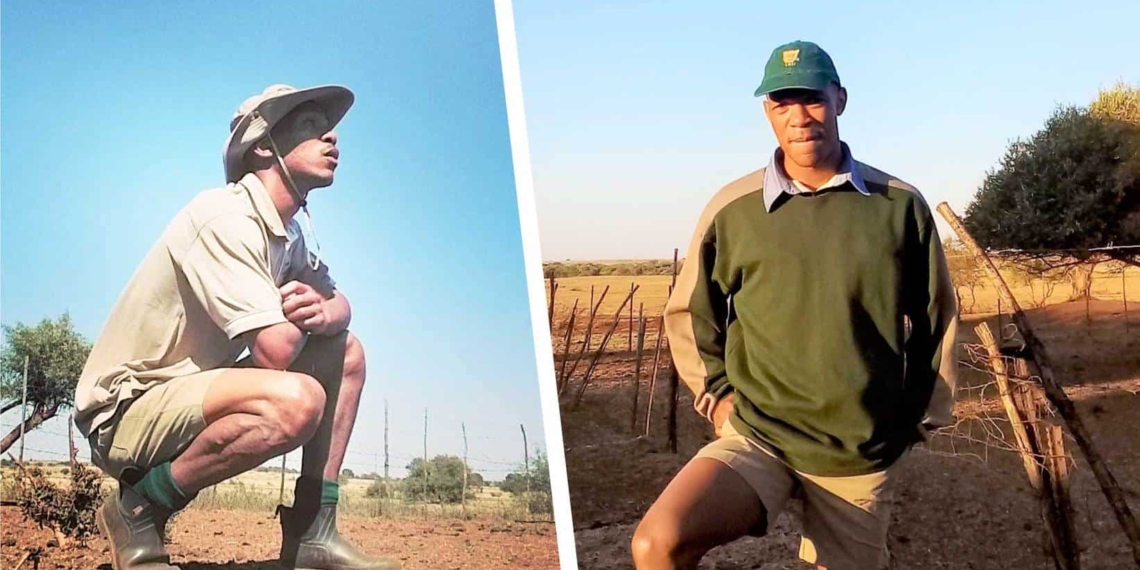

For years 28-year-old Gustav Thekiso’s father toiled away on his own as a subsistence farmer. It was the only thing he was good at after retiring from the South African Police Service (SAPS) after 39 years of loyal service.
As subsistence farmers, the family’s farming activities took place behind their humble home in Zeerust in the North West province. There, they farmed with fewer than 30 animals.
“I come from a village where people can house 20 goats, 20 sheep and eight cattle at a time in their yards,” he says. “There was land on which our animals could graze, but it wasn’t ours, it belonged to the king. You didn’t have land that you could call yours.”
After Thekiso matriculated, that all changed. He decided to work the land alongside his father, Tshimologo Thekiso. Slowly, they transitioned from subsistence farming to become commercial producers farming in three towns.
Their registered farming business, Thekiso & Co, operates from the Dinokana trust camp in Zeerust where they keep a small herd of goats, sheep and cattle. Their second location called Klippan Farm in Koster is where they lease 70 hectares of land for planting sunflowers, soybeans and a variety of crops.
Not far from there, on Leliefontein farm, their goats, Brahman, Bonsmara and Simbra cattle can be found grazing on 50 hectares of land.
They are a long way from their subsistence farming days and Thekiso emphasises that they did not get this far alone.
“We reached out to commercial farmers, mentors and people we could partner with. We had to do research and be curious about growing our business,” he explains.

Born and raised a farmer
Thekiso’s love for farming started during his high school years. His father retired and bought a few livestock. Zeerust is a small farming community near Mafikeng where scores of farmers work the land near the southern part of the Kalahari Desert.
Thekiso’s schoolmates were the sons and daughters of commercial farmers. As a result, he often found himself in the company of men and women who spoke the language of his father – agriculture.

“You learn from them and pick up so much. To this day I still ask for advice and learn from others. If there’s things that I don’t know, I Google if I have to,” Thekiso says.
Subsistence farmers should want to know what is happening in the industry. Follow agricultural pages and check for opportunities on a regular basis, he advises.
But even while being surrounded by farmers, Thekiso still chose a different route at first. Like his father, he wanted to be an officer of the law. Then he realised that he was talented in rugby. He played at provincial level and even got his national colours.
But life had other plans for him, and he soon realised this truth.
“I decided to focus on agriculture. My father and I started doing things differently. We registered the business and grew the herd,” he explains.
Creating employment, feeding the nation
When the company was formed in 2016, father and son implemented new ideas and leased more land. Crop cultivation also attracted them.
The first step they took was going to a trust camp. Thekiso explains that these are camps that belong to the royal house. It’s about 1 000 hectares and people use it to keep their livestock away from the village.
“It’s quite important that subsistence farmers consider developing their farming enterprises into businesses,” Thekiso says.
“Your growth as a subsistence farmer is limited. You never understand the opportunities you have with the small portion of land or herd you have.”
“Don’t rush to make money, work on something that in the future you can take ownership of and be proud of”
Thekiso explains that when subsistence farmers start growing their herd and sell to abattoirs and auctions, profit margins increase.
“You start seeing that you are able to make double or triple the money you made when you were still a subsistence producer,” says Thekiso.
“The nice part about commercialising your farming business is that you are creating work opportunities. You would need more hands for more land. There will be more work that you will have to do. It’s a great feeling to know that while you are creating employment you are also feeding the nation.”
Making wise moves
Looking back at their journey, Thekiso is grateful for one thing and that is that they chose agriculture. The business was started with capital from his father’s pension fund and they chose to invest it in agriculture and nothing else.
“I’m glad we took this route because look now, Covid-19 did not affect agriculture that much. As a business we only reached the peak of our commercial level in 2020. So imagine we went for a different industry, we’d be struggling right now.”
While he describes it as being quite challenging to run three farming operations, he wouldn’t want it any other way.

“Agriculture is something I love. I enjoy getting my hands dirty, checking on my cattle and their wellbeing. I really don’t see myself working in an office, sending out emails every day,” he laughs.
While he may be young, he says he knows how to work hard for something he is passionate about.
“I was taught to work and invest time in something that one day I can own. That’s why I tell farmers don’t rush to make money, work on something that in the future you can take ownership of and be proud of.”