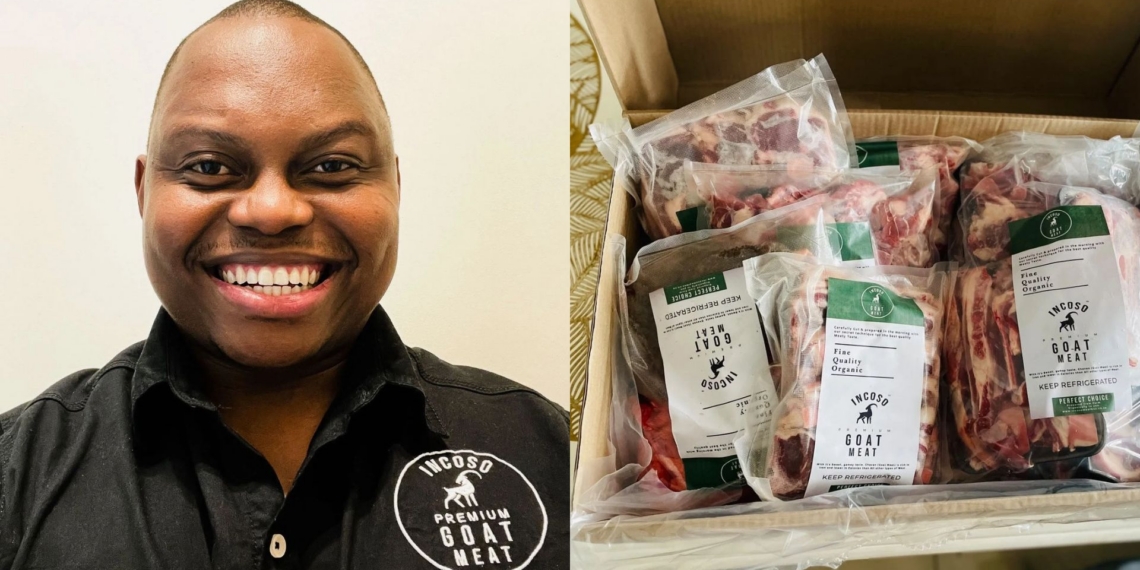
Goat farming is an established part of livestock farming in Mzansi, with demand linked to traditional and cultural practices. Buhlebenkosi Mbatha saw another opportunity in the market by exploring goat meat processing and formal markets.
With eight years of goat farming experience, he researched the value chain, and that journey led to Incoso Goat Meat. He started the business in 2022, with a focus on taking South African goat meat into export markets, including Dubai in the United Arab Emirates.
Mbatha tells Food for Mzansi that he has moved from being a primary farmer to coordinating different parts of the goat value chain. He helps primary farmers breed and raise the right animals that can eventually be used as raw material for products such as meat and milk.
From primary farming to value-chain coordination
Mbatha has no formal farming background. His father is a retired priest and his mother a retired teacher. His interest in goat farming grew after he heard Dr Bandile Mkhize speak about the goat industry at an Amandla Omnotho conference in eThekwini around 2017 or 2018.
At the time, Mbatha was helping with the conference’s marketing and was responsible for recording video and audio. He says he overheard Mkhize speaking about the goat industry, which sparked his interest in its untapped potential in South Africa.
In 2018, while an unemployed University of Pretoria graduate, Mbatha bought five goats and began farming with indigenous veld goats at home in Ulundi, KwaZulu-Natal.

He later gained exposure to Kalahari Reds through a farming programme supported by the department of agriculture. His own farming experience, followed by training other farmers, gave him a deeper understanding of goat farming, animal husbandry and the challenges facing the goat meat value chain.
While the goat meat industry is still developing, Mbatha says he wants to see goat farmers taken more seriously as commercial suppliers.
“My focus isn’t only just goat farming, but to ensure that goat farmers are considered commercially for products to be sold in mainstream retail stores like supermarkets, restaurants and butcheries.”
Related stories
- Goat meat: From inyama yesiko to menu must-have
- One goat sparked Sibonelo’s farming future in Vaalkop
- Turning goat milk into gold: Farmers tap agro-processing power
- Hardy goats and hard work are Njabulo’s recipe for success
His move into goats also ties back to his background in marketing. Mbatha obtained a bachelor of information sciences in publishing in 2013, followed by a postgraduate diploma in digital innovations and marketing, both from the University of Pretoria.
Beyond tradition: Marketing meets agro-processing
With this background, he says he was interested in more than simply keeping goats. He wanted to understand what it would take to raise animals that could eventually feed into a commercial processing market.
“This was the very reason why I even started goat farming, not just to keep animals, but to understand the process of raising the right ones for agro-processing.

“My job and interests were on how we can rebrand goats to be more on the commodity side of the economy of the country.”
That thinking now shapes how he runs his operation. Mbatha buys live goats from farmers through the Qhakaza Goat Farmers Association and checks the animals daily, either himself or through his workers.
Quality control and premium products: Redefining retail
Incoso Goat Meat outsources slaughtering to commercial and small abattoirs, while cutting and packaging are done in-house, Mbatha explains.
“Our packaging is our signature and has been celebrated by all retailers, brand design, and to preserve the meat over a long time.”
The animals are selected according to age and breed, after which Incoso guides the abattoir on its processing procedures, which form part of the company’s intellectual property and standard operating procedures.
“We make sure the animals we buy from farmers are those reserved for food production and not breeding, hence we’ve never worried about odour or smells people worry about.”
Mbatha says this approach comes from years of testing and refining the procedures while he was still farming.
The business sells whole meat carcasses, stew and chops, mince, goat meat wors and offal, while experimenting with products such as goat meat salami and biltong.

“By-products being skins, we sell to tanneries that make bags and kids’ shoes.”
Its market now includes Jackson’s Real Food Market and Food Lovers Market stores in Gauteng, The Harv Table by chef Leko Madlala, Hlope Butcheries in Pietermaritzburg, hotels in Gauteng and KwaZulu-Natal, as well as private chefs and caterers.
Incoso also has a reseller network in KwaZulu-Natal and Mpumalanga, with networks being set up in the Eastern Cape and Limpopo.
Related stories
- Why Kalahari Red goats are winning over SA farmers
- Farmers cash in as goat meat gets gourmet makeover
- Goat and sheep farmers breed smarter to beat climate stress
Breaking misconceptions: Expanding operations
Mbatha says the company has also secured an export deal for Dubai through an international importer based in the UAE, although the parties cannot be named due to non-disclosure agreements.
Goats are often associated with African cultural and Asian religious practices, Mbatha adds, which has contributed to misconceptions around the meat and a weak formal supply chain.
He says much of the goat trade still happens through informal markets and private consumption, with little investment in developing a strong local commercial market for goat meat.
For Mbatha, changing this means profiling goat meat as a proper commercial commodity so retailers are willing to put it on their shelves. That is where Incoso operates as a wholesaler, supplying retailers and hospitality businesses.
Mbatha says the business has built its market through stronger packaging and branding, while working with farmers to ensure the goats meet the specifications required by its customers.
The aim is to give retailers a consistent product that keeps customers coming back, while bringing more farmers into a formal goat meat value chain.
He shares lessons learned: “Develop thick skin and learn from failure. Stick to your vision. Know your numbers. Business is about certainty, not just passion.”
Lastly, he encourages aspiring agripreneurs to keep working on their ideas and business owners to delegate when you need to. “Become good at what you do. You do not have to do everything yourself.”


READ NEXT: Farmers cash in as goat meat gets gourmet makeover