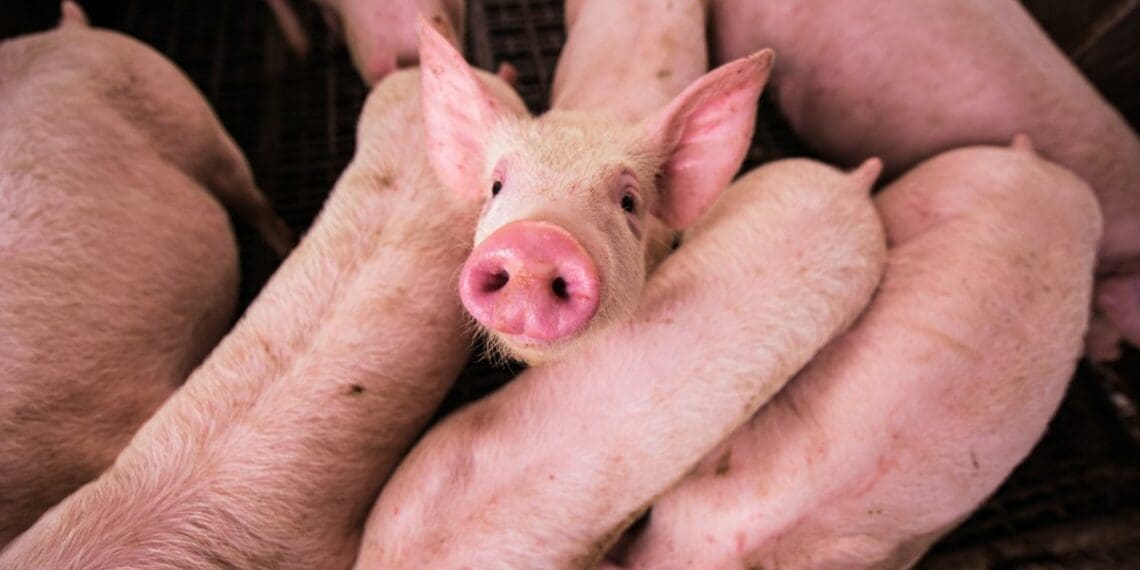
Market challenges in the pork industry such as fluctuating pork prices and raw material volatility, require farmers to have strict control over their input costs. Feed costs make up 70% of the input costs of a piggery operation, which is why strategies to decrease on-farm feed costs are vitally important, writes Stephani Barker, technical advisor at Meadow Feeds.
Decreasing the total nutrients in the feed or restricting the feed intakes of pigs is not a solution when trying to maintain growth performance and income from the operation. In this article, we discuss several strategies to consider when minimising on-farm feed costs without impacting the feed efficiency of pigs.
Reducing feed wastage

Ensure feeders are in good working condition to prevent feed wastage. Feeders should be frequently recalibrated and cleaned to ensure the correct quantity of feed is consistently provided to the pigs and to prevent feed from spoiling. Research shows that pelleted feed, compared to a meal, not only reduces feed wastage but also promotes feed intake.
The digestibility of the diet
The digestibility of the feed is essential when it comes to ensuring pigs fully utilise the nutrients that the feed has to offer. The type and quality of raw materials are key aspects to consider when producing animal feed products.
Ensuring the correct high-quality raw materials are used can improve the digestibility of the feed and improve animal performance. Protein is one of the most expensive nutrients in the diet and contributes heavily to the total cost of feed.
When done correctly, reducing the total protein content of the diet whilst ensuring the correct level and ratio of amino acids, can improve the digestibility of the diet and maintain animal performance at a lower feed cost.
Consider raw material availability and cost
Certain substitutions of expensive raw materials for more affordable options can successfully be achieved where expert knowledge and qualitative protocols are used. Although maize is the most widely used energy source for pigs in South Africa, grains such as barley and wheat can be considered good alternatives to reduce maize inclusion when they are available and more affordable.
Continuous review of the raw material nutrients
A consistent and accurate evaluation of the raw materials in the feed will allow for more accurate feed formulations and superior animal performance.
Including enzymes in the feed
Enzymes are protein compounds that increase the nutrient absorption of the feed by breaking down certain components that animals may have problems otherwise digesting. Enzymes allow for improved diet digestibility and when used correctly can be a cost-effective solution. Examples of enzymes commonly used include carbohydrates, proteases, and phytases.
A more accurate feeding approach
Phase feeding is the changing of an animal’s diet according to its age, weight, or physiological state. It is designed to assist a farmer in achieving the most out of their feed, in the most cost-effective way.
Introducing an additional phase when feeding pigs – a phase that is more accurate to the age or production level of the pig – can result in cost-saving through improved feed efficiency. The practicality of feeding a higher number of phases should be considered when comparing this to the benefits of a more accurate feeding schedule.
Consider the in-feed medication costs
Medication costs can be extremely expensive, which is why it is important to regularly consult with your veterinarian to ensure that the farm is on the correct medication program. Discuss with your veterinarian which medications are necessary depending on the health status of the farm and whether in-feed medications, in-water, or injectables will be the best solution.
Split sex feeding
At the same age, growing pigs will have different growth rates and nutrient requirements according to their sex. Separating the grower herd into boars and gilts to feed specialised diets according to their sex will allow for a more efficient feeding and management program.
Concluding remarks
There are many solutions to reducing on-farm feed costs and finding the ones that work for your farm both practically and effectively will be the most successful. Not every farm is the same, so a copy-and-paste approach may not be the right way to go about it.
Meadow Feeds has more than 80 years of experience in the feed industry. Speak to one of our technical advisors for advice on how to implement solutions that will work for you.
- Stephani Barker (MSc Animal Nutrition) is a technical advisor at Meadow Feeds. For more information contact her at Stephani.Barker@meadowcape.co.za.
ALSO READ: Top tips to keep tail biting among pigs at bay
Sign up for Farmer’s Inside Track: Join our exclusive platform for new entrants into farming and agri-business, with newsletters and podcasts.