Sunday, February 22, 2026
SUBSCRIBE
21 GLOBAL MEDIA AWARDS
Food For Mzansi
  • News
  • Changemakers
  • Lifestyle
  • Farmer’s Inside Track
  • Food for Thought
No Result
View All Result
  • News
  • Changemakers
  • Lifestyle
  • Farmer’s Inside Track
  • Food for Thought
No Result
View All Result
Food For Mzansi
No Result
View All Result
in Food for Thought

Why South Africa needs to invest in small-scale beekeepers

South Africans love honey, consuming 10 million jars a year, yet the country relies heavily on imports. While 400 commercial farmers dominate the market, thousands of small-scale beekeepers remain underutilised

by Sibongiseni Peacock
22nd February 2026
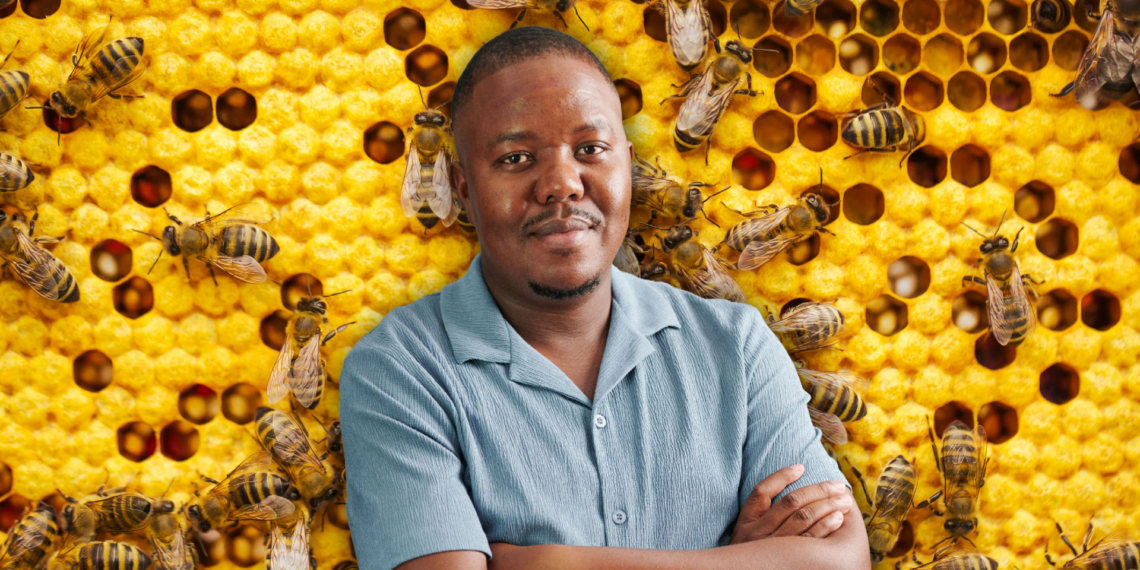
South Africa imports most of its honey despite high demand. Sibongiseni Peacock, an innovation manager at the DG Murray Trust, explains how the Siyazisiza Trust is empowering small-scale beekeepers to boost rural economies. Photo: Gareth Davies/Food For Mzansi

South Africa imports most of its honey despite high demand. Sibongiseni Peacock, an innovation manager at the DG Murray Trust, explains how the Siyazisiza Trust is empowering small-scale beekeepers to boost rural economies. Photo: Gareth Davies/Food For Mzansi

Share on FacebookShare on TwitterShare on WhatsApp

Bees aren’t just about honey; they are the backbone of agricultural productivity. Sibongiseni Peacock, an innovation manager at the DG Murray Trust (DGMT), says that to protect South Africa’s food systems, the country needs a coherent policy vision that supports small-scale beekeepers with land access and extension services.


South Africans consume about 5 000 tons of honey annually – that’s roughly 10 million standard jars. However, most of it is imported because the local honey industry is unable to meet demand for the natural sweet stuff. 

The industry comprises about 400 “commercial bee farmers” who own about 60 000 hives between them. There are over 2 000 small-scale beekeepers in the formal sector (those with fewer than 200 hives) and an estimated 4 000 informal beekeepers.

Production, though, is not evenly split between the different categories of honey producers. To their detriment, small-scale beekeepers are often excluded from the value chain and face underinvestment, rendering them underutilised. Instead of thriving in a market where there is high demand, small-scale beekeepers are struggling to expand. Their success is not only good for local economies but would improve rural livelihoods.

This is the logic behind a pilot initiative run by the non-profit, Siyazisiza Trust, in the Eastern Cape and Kwa-Zulu-Natal, which seeks to demonstrate how small-scale beekeepers can be supported to improve rural livelihoods and agro-based businesses. The pilot centres around 50 young people who are trained and mentored in beekeeping.

Fake honey threatens SA beekeepers, harms agriculture

A sweet success story

One of the programme’s success stories is the experience of Sabelo Khubone, a young KwaZulu-Natal sugarcane farmer who turned to beekeeping to diversify his income. Sugarcane has been the main source of income for many rural communities, but over the years, farmers have felt the pressure of higher input costs, bad weather and cheaper sugar imports. 

Because sugarcane fields are rich in nectar sources that support robust and thriving bee colonies, the landscape is conducive to beekeeping. Farmers like Sabelo can easily incorporate beekeeping while continuing with their core business. 

Today, Sabelo is producing premium honey from his twelve hives and beeswax for local markets, all within a few months of completing his training. With continued guidance and assistance from the Siyazisiza Trust, he has expanded into auxiliary beekeeping services, such as aiding farmers with pollination, processing honey into other products, and providing safe removal and relocation of honeybee colonies from houses or public areas.

Sabelo’s transformation from a struggling sugarcane farmer to a budding beekeeper demonstrates what happens when opportunity and support come together. Siyazisiza’s training programme demonstrated to Sabelo and other young farmers that innovation is feasible even in traditional agricultural systems. 

“I feel like I’m running a business that I can grow for the first time, instead of one that is shrinking every year,” Sabelo told me. 


Related stories
  • The buzz about honeybees: Farmers’ role in protecting pollinators
  • Beekeepers of Mngazana find hope in honey
  • Bonsmara, beekeeping, and beyond! Sepeng’s vision grows
  • Beekeeping sector poised for growth, jobs, and sustainability

Bees and agriculture 

According to industry predictions, agricultural productivity will continue to decline until more beekeepers receive training because of the crucial role bees play in pollinating crops. 

Supporting small-scale beekeeping helps protect food systems, rural livelihoods, entrepreneurship, ecological resilience and conserving bees. Yet in conversations about rural development, beekeeping tends to be overlooked as an opportunity. 

Although there are regulations about bees in South Africa, there’s been no coherent policy vision which recognises beekeeping as a strategic economic, ecological and food-system asset. There have been some positive shifts, like agriculture minister John Steenhuisen recently acknowledging the importance of this subsector in food security. 

What is needed

Still, existing regulations treat bees primarily as a biosecurity issue, focusing on compliance, registration, disease control, and hive movement rather than their economic role. This creates a policy gap in South African beekeeping: without support for beekeepers, the healthy colonies that underpin agricultural pollination are weakened.

Access to extension services, land, processing facilities, and markets is limited for small-scale and emerging beekeepers, especially in rural and peri-urban areas. From entry-level training to sustainable business development, there is no well-defined national pathway to support them. 

Even though NGOs and community organisations are filling this void by assisting beekeepers like Sabelo in gaining market access and skills, these initiatives must be supported by policy and funding at a national level.

  • Sibongiseni Peacock is an innovation manager at the DG Murray Trust (DGMT) focused on building productive synergies between communities and the environment. The views and opinions expressed in this article are those of the author and do not necessarily reflect the views or positions of Food For Mzansi.

READ NEXT: MEC champions beekeeping boom in North West

Sign-up for the latest agricultural news delivered straight to your inbox every day with Mzansi Today!

Sibongiseni Peacock

Sibongiseni Peacock is an innovation manager at the DG Murray Trust (DGMT) focused on building productive synergies between communities and the environment. He is completing his PHD in environmental science at Rhodes University and holds a master’s in agriculture: food security from the University of KwaZulu-Natal. As part of his doctoral research, Sibongiseni examines the processes and impacts of deagrarianisation in the livestock sector in the Peddie area of the Eastern Cape.

Tags: BeekeepingHelp me understandhoneyimports

Related Posts

CGA’s Dr Ntshabele charts bold citrus future for SA

CGA CEO marks first year with renewed drive for citrus growth

17th February 2026
Digital agriculture: The golden key to global market access

Steady interest rates strengthen agricultural investment outlook

12th February 2026

South Africa’s FMD crisis exposes veterinary system failures

An FMD-free future: Pipe dream or reality?

Shelembe family turns neglected land into thriving KZN farm

Agoa extension could boost SA’s value-added exports

A commercial farmer’s dismay: Steenhuisen faces FMD storm

Africa’s food future: Urgent action for a secure 2026

Advertorial

Precision irrigation drives Zimbabwe’s blueberry boom

by Patricia Tembo
19th February 2026

Zimbabwe is rapidly becoming a global blueberry powerhouse. By combining high-altitude growing conditions with Netafim’s precision irrigation technology, the country...

Read moreDetails
Beyond sugar: How SA’s farmers are crushing it with diversification

Beyond sugar: How SA’s farmers are crushing it with diversification

19th February 2026
Choosing the right maize variety for South African conditions is key to boosting yield, resilience, and profitability.

South Africa eyes bumper grain and soybean crops

19th February 2026

Traditional medicinal plants offer hope for men’s health

18th February 2026
Pomegranate pioneer: Debbie Theunissen’s rise in fruit farming

Pomegranate pioneer: Debbie Theunissen’s rise in fruit farming

18th February 2026

Meat is safe to eat despite FMD outbreak, assure experts

South Africa eyes bumper grain and soybean crops

Cane to craft: Brad O’Neil blends legacy and innovation in sugar

Precision irrigation drives Zimbabwe’s blueberry boom

Rooibos industry holds its ground amid climate uncertainty

Join Food For Mzansi's WhatsApp channel for the latest updates!

JOIN NOW!

THE NEW FACE OF SOUTH AFRICAN AGRICULTURE

With 21 global awards in the first six years of its existence, Food For Mzansi is much more than an agriculture publication. It is a movement, unashamedly saluting the unsung heroes of South African agriculture. We believe in the power of agriculture to promote nation building and social cohesion by telling stories that are often overlooked by broader society.

Why South Africa needs to invest in small-scale beekeepers

Relief at last: 1 million FMD vaccines touch down in Mzansi

High-tech DNA instrument strengthens SA’s livestock industry

China tariff cuts to boost SA apple and pear exports

High seas to harvest: Nonjabulo navigates new path in Ndwedwe

Agri jobs rise, yet small-scale farmers still struggle

  • Awards & Global Impact
  • Our Story
  • Contact Us
  • Cookie Policy
  • Privacy Policy
  • Copyright

Contact us
Office: +27 21 879 1824
News: info@foodformzansi.co.za
Advertising: sales@foodformzansi.co.za

Contact us
Office: +27 21 879 1824
News: info@foodformzansi.co.za
Advertising: sales@foodformzansi.co.za

  • Awards & Global Impact
  • Our Story
  • Contact Us
  • Cookie Policy
  • Privacy Policy
  • Copyright
No Result
View All Result
  • News
  • Changemakers
  • Lifestyle
  • Farmer’s Inside Track
  • Food for Thought

Copyright © 2024 Food for Mzansi

This website uses cookies. By continuing to use this website you are giving consent to cookies being used. Visit our Privacy and Cookie Policy.