Beekeeping sector poised for growth, jobs, and sustainability
South Africa’s beekeeping industry offers opportunities for economic growth, environmental protection, and social inclusion, especially for women and youth. Agriculture minister John Steenhuisen highlighted the sector’s potential to strengthen food security while empowering communities
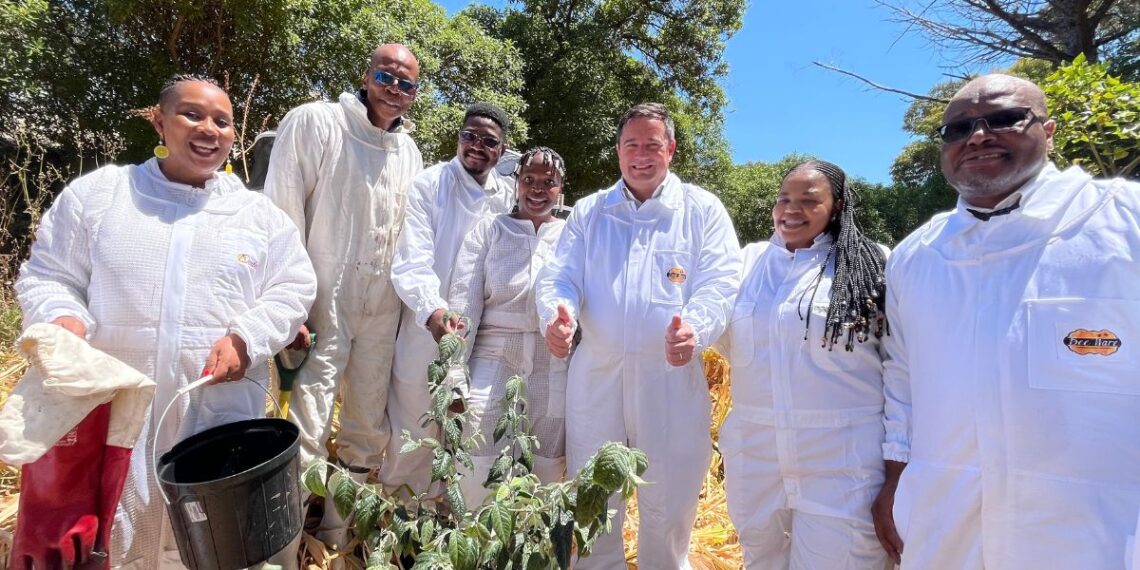
Agriculture minister John Steenhuisen and director-general Mooketsa Ramasodi, alongside other stakeholders, engage with the beekeeping community at the “Bees and Beyond” stakeholder session in Westlake, Cape Town. Photo: Ivor Price/Food For Mzansi
South Africa’s beekeeping sector is showing strong potential for economic growth, environmental sustainability, and social inclusion. It offers particular opportunities for women and youth.
This emerged from a stakeholder engagement session with the bee industry held at Oude Raapkraal in Westlake, Cape Town. Government officials, industry experts, and small-scale beekeepers came together to discuss the future of an often-overlooked industry that is vital to agriculture and biodiversity.
The session, themed “Bees and beyond: Unlocking opportunities to grow a sustainable and inclusive beekeeping industry,” highlighted how strategic support and innovation could strengthen the sector while addressing environmental challenges.
Agriculture minister John Steenhuisen noted the importance of bees to South Africa’s agricultural economy and food security.
He further added that the government is actively exploring policies to incentivise small-scale beekeepers and create market access opportunities for their honey and other bee products. “Our vision is for every community to see beekeeping not only as a source of income but also as a tool to protect biodiversity,” he said.
“Bees are not just pollinators. They are the backbone of our food system,” Steenhuisen said. “By empowering women and youth in this sector, we are investing in both economic growth and sustainable agriculture for future generations.”
📢 Stand Up, Be Seen, Be Counted
We want to provide you with the most valuable, relevant information possible. Please take a few minutes to complete this short, confidential survey about your farming practices and challenges. Your feedback helps us tailor our coverage to better support the future of agriculture across Mzansi.
The economic potential
Beekeeping offers a surprisingly low-cost entry point for entrepreneurs. Tumi Mobu, chairperson of the South African Bee Industry Organisation (Sabio), pointed out that a small-scale operation can start with just ten hives, with careful management allowing for gradual expansion.
“Women and youth have a real opportunity here,” Mobu said. “This is a sector where innovation, creativity, and commitment can lead to financial independence and community empowerment.”
Mike Allsopp, senior researcher at the Agricultural Research Council (ARC), highlighted the significant economic impact of bee pollination. “African honeybees support up to 300 000 jobs across agriculture and contribute billions of rands to the economy through commercial crops,” he explained.
He stressed that despite this contribution, the industry is operating in what he described as an “information vacuum,” with insufficient data on hive numbers, beekeeper demographics, and pollination needs.
Allsopp called for a coordinated national effort to map the sector and provide technical support where needed.
Steenhuisen also highlighted the broader economic potential.
“Supporting our beekeepers is not just about honey production. It’s about strengthening the backbone of our agriculture. Each hive contributes to our food security, supports jobs, and ensures resilience in the face of climate change.” He added that government incentives and partnerships with private industry could create sustainable revenue streams for small-scale operators, particularly in rural areas.
Environmental and social impact
Bees are vital to ecosystems as pollinators, helping maintain biodiversity and supporting food production. Allsopp explained that African honeybees are genetically diverse and naturally resistant to many threats that have decimated populations elsewhere in the world.
However, he warned that pressures from habitat loss, wildfires, and pesticide exposure are increasing the risks to bee populations. “Without careful management, we risk undermining an incredibly resilient species that is crucial to our economy and our environment,” Allsopp said.
Steenhuisen also stressed the need for integrating indigenous knowledge with modern scientific approaches.
“We must combine local wisdom with research to protect our bees and ensure sustainable practices,” he said. “Communities have managed hives for generations, and this knowledge is invaluable.”
He added that initiatives supporting women and youth in beekeeping have a double benefit. “They not only empower individuals economically, but they also foster a generation of custodians for our environment.”
The engagement also explored how technological innovation could further expand the sector. Digital tools for hive monitoring, disease tracking, and market access were highlighted as ways to increase productivity and sustainability. “Technology can help even the smallest beekeeper manage their operation efficiently,” Mobu said. “It’s about making sure everyone has the tools they need to succeed.”
Steenhuisen welcomed innovation, noting that it should complement rather than replace traditional practices. “We are looking at a blended approach, where science and technology enhance the wisdom of our communities,” he said. “This is how we build a truly sustainable, inclusive, and productive beekeeping industry.”
Contains information related to marketing campaigns of the user. These are shared with Google AdWords / Google Ads when the Google Ads and Google Analytics accounts are linked together.
90 days
__utma
ID used to identify users and sessions
2 years after last activity
__utmt
Used to monitor number of Google Analytics server requests
10 minutes
__utmb
Used to distinguish new sessions and visits. This cookie is set when the GA.js javascript library is loaded and there is no existing __utmb cookie. The cookie is updated every time data is sent to the Google Analytics server.
30 minutes after last activity
__utmc
Used only with old Urchin versions of Google Analytics and not with GA.js. Was used to distinguish between new sessions and visits at the end of a session.
End of session (browser)
__utmz
Contains information about the traffic source or campaign that directed user to the website. The cookie is set when the GA.js javascript is loaded and updated when data is sent to the Google Anaytics server
6 months after last activity
__utmv
Contains custom information set by the web developer via the _setCustomVar method in Google Analytics. This cookie is updated every time new data is sent to the Google Analytics server.
2 years after last activity
__utmx
Used to determine whether a user is included in an A / B or Multivariate test.
18 months
_ga
ID used to identify users
2 years
_gali
Used by Google Analytics to determine which links on a page are being clicked
30 seconds
_ga_
ID used to identify users
2 years
_gid
ID used to identify users for 24 hours after last activity
24 hours
_gat
Used to monitor number of Google Analytics server requests when using Google Tag Manager
1 minute
Jetpack's built-in visitor analytics. It records page views, referring sites, search terms, and outbound link clicks, and also carries the shared visitor-tracking library used by Jetpack Instant Search and WooCommerce Analytics.