Farming that ignores the environment is farming without a future. South Africa’s food security depends on healthy soils, clean water, and balanced ecosystems. Dr Ndeke Musee of Beyond Genβeta Solutions (Pty) Ltd explains how putting the environment at the heart of agriculture ensures lasting success.
When farming does not consider the health of the planet, the consequences are severe. Failing to make environmental sustainability a core part of agriculture doesn’t just hurt profits; it poses a genuine threat to our food supply and the nutrition we need to stay healthy.
This article explains simply why we must focus on the environment and how we can achieve it.
This is important, for a country where, in 2025, our agriculture fed 65 million people, and the number is expected to rise to 80 million by 2050, besides exporting to other countries to meet their food and nutritional needs.
Yet, our national surface area will not change, and environmental protection is an urgent need.
The problem facing South African farms
Farming in South Africa faces many complex hurdles, from the field to our dinner plate. These include a tough economy, lack of skills and technology, social issues, and, critically, a rapidly degrading environment.
If you look closely at these problems (which are summarised in the figure below), you’ll notice one crucial thing: they are all deeply connected and interdependent. Even though they might look like separate problems, their ultimate source is almost always human activity.
This means we cannot fix them one by one. We need a systems approach, looking at the farm as one whole connected system. The goal must be clear: to get multiple benefits, like better financial returns and a healthier environment, lower costs, stay profitable over time, and measure success with clear, open standards.
It’s widely accepted that politics is a major force influencing everything else, setting the stage for how decisions are made and carried out. Farming, like all other parts of society, is not exempt from this influence.
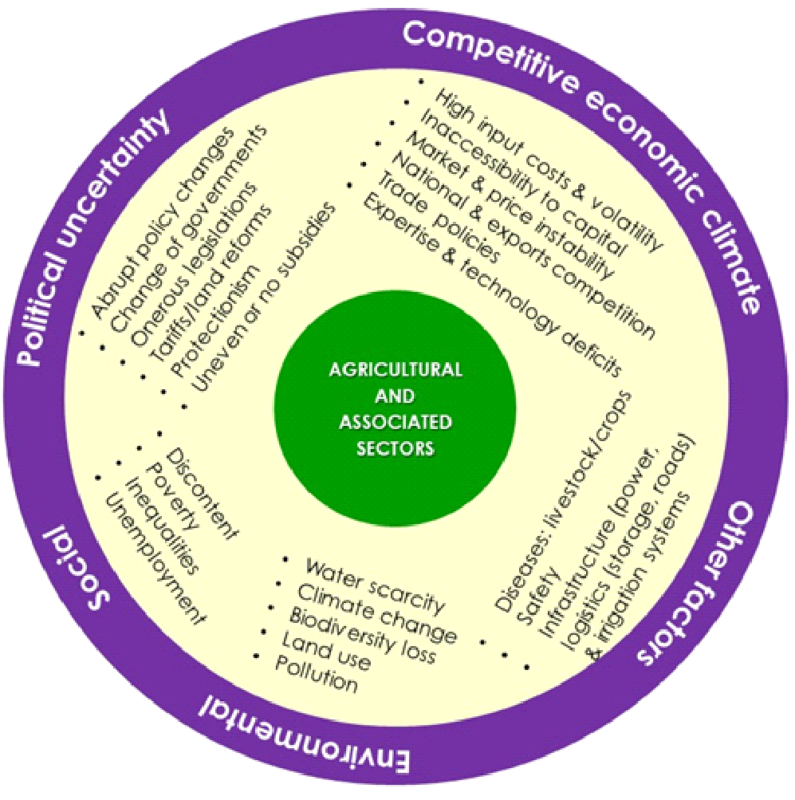
Framing and summary of challenges in the South African agricultural and associated sectors from farm to folk. The outer ring outlines the five aggregated challenges. The inner ring set outs 24examples of sub-challenges under each main challenge. Figure © by Ndeke Musee
Why the environment must come first
From a practical perspective, the environmental part of farming is the area where farmers and the industry have the most immediate control. So, why should environmental issues be the main focus?
There are two main reasons:
- Our dependence on nature’s health: For farming to be productive and profitable, it must rely on nature. The conditions that allowed agriculture to flourish since the time of the Garden of Eden Period (the Holocene Epoch) are the same conditions required for successful farming today and tomorrow. The problem is, these conditions are breaking down, and pretty fast.
Today, nature’s support factors are swinging wildly between extremes, for example, severe water shortages or massive flooding, rising average temperatures, and unreliable natural services like pollination. This volatility makes farming incredibly difficult and poses an existential threat to keeping farm operations successful.
- The environment is becoming increasingly hostile: South Africa has recently experienced some of the world’s most severe environmental changes, creating conditions increasingly hostile to farming. This has led to huge losses of crops and livestock, for example, directly linked to events like the 2014–2016 drought and the widespread flooding in 2022–2023.
The painful results included financial ruin for many farmers, reduced stability in agriculture, loss of income for families, erratic food prices, and widespread food insecurity and insufficient nutrition.
Related stories
- Respecting planetary boundaries protects SA food future
- Farming with nature: The hidden power behind food security
- Climate change resilience: Practical strategies for farmers
- Indigenous crops hold key to sustainable agriculture in SA
Environmental sustainability: a clear definition
Sustainability is typically broken down into three broad areas: economic, social, and environmental.
Environmental sustainability refers to the preservation of natural resources so that we can meet the needs of people today and tomorrow without harming the health of ecosystems that provide them (e.g., from wastes generated from human activities).
Applying this to agriculture means focusing on four key areas:
- Preserving natural variety (biodiversity): Preserving forests, wetlands, animals, plants, and microorganisms.
- Protecting natural wealth (natural capital): Ensuring that we use resources, like water and soil, more slowly than nature can replace them. This means living within the earth’s natural limits.
- Addressing social needs: Making sure current and future generations have equal access to food security, nutrition, and stable livelihoods in farming communities.
- Optimising resource use: Being highly efficient in the use of resources like water, energy, and chemicals, and working to reduce waste and emissions. Pay attention to the inputs and outputs characteristics of the commodity of focus.
These points help us implement the concept of planetary boundaries, the limits within which humanity can safely operate in the agricultural sector.
Making environmental health the centre of farming
A successful shift requires a systematic approach and intense, coordinated effort from everyone involved in the food chain. The main rule must be a shared vision and a clear plan for the future.
Delaying action will be expensive for both agriculture and society. While making the transition will be difficult, it guarantees a controlled, manageable shift. Letting nature’s health rapidly collapse, on the other hand, would be chaotic, potentially disastrous, and deadly in the long term.
Does environmental health truly deserve more focus than economic or social goals? Yes. The goal of any successful business is long-term viability, and the long term shows that economic goals must bend to environmental limits.
Think about using groundwater for irrigation. The economic success of the crop is completely limited by environmental sustainability. If the crop uses too much water more quickly than the borehole can naturally refill, the whole farm operation will eventually collapse or face the huge expense of finding new water sources.
This simple example proves that environmental sustainability must be the centre of strategy for farming businesses. The best way to achieve this is through a shift in mindset: seeing the natural environment as a form of wealth – the natural capital. This natural capital must be prioritised above all other forms of capital – social, human, and economic.
Why? Because research shows that whenever natural capital was ignored, any short-term gains achieved were quickly lost and ultimately led to higher long-term costs for the farm with potential cascading effects to higher tiers of the value chain.
In short, these examples confirm that a healthy, functioning society, starting with agriculture and other sectors of society, must place environmental sustainability first.
Key takeaways for everyone
- Historical lessons show that a healthy environment is the foundation for a functioning society, including successful agriculture.
- Farming that ignores the environment is a direct threat to our food supply and nutrition.
- To systematically achieve environmental sustainability, we need a shared:
- Understanding of what it truly means.
- Vision and a clear, forward-looking strategy.
This leaves us with a critical question: How will this necessary shift change what farmers grow, how they grow it, what food will cost, and how we will fund this transition? Plenty of food for thought!
*Dr Ndeke Musee is the founder and director of Beyond GenBeta Solutions Pty (BGβS) and holds a doctorate in chemical engineering science from Stellenbosch University. The views and opinions expressed in this article are those of the author and do not necessarily reflect the views or positions of Food For Mzansi.
READ NEXT: KZN smallholder groundnut farmers fight middlemen for fair prices