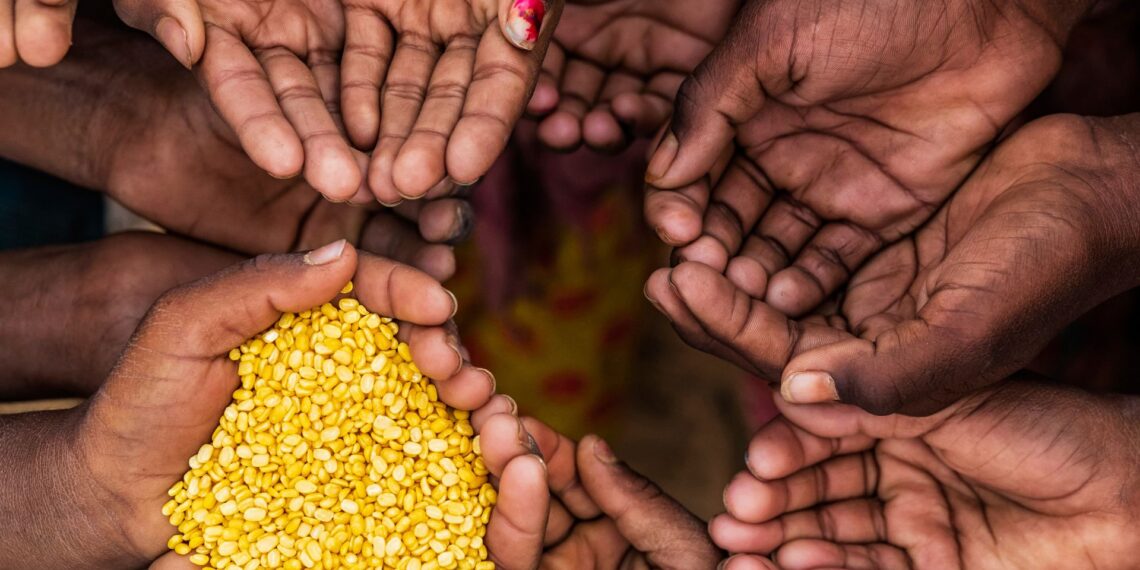
Agbiz chief economist Wandile Sihlobo recently shared on X that South Africa is food secure at a national level, but household food insecurity is still a big issue. He explained that his post wasn’t meant to downplay the real struggles with hunger that so many people face every day. In this follow-up, Sihlobo breaks down his thinking and wraps up with some ideas on how we can tackle the problem going forward.

South Africa is generally food secure at a “national level” but has a major “household food insecurity” challenge. Given the difficulty many South Africans face, I should have offered more detail on what I meant. The idea was not to disregard the painful challenge of hunger we all witness daily across the country.
Hence, I want to explain my thought process at length in this post and offer some suggestions about improving our situation at the end of this piece.
One of the measures some researchers often use to evaluate the food security condition of each country relative to the world is The Economist’s Global Food Security Index. In 2022, South Africa ranked 59th out of 113 countries in the index and was the most food secure in Sub-Saharan Africa.
This is an improvement from the previous year’s ranking of 70th in 2021.
South Africa ranked the second most food-secure country in the African continent after Morocco.
The Global Food Security Index comprises four subindices, namely: (1) food affordability, (2) food availability, (3) food quality and safety, and (4) sustainability and adaptation. The affordability and availability subindices carry a combined weighting of two-thirds of the total index.
The affordability subindex includes the change in average food costs, agricultural trade, food safety net programmes, the proportion of the population under the global poverty line, and funding for food safety net programmes.
Meanwhile, the availability subindex includes the sufficiency of supply, access to inputs, agricultural research and development, farm infrastructure, supply chain infrastructure, food loss, and political and social barriers to food.
In 2022, South Africa experienced a mild deterioration in the food affordability subindex of 7 points.
Meanwhile, the rest of the other subindices improved significantly. This decline in the affordability subindex is unsurprising as the country witnessed a broad acceleration in consumer food price inflation since the start of the year. South Africa’s consumer food price inflation averaged 9.5% y/y in 2022, from 6.5% up from in 2021.
Food inflation was also elevated in 2023, averaging at 11.0%.
In 2024, however, we saw market deceleration, with South Africa’s food inflation averaging 4.8% in the first eight months of the year.
Global challenges that pushed up food prices
Importantly, the higher food inflation in 2022 and 2023 was a global challenge not unique to South Africa.
Admittedly, in an environment such as South Africa with higher unemployment, the effects of food inflation shocks tend to be more severely felt by consumers.
Over the last few years, several factors have added upward pressure on global food prices. First, the drought in South America in the 2019/20 season reduced the harvest notably, primarily in Brazil and Argentina.
These countries collectively account for 14% and 50% of global maize and soybean production. The drought persisted for roughly three seasons since 2019/20, further exacerbating the grain price increases from 2020 to 2022.
Secondly, China’s imports of grains and oilseed as the country was rebuilding its pork industry after a devastating African Swine Fever also added to the surge in demand at a period when global stocks were tight.
China’s growing demand had a consequential impact on global grain prices because of its share size of imports.
The country imports about 60% of globally traded soybeans.

As Covid-19 spread in early 2020, several major grain producers, such as India, Kazakhstan and Vietnam, worsened global price increases by temporarily banning exports. As this unfolded, shipping costs soared, increasing global grain prices further. In sum, a combination of trade policy actions by other countries, logistics and weather conditions placed upward pressure on food prices.
These challenges were further worsened by the Russia-Ukraine war. Russia and Ukraine are substantial players in the grains and oilseeds market. The former produces about 10% of global wheat, while Ukraine accounts for 4%. Together, the two countries account for a quarter of global wheat exports.
Moreover, Russia and Ukraine are notable players in maize, responsible for 4% of production combined. However, their contribution is even more significant in exports, accounting for an average of 14%.
Both countries are also among the leading producers and exporters of sunflower oil. Pre-war, Ukraine’s global product exports accounted for 40%, with Russia accounting for 18%. Thus, the war led to a surge in grains and oilseeds prices for much of 2022.
Related stories
- Leap of faith as farmers prepare for planting season
- Tricky times as Weather Service warns of turbulent summer
Mzansi’s problems
As a small, open economy, South Africa, interlinked with the world, was not insulated from these agricultural and food price shocks.
Admittedly, in 2022 and 2023, South Africa was in a reasonably better place, with abundant supplies, as the La Niña weather event brought good rains across the country and supported agricultural activity. Still, the prices did not reflect the increased domestic supplies as the global shocks dominated.
These were the first round of shocks in global food prices. Fortunately, by the end of 2022, as the grain trade resumed in the Black Sea region following the Black Sea Grain Deal initiative that started in July 2022 and allowed for exports of grain from Ukraine without military attacks by Russia, the global agricultural prices came off the record levels seen months after the invasion of Ukraine.
The global agricultural prices continued to decline throughout 2023 and 2024. Thus, even domestically, the food price inflation moderated somewhat in 2024 (The new upside risk on prices in South Africa is the domestic drought in the 2024 summer season.)
The problem with food security measurements
The major issue to keep in mind when observing global agricultural indices, such as the Global Food Security Index, is that subjectivity can never be fully eliminated from the authors’ judgment. Resource constraints can hinder objective data collection on the ground in each country, and they sometimes rely on blueprint models that may not be site-specific.
Sources of bias can stem from inconsistency in data quality, frequency and reliability across all countries. The weightings and rankings are also tricky because they must be tailored to suit different socio-economic contexts.
With that said, the key message is that South Africa is in a better place regarding food security when compared with various countries in the world. This does not mean there should be complacency.
South Africa will need to continue improving food security through expansion in agricultural production and job creation in various sectors of the economy.
At a technical level, the ideas of expanding agriculture and agro-processing capacity to boost growth and job creation were well established as far back as in the National Development Plan 2012.
They were again highlighted in the 2019 National Treasury paper, in the 2022 Agriculture and Agro-processing Master Plan, and, most recently, in my book titled A Country of Two Agricultures: The Disparities, The Challenges, The Solutions.
These include expanding agricultural activity in the former homelands and government land, the release of PLAS land with title deeds (about 2,5 million hectares that are in government books), effective blended finance scheme, enhancing government-commodity organisations’ partnerships in extension services, investment in the network industries (water, electricity and road infrastructure), port infrastructure, and state laboratories.
Across the regions, Limpopo, KwaZulu-Natal and the Eastern Cape are the most food-insecure provinces, but these provinces also have vast tracts of underutilised land.
These provinces should be a priority in agricultural development plans, with a commercial focus where conditions permit job creation to be achieved, all to boost South Africa’s food security conditions.
READ NEXT: AgriSA’s congress tackles future of sustainable farming
Sign up for Mzansi Today: Your daily take on the news and happenings from the agriculture value chain