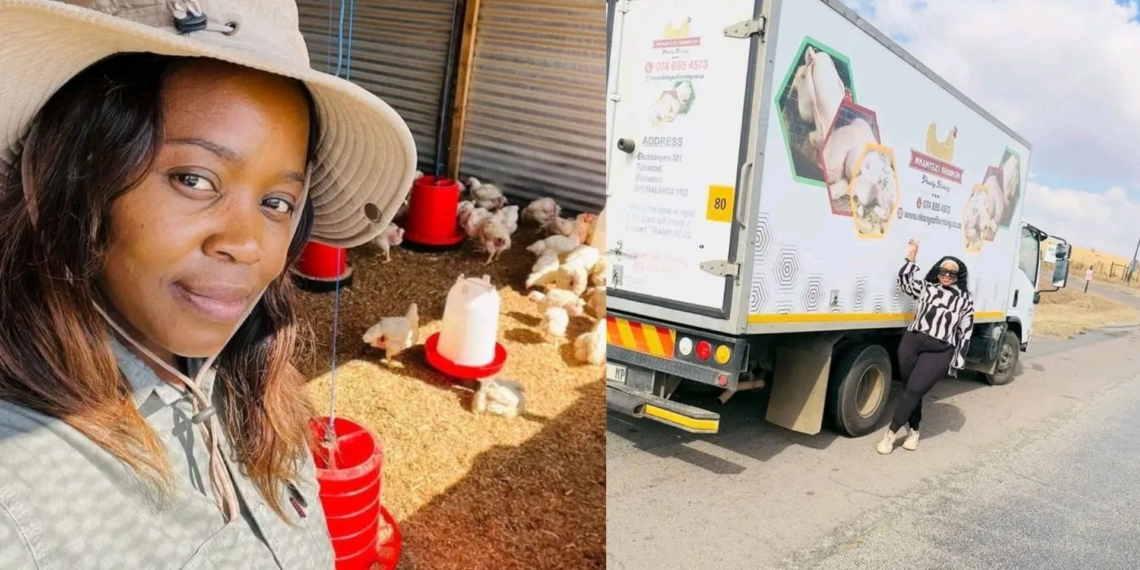
Driven by an entrepreneurial spirit and a problem-solving mindset, Lebogang Dhludhlu, the CEO of Nkanyezii Group, is rewriting the narrative of modern farming in South Africa.
Through vertical integration, continuous learning, and a focus on solving systemic gaps, this former electrical engineer has turned a modest poultry start-up on tribal land into a rapidly growing, diversified agricultural empire.
Entrepreneurial roots and an engineering foundation
Although Dhludhlu did not grow up in a farming household, business was already in her blood. Her late grandmother, Philippine Molahlwa, was a businesswoman, and her mother, Peggy Medupe, was also actively involved in enterprise.
“That entrepreneurial environment taught me the importance of hard work, resilience, and creating opportunities,” Dhludhlu notes.
Dhludhlu’s roots trace back to Ekangala, east of Tshwane, where she grew up in a family of six. She completed her early education at Zivuseni Primary School before matriculating from Lingitjudu High School.
“From a young age, I was always hard-working and focused on my education. I consistently worked hard to achieve good marks, which opened doors for me to pursue tertiary education,” she recalls.
She initially pursued a career in engineering, earning her diploma and BTech in electrical engineering from the Tshwane University of Technology (TUT) Witbank Campus. She also completed a BTech and an honours degree in project management from the University of Pretoria.
Her thirst for knowledge continued as she earned a master’s degree in sustainable agriculture from the University of the Free State in 2023, and she is currently pursuing her MBA with the Henley Business School.

Personal milestones also marked this period. Dhludhlu met her husband, Isaac Dumsane Dhludhlu, in 2010. The couple held their lobola ceremony in 2012, followed by their white wedding in 2017.
Dhludhlu built a career as an electrical engineer at Eskom. However, observing the vast, untapped potential within agriculture inspired her to pivot into entrepreneurship.
Related stories
- Unstoppable: Double-amputee farmer sets sights on commercial success
- 5 000 to 100 000 cabbages: EC co-op gamble pays off
- Mother’s legacy, neighbour’s grace: Venessa Simelane’s farm story
- Flying solo: FS farmer beats hurdles to scale poultry enterprise
Starting small on tribal land: From poultry to pivot
Two years after the couple’s wedding, they launched their agricultural venture using their own funds despite having no formal farming background. Operating on tribal land, they began on a very small scale with poultry production, selling their very first batch to Dhludhlu’s mother.
“The most important thing for me was that we started with what we had. We did not wait until everything was perfect before taking the first step. We started small, learnt along the way and continued building,” she says.
As the business demonstrated viability, it attracted agricultural support programmes and development opportunities, allowing the couple to reinvest revenue into infrastructure.
In 2023, Dhludhlu resigned from Eskom to run the business full-time. Her husband, a master millwright who was working for Sasol, joined her full-time shortly thereafter.

“My professional background in engineering and project management has played a significant role in how I approach business today, particularly when it comes to planning, systems, problem-solving, and managing large projects,” she explains.
Today, Nkanyeziii Group has evolved into a multi-faceted enterprise. While poultry remains a core foundation, the business has diversified into cattle and crop farming, while actively constructing its own abattoir and establishing its feed mill, TerraGrain.
“Our vision is not simply to be another poultry farmer. We want to participate meaningfully across the agricultural value chain and demonstrate how African agricultural businesses can grow into integrated enterprises.”
Lebohang Dlhudlhu
Overcoming hurdles through strategic vertical integration
“The development of TerraGrain, for example, is aimed at strengthening our feed supply and reducing our dependence on external suppliers. Our abattoir gives us greater control over processing… You cannot control every challenge in agriculture, but you can build systems that make your business better prepared to respond.”
Currently, Nkanyeziii Group supplies a wide network of individual consumers, resellers, local businesses, boarding schools, and day-care centres across Mpumalanga and Gauteng.

Dhludhlu has also expanded her business footprint into property, as well as the floral and hospitality sectors through Naledi Flower Boutique and Coffee Shop, which operates locations in Witbank and Bethal. Together, these ventures employ over 100 permanent and part-time workers.
“My greatest achievement is seeing the business evolve into something much bigger than what we initially envisioned,” she shares.
“I am proud that the businesses we are building are not only about making a profit. They are about creating jobs, solving problems, creating opportunities and contributing to local economic development.”
Scaling the vision
Looking ahead, Dhludhlu’s roadmap for Nkanyezii Group is to bring TerraGrain to full operational capacity, scale up poultry and livestock yields, and fully establish an end-to-end processing and distribution network.
She is equally dedicated to empowering the next generation, regularly hosting mentoring sessions for aspiring farmers and young entrepreneurs looking to break into the industry.

Her advice for those contemplating a future in farming is to shift their perspective from basic production to strategic entrepreneurship.
“Look beyond simply becoming a farmer and start thinking like an agricultural entrepreneur. Agriculture has many gaps and opportunities. You do not necessarily have to produce the same product as everyone else. Look at the entire value chain and ask yourself: Where is the gap? What problem can I solve? What can I do differently?”


READ NEXT: SA food inflation slows, but rising costs squeeze farmers