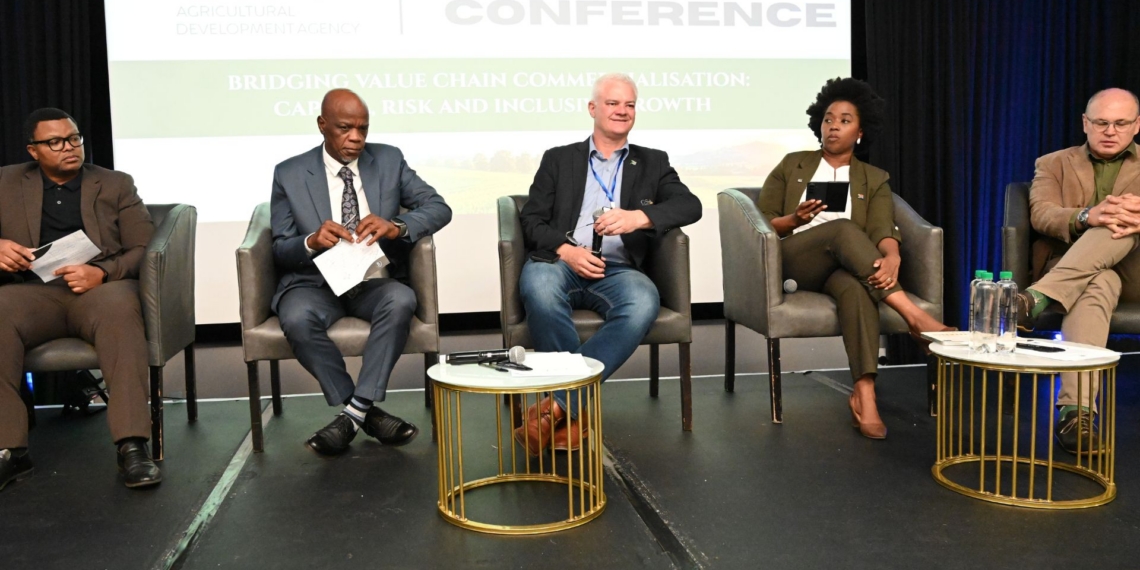
South Africa’s agricultural sector must do more than increase production to unlock commercial opportunities for emerging farmers. At the Agricultural Development Agency’s (Agda) annual congress in Boksburg, Gauteng, experts emphasised that access to markets, patient capital, agro-processing and stronger partnerships are vital.
Speakers highlighted the need to help small-scale farmers transition to commercial agriculture, improve their competitiveness in international markets and build stronger connections between producers, processors, funders and buyers.
AfCFTA, informal markets offer growth opportunities
Vuyiswa Ramokgopa, Gauteng MEC for agriculture and rural development, said the African Continental Free Trade Area (AfCFTA) presents opportunities for agricultural exports, value creation and agro-processing.
“We are already quite a significant and prominent player on the continent from an agro-processing perspective,” she said, adding that South Africa has an established base on which to build.
Ramokgopa pointed to opportunities within the Southern African Development Community (SADC), noting that bananas produced in Mozambique are transported to Johannesburg for ripening before returning to Mozambique and other markets for sale.
She said the example demonstrates the potential to expand agro-processing and strengthen regional agricultural trade.
Related stories
- Agda pushes for pathways to commercialise emerging farmers
- Agda conference puts inclusive agricultural growth in focus
- Agda strives towards an inclusive agri sector
- Absa, Agda tackle fragmented funding for emerging farmers
Ramokgopa also called for greater recognition of the informal market, which accounts for about 60% of fresh produce trade in the country. She argued that market access discussions should extend beyond major retailers to include informal traders, who need support and capacity-building to participate more effectively in the agricultural value chain.
On agricultural finance, Ramokgopa said the challenge is not necessarily a shortage of funding, but farmers’ limited access to information about available opportunities and the requirements of different institutions. “There is a shortage or a lack of understanding and knowledge of how to get that money.”
She emphasised that farmers need to understand funders’ requirements and build commercially viable businesses supported by reliable revenue, appropriate security and strong business relationships. Ramokgopa also called for a deeper pool of patient capital, warning that agriculture could not always accommodate investors seeking returns within five years.
How agro-processing can increase the value of grain
Meanwhile, Dr Tobias Doyer, chief executive officer of Grain SA, said South African farmers need to compete internationally by improving productivity and better using opportunities in value-added markets.
“We’re competing in the international Olympics of farming. We’re competing in the World Cup, and we need to support our farmers to enable them to win that game,” he said.
Doyer stressed that economic growth is essential to create jobs and strengthen domestic demand, while international markets offer further opportunities for agricultural producers.
He argued that grain producers should consider opportunities beyond exporting bulk commodities, including converting grain into higher-value animal protein products such as poultry, pork and beef.
“If we’re competing with grains, we’ll always be in a commodity market, but if we’re competing in the animal protein market, we are competing and earning in a premium market,” he said.
Diversifying production and strengthening partnerships
The president of the African Farmers’ Association of South Africa (Afasa), AJ Mthembu, said agriculture remains strategically important despite rapid technological change because food production is essential.
He also highlighted opportunities to expand South Africa’s food basket by producing a wider range of products for domestic and international consumers, calling for resilience as farmers navigate changing markets.
Sizwe Dludla, investment principal at the National Empowerment Fund (NEF), said greater integration among existing agricultural businesses could help farmers use available resources more effectively.
He pointed to opportunities to connect fragmented farming operations with established markets and complementary businesses, including linking milling operations with poultry producers and connecting farmers to school nutrition programmes.
“The market is there, but they need certain specific quality, consistency of quality, and the funders are there to fund the farmers to produce the right quality,” Dludla said.
He encouraged farmers, buyers and funders to work together to develop an agricultural ecosystem that supports consistent production and meets market requirements.
Commercial success requires more than finance
Johann Kotzé, CEO of AgriSA, cautioned that finance and production resources alone would not guarantee success for emerging farmers. He said South Africa needs better pathways to help people move from small-scale farming into sustainable commercial operations.
Kotzé also emphasised the importance of social structures, skills, partnerships and shared responsibility in building successful farming businesses.
“The fact that you are a farmer doesn’t entitle you to come to me and say ‘I need to borrow your money’,” he said, highlighting the need for farmers and financial institutions to understand their respective responsibilities.
He warned that focusing only on land, water and funding while neglecting the relationships and support systems underpinning agricultural businesses could leave farmers vulnerable to failure.
READ NEXT: Becoming bankable: How to get your farm ready for finance