When the rains fail, your soil is your farm’s first line of defence. With El Niño returning, agricultural scientists Dr Lehlogonolo Matelele, Sithembiso Fakude, Adolph Malatji, Nompumelelo Ngejane and Khumbelo Sirakalala highlight why building soil organic matter and improving water retention is essential for surviving dry spells.



When the rains fail, farmers often look first to the sky. But the real battle may already be taking place beneath their feet.
The soil is the farm’s first reservoir. It stores water, holds nutrients, supports roots and provides the biological foundation on which crops depend. When that soil is healthy, a crop has a better chance of surviving a dry spell. When it is degraded, even a short period without rain can turn into a crisis.
This is why the return of El Niño should not be viewed only as a weather story. It should also be seen as a soil-fertility story.
El Niño is a natural climate phenomenon caused by unusually warm surface waters in the central and eastern Pacific Ocean. Although it begins thousands of kilometres from Africa, it can disrupt rainfall and temperature patterns across the world. Its effects differ from region to region, but Southern Africa has historically experienced reduced rainfall during parts of the main cropping season during El Niño events.
And in 2026, farmers have another reason to pay attention. The Food and Agriculture Organisation of the United Nations (FAO) reports that a new El Niño phase is developing, with agricultural drought risks particularly concerning in parts of Southern Africa and other vulnerable regions. Some agricultural and pasture areas identified by FAO face more than a 50% probability of drought.
For farmers, the message is simple: prepare before the rain stops.


Why soil fertility matters during El Niño
It is easy to think of soil fertility simply as the amount of fertiliser applied to a field. But fertility is much more than that.
FAO defines soil fertility as the ability of soil to sustain plant growth by supplying essential nutrients while providing suitable physical, chemical and biological conditions for plants.
A fertile, healthy soil does something extremely valuable during drought: it helps the crop make better use of the water that is available.
Organic matter, good soil structure, biological activity and adequate nutrient availability all contribute to productive soil. A soil with good structure can allow water to infiltrate rather than simply running off the field. It can also store water in spaces accessible to plant roots.
Related stories
- How farmers can prepare as El Niño looms large
- Beyond maize: Why neglected crops are SA’s climate-smart future
- Prepare your livestock for a drier 2026/27 breeding season
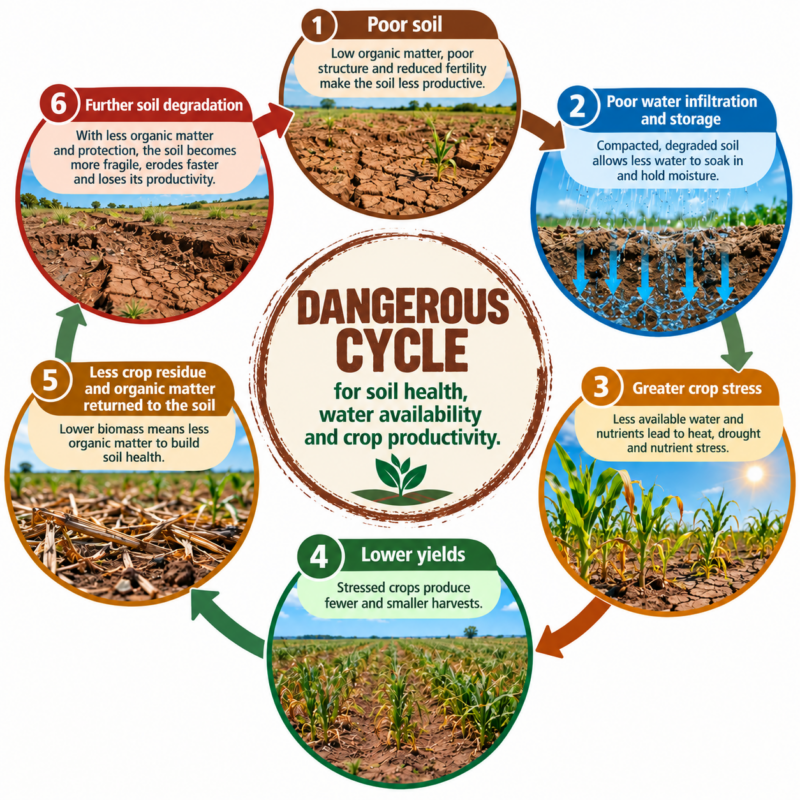
By contrast, degraded soil may crust, compact or lose organic matter. Rainfall can run off rapidly, taking valuable topsoil and nutrients with it. When the dry period arrives, the crop is left with a smaller water reserve and weaker root development. This creates a dangerous cycle (Figure below). El Niño can intensify this cycle.
Drought does not only remove water
When farmers hear an El Niño warning, the first concern is understandably rainfall. But drought affects the movement and availability of nutrients as well.
Plants need nutrients such as nitrogen, phosphorus, potassium, sulphur, calcium and magnesium, as well as several micronutrients. Yet nutrients are useful to a crop only when the plant can access and take them up.
When soils become extremely dry, root growth and nutrient uptake can be restricted. A crop may therefore suffer from both water stress and nutritional stress at the same time.
This is one reason why simply applying more fertiliser is not necessarily the answer to an El Niño season.
Farmers need to think in terms of efficient nutrient management: putting the right nutrient, in the right amount, in the right place and at the right time, while improving the soil’s ability to hold water and support roots.
The soil can become a farmer’s drought insurance
Farmers cannot control how much rain falls. But they can influence how much of that rain remains available to the crop. This is where soil-health practices become particularly important.
Keeping crop residues on the soil surface, increasing organic matter, reducing unnecessary soil disturbance, controlling erosion, rotating crops and incorporating legumes can all contribute to better soil management. Integrated soil fertility management can combine organic resources, appropriate fertilisers, crop rotations and other practices to maintain productivity while reducing nutrient losses.
For example, manure and well-managed compost can contribute organic matter and nutrients. Legumes can contribute biologically fixed nitrogen. Crop residues can protect the soil surface from heat and erosion and help maintain soil organic matter when properly managed.
The objective is not simply to make the soil “rich”. The objective is to build a soil that can hold water, hold nutrients and keep roots functioning when conditions become difficult.
What can farmers do before El Niño arrives?
The best time to prepare for drought is before the drought.
1. Listen to climate and weather warnings
Farmers should make greater use of seasonal forecasts, local weather information and agricultural extension advice.
El Niño can often be anticipated months in advance, creating an opportunity for farmers to change decisions before planting. FAO emphasises that early warning is valuable because it allows farmers to consider actions such as adjusting planting dates, selecting appropriate varieties, securing water and storing livestock feed.
The important point, however, is that a global El Niño forecast should not automatically be interpreted as a prediction for every farm.
Local conditions matter.
A farmer should ask: What does the forecast mean for my district, my soil type, my water supply and my cropping season?
2. Choose crops and varieties carefully
An El Niño season may not be the year to take unnecessary risks with varieties that require a long, reliable growing season.
Where locally recommended options are available, farmers can consider drought-tolerant, heat-tolerant or shorter-duration varieties.
Changing the planting date may also be appropriate where seasonal forecasts indicate delayed or reduced rainfall.
FAO’s current guidance similarly highlights drought-tolerant crops, short-cycle crops and adjustments to planting dates as potential anticipatory measures.
3. Protect every drop of rain
Rainwater that runs off the field is water the crop cannot use.
Farmers should therefore consider practices that slow runoff, reduce erosion and improve infiltration. Depending on the farming system, these may include maintaining soil cover, contour farming, mulching, conservation agriculture practices, tied ridges, terraces or other locally appropriate water-harvesting techniques.
The principle is straightforward: Don’t just wait for rain. Make the soil ready to catch it.
Related stories
- Sustainable farming: How to balance soil health and income
- Maintaining organic matter: Key steps to boost soil health
- Know your water and soil: Practical tips for smarter drip irrigation
4. Build soil organic matter
Organic matter is one of the farmer’s most important tools for improving soil function.
Returning suitable crop residues to the soil, using manure or compost where available, rotating crops and incorporating legumes can help improve soil structure and nutrient cycling.
This is particularly important in dry environments, where the ability of soil to retain and supply water can make the difference between a crop surviving a dry spell and failing.
FAO notes that maintaining soil texture and fertility can improve crop water productivity and highlights integrated soil fertility management, manuring, crop rotations, legumes and agroforestry among approaches that can help restore soil nutrients and improve resilience.
5. Do not abandon fertiliser; use it more intelligently
A drought warning should not automatically mean abandoning fertiliser.
Poor fertility can make drought stress worse because a poorly nourished crop may have limited growth and reduced ability to make productive use of available water.
However, fertiliser decisions should be based on soil conditions, crop requirements, expected yield potential, available moisture and professional agronomic advice.
The goal is nutrient-use efficiency, not simply applying more fertiliser.
Where possible, farmers should use soil testing to identify nutrient deficiencies and avoid spending scarce resources on nutrients that are not limiting.
6. Protect livestock as well as crops
For mixed farmers, El Niño is not only a crop problem.
Reduced rainfall can mean less pasture, declining grazing quality and shortages of drinking water. Farmers should therefore consider livestock numbers, available grazing, fodder reserves and water supplies before conditions become severe.
FAO recommends measures such as fodder storage and securing water supplies as part of early action in areas facing El Niño-related agricultural drought.
Sometimes the most important drought decision is not what to plant, but how many animals the land can realistically support.
Don’t wait for the first failed crop
One of the biggest lessons from previous El Niño events is that agricultural damage can continue long after the rain returns.
A failed harvest means less food, less income, fewer resources to buy seed and fertiliser, and potentially fewer animals available for the next production cycle.
FAO’s analysis of the 2015/16 El Niño shock in Zambia found that drought-affected households experienced substantial reductions in maize yields and income. It also found that strategies such as livestock and income diversification and agroforestry helped moderate some of the impacts.
This is an important lesson for today’s farmer: resilience is not about surviving one drought. It is about being able to farm again after the drought.
El Niño is a warning, but healthy soil is a long-term investment
Farmers should not think of El Niño as an isolated disaster that appears every few years and then disappears.
The bigger challenge is that El Niño is now occurring against a background of a warmer climate. FAO notes that global warming can amplify the impacts of El Niño by raising the temperature baseline and increasing the potential severity of heat and drought in vulnerable regions.
That changes the conversation. The question is no longer simply: “How do I survive this El Niño?”
It should become: “How do I make my farm more resilient to the next ten El Niño seasons and the changing climate around them?”
The answer begins with the soil.
A farmer cannot manufacture rain. But a farmer can improve the soil’s capacity to capture rainfall, store moisture, cycle nutrients and support strong roots.
That means protecting soil from erosion. Returning organic matter. Managing nutrients carefully. Diversifying crops. Using suitable varieties. Conserving water. Monitoring weather information. Planning livestock numbers. And, where possible, combining farming income with other sources of livelihood to reduce dependence on a single harvest.
The farmer’s best defence may be beneath his or her feet
El Niño reminds us that agriculture is ultimately a partnership with nature.
The farmer plants, but the weather decides how much rain arrives. The farmer applies nutrients, but the soil determines how effectively they are stored and made available. The farmer can install irrigation, but water still has to be managed wisely.
A healthy soil brings these pieces together.
It is a reservoir when rain falls, a nutrient bank when crops grow and a buffer when the weather turns against the farmer.
As El Niño increases the risk of drought and climate uncertainty, investing in soil fertility is therefore not simply an agronomic decision.
It is an investment in farm survival.
The farmers best prepared for the next climate shock may not necessarily be those with the most expensive equipment or the biggest fields. They may be those who have spent years building something less visible but extraordinarily valuable: healthy soil beneath their crops.
Please note: El Niño impacts vary considerably by region and season. Farmers should combine seasonal forecasts with local weather information and advice from agricultural extension services before making major planting, fertiliser, or livestock decisions.
- Dr Lehlogonolo Matelele, Sithembiso Fakude, and Adolph Malatji of the national department of agriculture, Nompumelelo Ngejane of the KwaZulu-Natal department of agriculture and rural development, and Khumbelo Sirakalala of the Limpopo department of agriculture and rural development. The views and opinions expressed in this article are those of the author and do not necessarily reflect the views or positions of Food For Mzansi.
READ NEXT: Protect your soil and crops while saving water this season