For farmers, tax compliance and sound financial management are not simply administrative requirements; they can determine whether a business is able to access finance, government support, and new market opportunities.
Commercial sunflower farmer Happy Letsitsa and agricultural finance consultant Sibo Molo of Molo Consulting share practical advice on getting farm finances, records, and compliance in order, while guidance from the South African Revenue Service (SARS) highlights the tax provisions and requirements that apply specifically to farming enterprises.
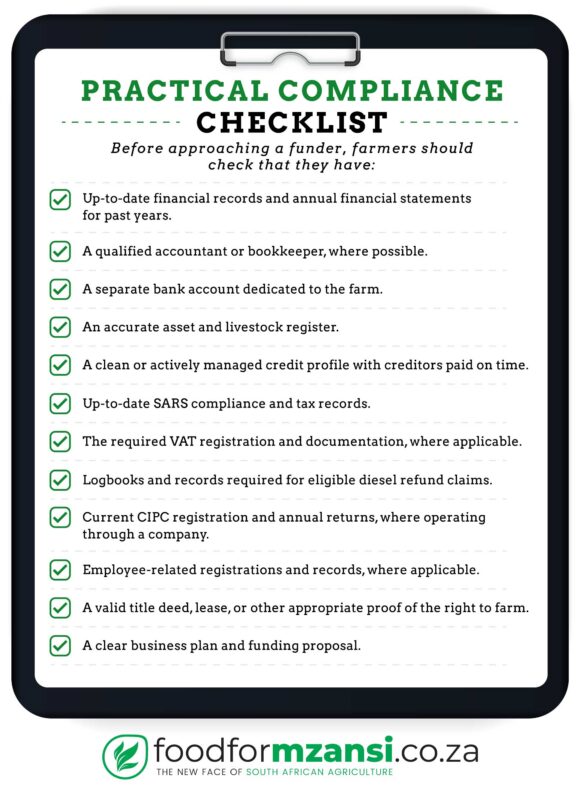
Together, their insights show why farmers should treat financial records, tax compliance, credit management, and supporting documentation as essential parts of building a finance-ready farming business.
1. Start with proper financial records and separate accounts
One of the most important requirements for both tax compliance and accessing finance is a clear picture of the farm’s financial position.
“Compliance is not really red tape. It is a document that unlocks your Land Bank finance, blended funds, retail supply contracts and government support.”
Sibo Molo, founder of Molo Consulting
Molo recommends keeping financial records up to date throughout the year rather than trying to reconstruct the business at tax or funding application time. Monthly bookkeeping should capture income and expenses and provide the information needed to prepare annual financial statements.
Related stories
- Four simple records every smallholder livestock farmer should keep
- Professionalism pays: How Jantjies built a thriving lucerne business
- Hope restored as Land Bank secures R500m to end funding freeze
- Four steps to formalise your farm and unlock finance
Letsitsa says farmers approaching commercial lenders should ideally have annual financial statements for the past three years.
“A farmer should always have a qualified bookkeeper or accountant and have his annual financial statements ready for the past three years, showing exactly what is happening in his entity.”
Happy Letsitsa, commercial sunflower farmer
Farmers should also avoid mixing personal and business finances. A farm should have a dedicated bank account, with farm income and expenses flowing through that account. Mixing household spending with farm transactions makes it difficult to determine the true performance of the business and can complicate tax and financial reporting.
“Everything for the farm must be within the farm’s business accounts. A farm needs to have its own bank account,” Molo advises.
2. Build and maintain an asset register
A farm’s assets form an important part of its financial position. Farmers should maintain an up-to-date asset register covering items such as tractors, vehicles, machinery, equipment, and livestock.
Molo says the register should reflect what is actually on the farm and contain identifying information where applicable, such as vehicle identification numbers, purchase dates, and values. Livestock should also be properly recorded, and stocktakes conducted regularly.
An accurate asset register can help with financial statements, insurance, tax records, and funding applications, particularly where assets may form part of the lender’s assessment of the farm.
- Movable assets: Vehicle identification numbers, serial numbers, purchase dates, and current values.
- Fixed infrastructure: Buildings, irrigation systems, and permanent fencing records.
- Biological assets: Regular livestock count records, breeding lines, and mortality tracking.
3. Understand your tax obligations
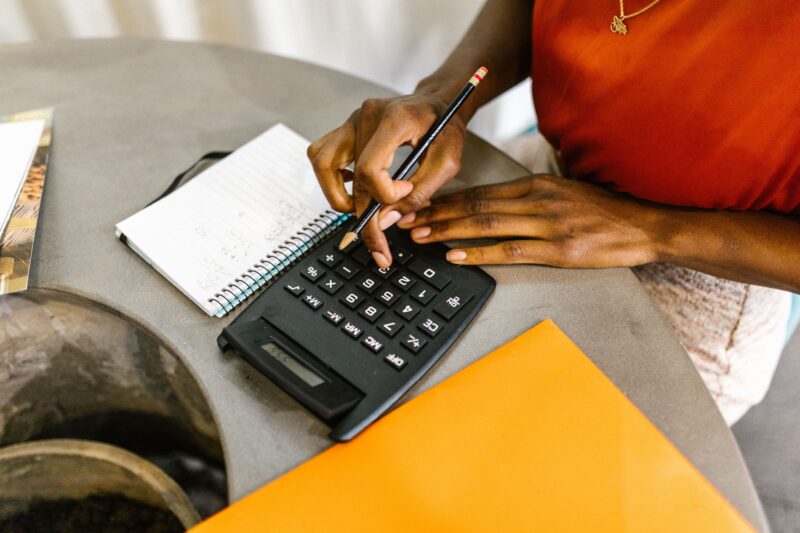
Proper financial records are also important for income tax. They allow farmers to distinguish between farm income and legitimate business expenses and provide the information needed to calculate taxable income.
Molo warns farmers against treating agricultural businesses like informal operations.
“Farm tax is a very specialised regime. An entire schedule of the Income Tax Act is written for farming,” he says.
This makes it important to work with an accountant or tax practitioner who understands agriculture and the specific tax provisions that apply to farming enterprises.
4. Make use of VAT provisions where you qualify
SARS provides specific VAT dispensations for qualifying farming enterprises.
A registered farming vendor may, subject to the relevant requirements and authorisation, acquire certain farming inputs at zero rate. These include items such as animal feed, animal remedies, fertiliser, pesticides, plants, and seeds used for cultivation.
Farmers must meet SARS requirements, including having a valid Notice of Registration and the required authorisation. A valid tax invoice must also be issued, and the goods must qualify under the relevant provisions of the Value-Added Tax Act, No. 89 of 1991.
SARS also provides for a six-monthly Category D VAT tax period for qualifying farming enterprises with turnover from farming activities not exceeding R1.5 million over a consecutive 12-month period. Farmers should confirm their specific circumstances with SARS or a qualified tax practitioner.
5. Keep records for eligible diesel refunds
Diesel can be a high operating cost for farmers, making proper record-keeping essential when claiming eligible diesel refunds.
Molo stresses that farmers cannot rely only on fuel receipts.
“The diesel refund is in the logbook, not at the pump.”
Sibo Molo, founder of Molo Consulting
Farmers should maintain the required records and logbooks and ensure that they understand the current SARS registration and claiming requirements. Because the diesel refund system and requirements can change, farmers should confirm the latest process with SARS or their tax practitioner.
SARS VAT & Diesel Refund Guide
Ensure your farm’s records are compliant to access essential tax relief. A registered farming vendor may acquire certain farming inputs at a zero rate. Additionally, SARS provides a Category D VAT tax period for qualifying farming enterprises with turnover not exceeding R1.5 million.
100% Diesel Refund Estimator
As of 1 April 2026, primary sector beneficiaries can claim a refund on 100% of eligible diesel usage (up from 80%). Use this tool to estimate your monthly return. Remember: “The diesel refund is in the logbook, not at the pump”[cite: 4].
Disclaimer: This guide and calculator provide estimates for illustrative purposes only and do not constitute formal financial or tax advice. This tool has not been signed off by a registered tax practitioner. Always consult a professional before submitting claims.
6. Keep your business legally compliant and protect your credit
Tax compliance is only one part of being funding-ready.
Farm businesses should ensure that their entity registration is up to date. Farmers operating through a company should maintain their Companies and Intellectual Property Commission (CIPC) compliance, including the required annual returns and beneficial ownership information.
Molo warns that failing to maintain CIPC compliance can result in a company being deregistered.
Employers should also meet their obligations relating to employees, including applicable labour requirements, Unemployment Insurance Fund (UIF), Pay As You Earn (PAYE), and the Compensation for Occupational Injuries and Diseases Act, No. 130 of 1993 (Coida).
Furthermore, a farmer’s credit profile can directly influence access to finance. Letsitsa highlights the importance of timely payments and maintaining solid creditor relationships.
“Pay your creditors on time, keep your credit record in good standing, and make sure that every transaction on the farm is recorded,” Letsitsa says.
Molo adds that lenders will often assess both the business’s financial health and the personal credit history of the owner.
7. Apply early and seek funding for what the farm actually needs
Proof that a farmer has a legitimate right to operate on the land is another important part of being finance-ready, whether through a title deed or a valid lease agreement.
When applying for finance, Letsitsa advises farmers to take a proactive approach and give lenders sufficient time to evaluate their business.
“Apply early so that if the bank asks for extra information, you have time to provide it,” Letsitsa advises.
Farmers should be able to explain exactly what the money will be used for. Rather than simply requesting a large amount, Molo advises linking the funding request to a specific business need, such as a tractor, irrigation system, livestock, or infrastructure.
“The amount you need is determined by what the farm needs,” Molo says.
As Molo puts it, financial statements should be viewed as part of the farm’s infrastructure, just like its machinery, fencing, or vehicles.
“Banks already know: no books, no loan. Financial statements are farm infrastructure,” he says.
Don’t miss this article from our Funding and Finance Series:
READ NEXT: Master farming first: Jotham’s formula for multi-stream income