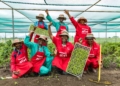
The Omnia Marketplace Academy (MPA) and the Gauteng department of education have celebrated the graduation of 20 learners from a pioneering agricultural skills development programme at the Katlehong Engineering School of Specialisation and the Oosrand Commerce and Entrepreneurship School of Specialisation.
The graduation marks a significant milestone, as the first cohort to complete the programme since its launch in 2025. The innovative initiative integrates occupational agricultural training into the school of specialisation model, helping to bridge the gap between education and employment by enabling learners to earn industry-recognised agricultural credits while still at school.
Graduates completed a specialised crop production skills programme comprising AgriSETA-recognised and National Qualifications Framework (NQF) aligned unit standards.
Bridging the gap between classrooms and agricareers
Delivered by accredited training provider Employment Solutions Management (ESM), facilitated by MPA and financially supported by Omnia, the programme combines classroom learning with practical workplace-based agricultural training.
The initiative forms part of Omnia’s broader commitment to supporting food security, skills development and economic inclusion across South Africa.
Related stories
- Omnia’s R45m share scheme rewards over 2 500 employees
- Omnia’s turnaround strategy lands on fertile ground
- Shoprite opens second food garden competition with R1m in support
- Protect your soil and crops while saving water this season
Commenting on the graduation, Stephan Serfontein, executive director of Omnia Group, said South Africa’s unemployment challenge continues to disproportionately affect young people.
“Through this partnership, learners are not only completing school with a matric certificate but are also earning industry-recognised credits towards further agricultural qualifications, enhancing employability and equipping them with practical, in-demand skills that can positively transform lives, strengthen families and uplift communities. Omnia is proud to contribute to creating lasting positive social and economic impact,” he said.
The MPA model strengthens leadership, classroom practice and learner outcomes while creating clear pathways from education into the world of work. Learners receive foundational and entrepreneurial training before progressing to specialised streams, including agriculture.
“Today’s graduation reflects the value of equipping young people with practical skills that can open doors, support livelihoods and contribute to stronger, more food-secure communities,” Mulder said.
Sowing seeds of community enterprise and food security
At Oosrand, the school garden has evolved into a small community enterprise, supplying fresh produce to the school feeding scheme, which serves approximately 1 600 learners daily, while generating additional income for the school. The initiative is also encouraging learners to establish their own gardens, promoting food security and self-sufficiency.
Similar outcomes are being achieved at Katlehong, where the school garden supports a feeding scheme serving approximately 1 000 learners each day.
Peter Arendse, principal of Oosrand Commerce and Entrepreneurship School of Specialisation, said the graduation is about far more than a qualification.
“It is about planting seeds of hope, opportunity and self- sufficiency that will continue to grow long into the future. Through this programme, our learners have gained practical agricultural skills that can help them support themselves, their families and their communities.
“We are nurturing the farmers, entrepreneurs and change-makers of tomorrow,” Arendse said.
READ NEXT: Africa’s indigenous crops and youth are the secret to ending hunger