AgriSETA’s Agri-Edu Symposium held today in Pretoria was a resounding success, bringing together key stakeholders from South Africa’s agricultural education, farming communities, and the broader agricultural sector. Under the theme “Bridging the skills gap in agriculture,” the event tackled the critical challenge of aligning academic training with the real-world demands of the farming sector.
Chief executive of AgriSETA Dr Innocent Sirovha, delivered a candid and solution-focused address on the challenges and opportunities in South Africa’s agricultural education sector.
He highlighted AgriSETA’s efforts to improve articulation, funding, and skills alignment across agricultural colleges and universities.
“The moment the board resolved to have agreed to do [the] symposium, the first thing to do was to visit all the provinces, and so that each province could have a solution of its own, and see what are the problems that we are facing,” he said.
He also addressed disparities in recognising agricultural diplomas across institutions, a long-standing issue in the sector. According to Sirovha, resolving such inconsistencies requires better collaboration and a unified approach to accreditation and articulation.
Whitfield Green, chief executive of the Council on Higher Education (CHE), presented a transformative roadmap for integrating South Africa’s colleges into the higher education system.
Speaking on the sector’s evolution, Green emphasised the importance of quality assurance, capacity building, and developmental support to prepare colleges for their “rightful place in higher education.”
Green highlighted that formally declaring colleges as higher education institutions is a critical step in this transition, enabling the CHE to provide oversight.
“Currently, colleges offering higher education qualifications operate with limited quality oversight beyond programme accreditation. This “hands-off situation,” will change as colleges adhere to newly established higher education standards,” he said.

Quality assurance framework
Green said the CHE’s quality assurance framework includes accreditation and periodic reviews to ensure colleges meet the required standards. Green outlined plans for a sector-wide “team review” to assess colleges’ alignment with higher education standards and identify capacity-building needs.
“There are the gaps, there are the capacity challenges. How do we as a collective now come together to support the colleges to address those challenges?” he said.
Green explained that the key outcome of the review process would be tailored improvement plans for each college. These plans will involve collaboration among stakeholders to build capacity and address challenges.
“Higher education does need to provide well-rounded graduates that can take up their rightful place in society. If we design the curricula so that the teamwork curricula, college curricula, talks to the agricultural college curricula, and the agricultural college curricula talks to the university curriculum, we have articulation,” he said.
Related stories
Advancing agricultural education and infrastructure
Also speaking at the Agri-Edu Symposium was Tebogo Letsie, chairperson of the portfolio committee on higher education and training. He delivered an insightful address on the state of agricultural education and infrastructure in South Africa, and highlighted the urgent need for transformation in leadership, infrastructure, and strategic investment.
“Many agricultural policies have fallen into disrepair, with crumbling infrastructure and inadequate resources,” he said. However, he highlighted progress, including over R49 million allocated to improve resources across 11 colleges in nine provinces.
“For some quality education, our teaching staff needs ongoing professional development to stay updated on agricultural and geopolitical advancements. Agriculture has invested over R135 million in the past five years. That’s quite huge,” Letsie said.

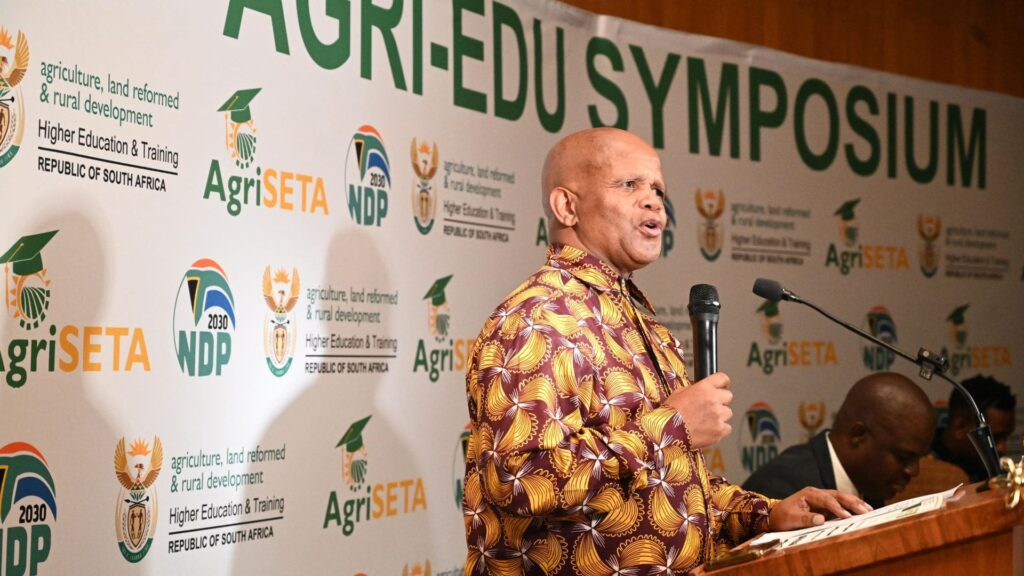
Zukile Mvalo, deputy director-general of the department of higher education and training, outlined a compelling vision for transforming agricultural education to drive economic recovery and sustainability.
“The topic is not only about addressing the educational needs of today. It is also about preparing these institutions for the challenges and demands of tomorrow. The role of our agricultural institutions is absolutely vital and critical,”
“I know when we left, we created more than 800,000 jobs within the agricultural sector. In fact, if you compare 2021 and 2022, the increase was about 3.9%,” he said.
This growth, Mvalo explained, is essential for sustainable economic development and improving livelihoods in local communities
READ NEXT: Supporting small-scale farmers key to Zim’s agricultural future
Sign up for Mzansi Today: Your daily take on the news and happenings from the agriculture value chain.