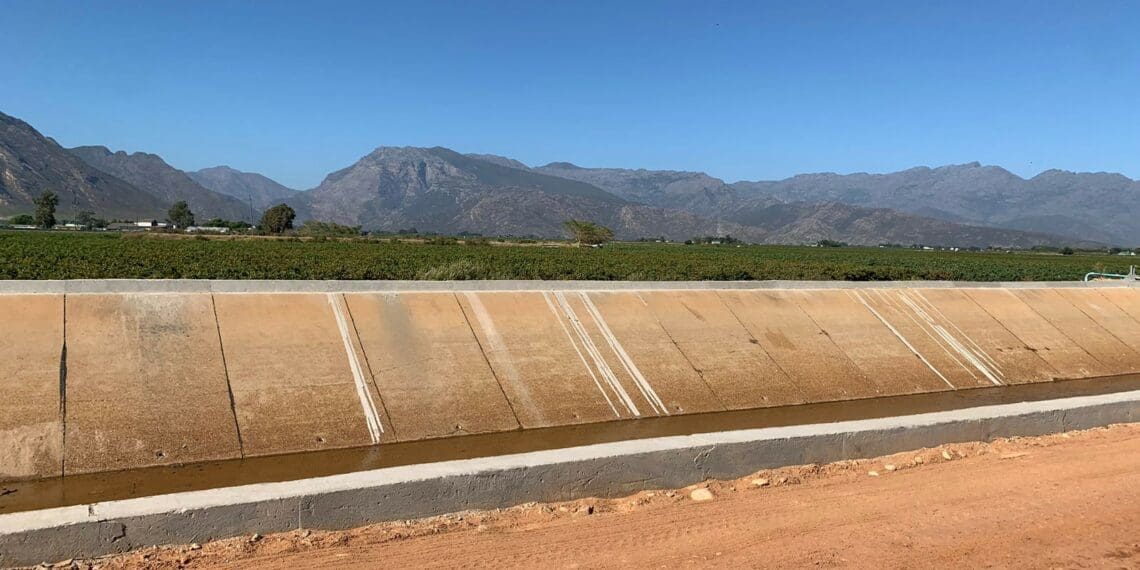
The recently completed Brandvlei Dam infrastructure project in Worcester, Western Cape is a crucial part of the wine industry’s vision for inclusive vineyard production.
Apart from the expanded irrigation scheme being an opportunity for inclusive growth in the wine industry, its completion in February this year addresses much-needed water allocation, job creation, and socio-economic development within one of the industry’s largest wine-growing regions.
“The project experienced some headwinds due to various reasons,” said Paiter Botha, compliance and special projects manager at Vinpro.
High-priority, high-impact initiative
“Vinpro, through our representation on the horticulture workstream of the Agriculture and Agro-Processing Master Plan (AAMP), ensured in 2020/21 that this project was positioned as a high priority, high impact project.”
Vinpro, the representative body of the South African wine industry, was invited to form part of an Inter-Governmental Steering Committee represented by 17 government departments and relevant industry stakeholders.
The committee was established in 2015 and chaired by the Western Cape department of agriculture (WCDoA).
“The high priority of this project to the Vinpro board is also clear from the fact that a dedicated Vinpro board task team was established to help drive the process from a transformation perspective, and the positioning of this project through the resources workstream of the wine industry value chain roundtable (WIVCRT) chaired by Vinpro,” said Botha.
Challenges faced
First identified in 2008, the improvements in the catchment infrastructure for the Brandvlei Dam project came to fruition when a call was heeded for a series of applications to contend for infrastructure finance from the government.
The catchment management authorities recognised that the Brandvlei Dam was an off-channel dam and water was diverted from the Smalblaar River into the Holsloot River. From the Holsloot River, a feeder canal had been built between the weir and the wall of the Brandvlei Dam, but this feeder canal could only fill the dam to 73% of capacity.
Increasing the canal wall by 30cm over a 4km stretch meant 33 million cubic meters – a 15% increase in water capacity. They, therefore, are motivated the heightening the feeder canal as part of the government’s strategic infrastructure programme.
According to the Wine Industry Strategic Exercise in 2014, 4 000 ha of additional water could be generated by the Brandvlei Dam scheme with infrastructure changes. This would form a crucial part of the wine industry’s vision for inclusive vineyard production.
Collaboration is key
According to Botha, they are proud and thankful to be part of the initiative.
“Raising the canal wall at the Brandvlei Dam is fantastic news for the wine and other agricultural subsectors.
“We would like to thank the Western Cape department of agriculture, notably Dr Dirk Troskie, chairperson of the Inter-Governmental Steering Committee that drove the budget of R21 million and created additional irrigation for 4 400 ha.”
Botha said the construction phase also created 32 local jobs. The national minister of water and sanitation, Senzo Mchunu, his acting DG, Dr Sean Phillips, and the team from Construction South also played key roles.
In the meantime, a phase that focuses on applying for and evaluating water licenses has been launched. The second call for water applications has been published by the Breede Gouritz Catchment Management Agency and will be effective until 30 June 2023.
ALSO READ: Water rights: Here’s what farmers should know
Sign up for Mzansi Today: Your daily take on the news and happenings from the agriculture value chain.