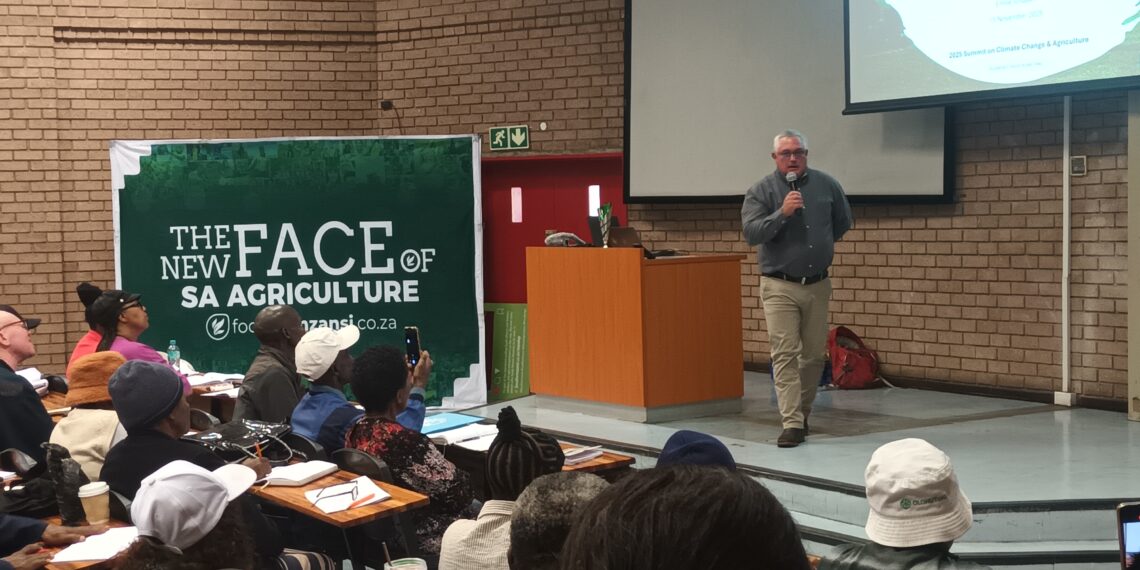
Small-scale farmers are central to South Africa’s climate resilience and food security future. This was the core message at the recent Climate Change and Agriculture Summit, hosted recently by Food For Mzansi at the University of Johannesburg’s (UJ) Soweto campus.
Emile Jordaan, general manager at Metos SA, painted a sobering picture of climate change, noting that extreme weather events are increasingly dominating global news from an agricultural perspective.
Jordaan emphasised that farmers cannot change their location or the basic soil composition where they farm. However, farmers can make strategic choices to optimise their production.
“Choose the crops, the varieties that are best adapted for where you live and what you have available. If you are in the privileged position to have access to irrigation, choose the right irrigation system for what you want to achieve,” Jordan said.
Echoing the call to select local crop varieties, Siphiwe Sithole, founder of African Marmalade, urged South Africans to reconnect with land, indigenous knowledge, and the crops that sustained earlier generations.
“I don’t teach people how to farm, I remind them. A lot of people know how to farm, but through displacement, they became disconnected from the land.”
Seed varieties and climate-smart crops
A key challenge, Sithole argued, is how South Africans manage their living spaces. She warned that rising food prices will outpace many household budgets, making home production essential.
“We need to unpave our land, so that it becomes food secure. If we don’t do this, you are going to starve with your money in your pockets,” Sithole said.
Related stories
- Ernest shows how smarter grazing can fight climate change
- Leave no one behind: Climate justice must include social justice
- Climate change resilience: Practical strategies for farmers
Sithole lamented that South Africa is losing access to traditional seed varieties. Hybrid seeds, she cautioned, are creating a cycle of dependency for farmers, as these varieties are designed to perform for only a single season, forcing growers to return and purchase fresh seed each year.
He presented a list of priority indigenous crops that thrive under heat and low-water conditions, highlighting the African horn cucumber. Other climate-smart crops include amaranth, tepe, imbuya, marula, millet, and turmeric-rich morogo varieties.
Wheat under threat
Agricultural trade economist Buhlebemvelo Dube from the National Agricultural Marketing Council (NAMC) delivered one of the summit’s most sobering analyses, unpacking decades of wheat production and consumption data.
His analysis revealed an industry under increasing strain. Although wheat output has risen, the area planted has declined, leaving fewer farmers producing more, often under harsher conditions.
“Generally speaking, we are saying that although wheat output has expanded, cultivated areas have declined. This causes a growing vulnerability to climate and rainfall variability,” Dube noted.
With almost every South African household consuming wheat daily, local shortages have increased import dependence. Yet imports are increasingly constrained by geopolitical instability and climate shocks in major wheat-exporting regions.
“Meaning that we are eating more wheat, but there are no farmers who can meet the target of consumption. You can say this is a crisis for food security from a national perspective,” Dube said.
Related stories
- Goat and sheep farmers breed smarter to beat climate stress
- Climate extremes cripple Cape Town’s kasi farmers
- Small-scale farmers give up as climate crushes dreams
The plight of small-scale farmers
Meanwhile, Prof. Naudé Malan, an associate professor in business management at UJ, reflected on decades of attempts, which have been unsuccessful, to integrate small-scale farmers into formal value chains.
“There is enough for everyone if we play it well. Our children will be different; they need a system where small farmers are valued and food security is local and community-driven.”
He argued that small-scale farmers fail not because they lack skill, but because they are taught to replicate large-scale business models that require impossible volumes, high capital costs, and bulk purchasing advantages.
“Your partner is the ecosystem. It’s nature. This partner doesn’t rest. It has been working for billions of years; that is the only way you can beat the big groups,” Naude said.
Small-scale farmers are central to South Africa’s climate resilience and food-security future, argued Dr Ndeke Musee, founder and director of Beyond Genβeta Solutions (Pty) Ltd. He stressed that the country’s agricultural landscape, dominated by smallholders, is the backbone of South Africa’s ability to withstand climate shocks, restore biodiversity, and feed a rapidly growing population.
Musee reminded farmers of the scale of their responsibility. According to him, of South Africa’s 182 million hectares, 80% is under agricultural custodianship.
“That means about 80% of our land in our beautiful country called South Africa is actually under the custodianship of the farmers, who control the biodiversity, who grow what the soil is able to have,” he said.
Musee challenged both small and large-scale farmers to rethink their production systems, reduce environmental impacts, and embrace absolute (not relative) sustainability. Planetary boundaries, he explained, help farmers assess their environmental footprint across issues such as water use, biodiversity loss, nutrient runoff, and aerosols.


READ NEXT: Mastering poultry feed: Tips to maximise efficiency