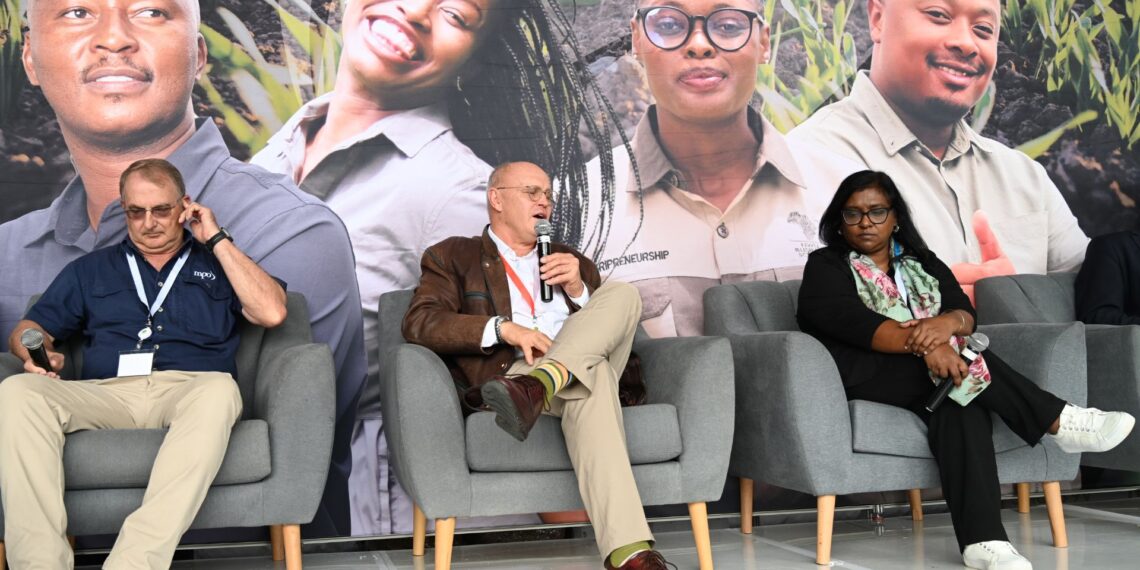
The future of new-era farmers and transformation took centre stage on the second day of the Food For Mzansi Young Farmers Indaba, where industry experts debated whether organised agriculture can truly bridge the gap for black farmers.
The challenge of uniting farmers in South Africa’s fragmented agricultural sector remains a pressing issue, noted Leona Archary, CEO of the Agricultural Development Agency (Agda). She emphasised that the conversation must go beyond land access to include financing and industry cohesion.
Land access remains a crucial concern, but Archary challenges conventional perspectives on land allocation. She calls for innovative approaches in collaboration with the government, given that a significant portion of agricultural land is held in trust by the state.
“I really think that the conversation and the work with government really needs to become a lot more innovative in how that land is being allocated. But again, it’s about working together with leadership.
“Government has a role to play because a lot of that land is held in trust by government. How that land is allocated and able to be used by someone who wants to be a farmer. Because that becomes the other big problem if you don’t have a title deed,” Archary said.
Related stories
- Agriculture bigwigs throw their weight behind youth development
- Funding, policy, innovation: Keys to future farming success
- Ramokgopa: Young farmers, rise and take your space in agriculture
Farmers, it has to start with you
Johann Kotzé, the CEO of AgriSA, emphasised that for transformation in agriculture to happen, it must start with the farmers themselves, and farmers should not rely government to make transformation happen.
“That first step is to deal with the land. This is where you need to start. More land. But also it needs to start with you; waiting on government will not take us anywhere if we need to deal with transformation,” he said.
Dr Tobias Doyer, CEO of Grain SA, stressed the importance of strategic expansion, technology adoption, and fertiliser optimisation as key drivers for the future of grain production in South Africa. According to Doyer, securing more land is at the heart of agricultural growth.
“The first step in ensuring a sustainable agricultural future is addressing land availability. Farmers need to understand how to expand their crops effectively,” he said.
According to Fanie Ferreira, CEO of the Milk Producers’ Organisation (MPO), the South African dairy industry is small but highly competitive, producing approximately 15 million litres of milk per day. Despite its size, the industry faces several challenges, from production costs to market accessibility and sustainability concerns.
He added that the industry’s scale, while significant, is impacted by various external pressures, including the rising costs of feed and production. One of the main challenges, according to Ferreira, is that not all cows produce milk at the same rate.

Ferreira stressed the importance of knowledge and experience in dairy farming, indicating that those not from a farming background may struggle to enter and succeed in the industry. “If you’re not born into a family that is successful, it’s gonna be tough,” Ferreira said.
“Firstly, you can’t farm dairy effectively without land. You need effective access to good land. You need to be in the right place,” Ferreira noted.
Bridging the gap with technology
Speaking on the role of technology in agriculture, Karidas Tshintsholo, co-founder and CEO of Khula!, highlighted key barriers that hinder emerging farmers and the need for systematic change.
Tshintsholo pointed out the disparity between established and new-era farmers in South Africa, describing it as a “two agricultures” scenario.
He said technology could provide solutions to these challenges by offering alternative ways of assessing financial viability and granting access to funding.
“If a farmer gets access to our trading platform, if they get approved and they meet the necessary standards, then you automatically sell to a multiple range of buyers. So you can sell to PepsiCo, you can sell to Tiger Brands, you can sell to Food Lovers, you can sell to many customers, without necessarily needing to go meet those people and go to close each individual deal,” he explained.
Tshintsholo also highlighted Khula!’s upcoming suite of impressive AI-powered innovations, positioning them as game-changers for emerging farmers navigating an often unforgiving agricultural landscape.
From early-stage pest detection that allows for swift intervention, to precision-engineered spray programmes and instant access to technical guidance, these tools are crafted to address real-world pain points on the farm.
More than just boosting yields, the technology aims to optimise resource use, reduce costly inefficiencies, and ultimately level the playing field – equipping new-era farmers with the kind of data-driven decision-making power typically reserved for large commercial operations.
READ NEXT: MEC Rockman: ‘No more failed government-funded farms’
Sign up for Mzansi Today: Your daily take on the news and happenings from the agriculture value chain.