Feathers are flying in the chicken industry with importers and local producers crossing swords over issues of pricing, consumer interests, employment and empowerment.
FairPlay sides unashamedly and wholeheartedly with South African workers, farmers and business people in this argument, simply because the benefits of local production that is part of a substantial value chain is so obvious. And also because the stories of people like Adolphina Mojatau show what true empowerment is.
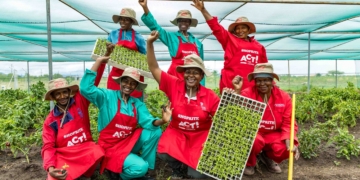
Mojatau is one of four internal trainers at the Grain Field Chickens abattoir and processing plant in Reitz in the eastern Free State. She is also one of almost a thousand women from this small rural community who are employed at the plant. Many of the employees, men and women alike, had been unemployed until six years ago when the Grain Field operation opened its doors.
An industrial plant with a largely female workforce is unexpected, says managing director of Grain Field Chickens, Theo van Strijp, but women are the best staffing option for a plant of this nature. “Women pay great attention to detail and can concentrate to perform repetitive tasks for long periods of time,” he explains. “In an environment governed by stringent quality and food safety standards, these are sought-after qualities in employees.”
According to statistics provided by the AgriSETA, the chicken industry as a whole employs more men (57%) than women (43%).

However, in processing plants, which are typically located in rural areas close to the farms where the chickens are raised, the picture is different. Here, women constitute around 73% of the workforce, according to figures supplied by Grain Field Chickens.
Women and young people are routinely placed at the top of South Africa’s employment need hierarchy. Ironically, and tragically, the one industry that has the potential to absorb thousands of people is under immense threat from dumping. Dumping is the predatory intent to capture a domestic market with the aim of securing pricing power and market domination. What producers in Brazil and the European Union are doing to South Africa’s chicken market has all the hallmarks of dumping.
The South African Poultry Association (SAPA) calculates that for every 100 000 tons of chicken that we produce instead of import, we can create 10 000 local jobs. (Crucially, it is estimated that each person employed in the chicken sector supports as many as 10 others.) Currently, around 300 000 tons of frozen chicken portions are dumped here every month. It follows that if dumping (not all imports) is stopped, up to 30 000 jobs could be created as the local industry expands to supply the demand.
Most of these jobs will be in rural areas – chicken farming and processing are not urban activities. And, as the statistics show, the recruits will be mainly women.
While many of the jobs in a processing plant are not for the highly skilled, it is an environment that offers professional advancement opportunities, as Mojatau and her colleague Lizzie Makichini have proven.
Makichini is the processing production manager at the abattoir in Reitz. With around 600 people reporting to her, she is responsible for the functioning of a plant that processes 850 000 chickens per week.
Makichini started at Grain Field four years ago as a poultry meat inspector. “I wanted to advance and they realised the potential in me and gave me the opportunity to study,” she says. Further studies through the University of the Free State underpinned the experience she was gaining in different positions in the plant, and in 2018 Lizzie joined the managerial ranks.
Currently busy with a qualification in food chain supply management, also through the university, she has her sights set on further advancement in an industry she is passionate about. “We serve the world. People can afford to have food on their plates because of us. That’s why I love the chicken business.”
Mojatau followed a similar path, having started at Grain Field Chickens as a quality supervisor and being promoted through the ranks to coordinator of the internal training team. “Since starting here I got a pile of certificates,” she says, singling out the national certificate in poultry management that she received from the University of the Free State as her crowning achievement to date.
According to statistics provided by the AgriSETA, the chicken industry as a whole employs more men (57%) than women (43%).
But professional and intellectual assets are not the only ones Mojatau is building. While she rents a home in Reitz for her and her two boys, she has bought a house in Bloemfontein and, recently, her dream car. Little wonder then that she refers to herself as an “independent woman”.
With 27.5% of South Africans who should be economically active currently unemployed, government’s priority should be to work with and support industries that can help alleviate the situation. The chicken industry, in partnership with government initiatives, has the potential to create sustainable jobs, attract investment and bring hope to communities that most need it. Mojatau and Makichini should not be the exceptions; such stories of advancement and empowerment can be the rule.