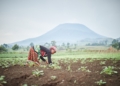
Sanelisiwe Felicia Zulu had no intention of becoming a farmer but due to a series of unfortunate events, she was compelled to enter the agricultural industry. Now, in Umvoti village in Upper Tongaat, KwaZulu-Natal, she cultivates one hectare of vegetables on church property, including spinach, potatoes, cabbage, and beans.
After earning her high school certificate, Zulu enrolled at Coastal TVET College to study electrical engineering. This is what she always dreamed of as a child. It was exciting and heart-warming to be able to do it, but she has had trouble getting in-service training since 2019.
“I got married in 2019, but it didn’t work out. The circumstances forced me to return home in 2021. I became the laughing stock in my society since it is still common in certain areas to be mocked if your marriage fails,” she says.
While feeling miserable at home, Zulu contemplated how to earn money. Food cultivation came to mind. She began in the family garden, where her mother Phetheni Gladys Khumalo grew food for the family’s livelihood.
“Since my mother used to cultivate crops, I acquired the fundamentals of farming at a very early age.”
They began with what they had on hand, which included spinach, cabbage, lettuce, and potato seeds. They were exquisite, but water shortage issues proved unmanageable.

Learning to dance in the rain
“I had to think outside the box. I ploughed food, which yielded excellent results, but I was challenged by water scarcity,” Zulu recalls.
“I went directly to my church, the Roman Catholic Church (Corpus Christi Mission), to seek their property for my crops since they had water pipes. When Father David Sthole granted my request, I felt as if a weight had been lifted off my shoulders.”

She tells Food for Mzansi that the beans multiplied among her other crops during harvest. She quickly advertised on social media, targeting church members, local teachers, and neighbouring communities.
“Everything I sowed turned out to be a huge success, and that’s what kept me going.”
Zulu utilises umgquba farmyard dung to nourish the land. Compost encourages the daily synthesis of necessary bacteria and fungi.
“Humanure contributes to the formation of soil aggregates. The presence of organic matter and organic and mineral components stabilises the soil and promotes the growth of food plants,” Zulu explains.
Market reach and networking
Her primary market is social media-based. She recalls that when she first began cultivating red kidney beans, she promoted them on social media. Instantaneously, they sold very quickly.
“I am learning from many people and different platforms, just like I do with my marketing. I have met people who have played a crucial role in my evolution into the farmer I am today.”
She praises her primary school teacher Dr QO Khuzwayo, a retired teacher from Hlalakahle Primary School, for coming to her rescue and guiding her through the healing process. Along with her ward seven councillor Nomfundo Ntetha, who helped to get things done with the agricultural department in KZN, and the Ndwedwe municipality that provided her with fertilisers and seeds in times of need.

She says that some of her current expertise was imparted to her by Maphumulo-born farmer Mhlengi Ngcobo, who is empowering other farmers in disadvantaged areas by transferring skills to open field and hydroponic system farming.
“Mhlengi is one of the members of my agricultural circle for whom I will be always thankful; he is an inspiration. The fact that he provided free training demonstrates that if we, as Mzansi farmers, can make this fashionable, we can certainly make this nation bigger and better.”
Beyond the tunnel
Food is life, and seeing the greens and various colours in a garden of a more expansive area makes her joyful, adds Zulu. She expresses gratitude for the life lessons that have helped her to see life through the perspective of farming.
“With the maize I will be growing soonest, I want to try my hand at manufacturing mealie-meal. I am seeing my company grow into a larger supermarket and assisting with South Africa’s unemployment crisis.”
Zulu says people need to stir the coffee, because sometimes they may believe they need something that they just cannot afford, only to discover that they already have it. They simply need to keep stirring to bring out the richness of the coffee.
ALSO READ: EC farmer’s hemp business brims with solutions
Get Stories of Change: Inspirational stories from the people that feed Mzansi