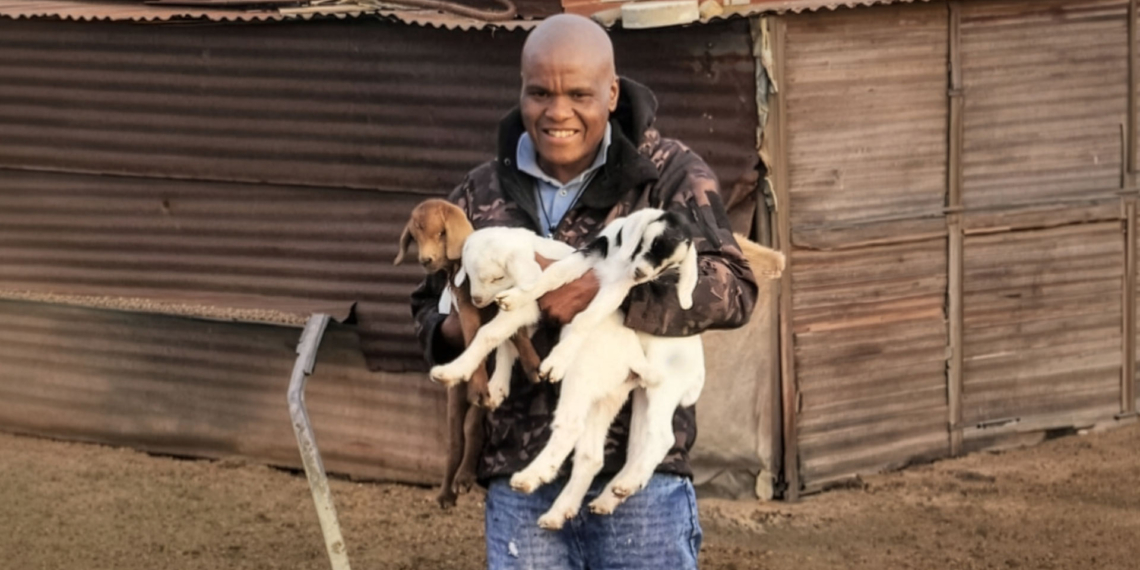
After two decades as a police officer and forensic facility manager, Siphumle Nangu walked away from a government salary to turn a backyard passion into a commercial livestock enterprise. It was a dream that started with financial freedom in mind.
Despite losing dozens of animals to a devastating aerial poisoning disaster in 2025, the founder of Nangu Resources Africa continues to scale his business through grit and self-funding.
Growing up in the village of Kambi in Mthatha, Eastern Cape, his parents, Vuyisile and the late Noncedile Nangu, were dedicated farmers who cultivated yellow maize for both home consumption and local sales.
Nangu’s early years were spent in the fields and gardens. “I always loved farming from the early stages of my growth,” he reflects. Working alongside his mother in her vegetable garden and herding the family cows provided him with a hands-on agricultural education long before he entered a classroom.
At a crossroads
While his time at Kambi Junior School included farming as part of the curriculum, the absence of agricultural subjects at Leslie Nkala High School forced him to focus on other areas like history. This left him at a crossroads after matric.
Related stories
- ‘Cayenne Chilli Lady’ brings the heat with 8.5ha farming success
- Simemo Nkosi grows family farm into diversified enterprise
- 100 ha of hope: Aphiwe revives family farming legacy in Engcobo
- Big dreams on his ‘Tiny Farm’: Setjhaba’s 300-hectare success
“After passing my matric, there was no career guidance. I was still young, and I did not know which career to follow. My father insisted I should go do my matric again to improve so that I can get an exemption and go to university. So I went back and passed my matric with exemption in 1996.”
However, instead of university, Nangu chose a different route and enrolled for business studies at a college in Mthatha. He graduated in 1999 at the age of 20, but with no capital to start a business, he had to find immediate work.
“I drove a taxi in Umtata from May 1999 to September 2000. That was my first job, apart from helping my mother in her vegetable garden,” he shares.
In October 2000, he joined the South African Police Service (SAPS), serving in Elliotdale, Qacha’s Nek Border Post, Maluti, and Humewood.
By 2006, he transitioned to the Mpumalanga department of health as a facility manager for forensic pathology services. He served in Delmas and later Middelburg until 2023, when political issues prompted his exit to focus on farming full-time.

Full-time farming
For Nangu, the journey into professional farming happened while he was still navigating the corporate world. “While I was working, I started farming for love, and I was also looking for financial freedom,” he explains.
Operating on communal land in Mpumalanga, on less than a hectare per family, Nangu has built his enterprise entirely from his own pocket. “From the beginning of my farming career, I have been using my own savings and out of my own pocket to fund the business. It is not easy at all,” he notes.
What started with a single cow grew into a herd of over 30. As the numbers grew, he began buying, feeding, and selling stock. With the operation gaining momentum, he formally registered his company, Nangu Resources Africa, in 2022. Following his exit from formal employment in 2023, he expanded further by adding goats and sheep to his portfolio.
Today, he employs four people and supplies livestock to auctions.
Overcoming disaster
His journey has been marked by significant hardship, particularly regarding land and resources. In May 2025, Nangu and his community suffered a devastating blow when a neighbouring farm used an aeroplane for pest control without informing them as required.
The poison leaked onto the communal grazing land. “As a community, we lost over 150 goats and six sheep,” Nangu recalls. “I personally lost 28 goats and six sheep. Out of 34 animals, 21 goats were heavily pregnant.”

Despite paying R18 000 for lab tests to confirm the poisoning, the community has received no assistance.
This disaster, combined with the 2025 foot-and-mouth disease outbreak, forced Nangu to reduce his stock to avoid total loss. While his cattle numbers currently fluctuate, his sheep and goat numbers are once again growing as he works to recover.
Despite the hurdles of limited funding and land constraints, Nangu views his persistence as his greatest milestone. “I take that as an achievement because we make things possible with nothing, and the government is failing to assist.”
He believes the future of agriculture relies on exposing children to food production early on, noting that for many, the business part of farming is hidden behind the daily chores of being a herd boy.
His advice to aspiring farmers is a reflection of his own grit: “Start small, as it is tough to start without funding. Try to create your own market where you’re going to sell your products, but be consistent and make sure you do not disappoint customers who rely on you.”
READ NEXT: State of disaster: Floods and storms push farming into crisis mode