The National Disaster Management Centre (NDMC) has officially declared a national state of disaster this week as erratic and intensified weather patterns wreak havoc across several provinces. Following orange-level alerts in the Western Cape that left devastation in its wake, the agricultural sector is shifting into survival mode, prioritising the safety of farmworkers and livestock over production.
The declaration follows days of relentless rainfall, damaging winds, and snowfall that have crippled infrastructure. This move is intended to unlock emergency funding and allow all spheres of government to coordinate a swift and decisive response to the crisis.
The intensified nature of climate change has turned predictable seasonal shifts into frequent threats to infrastructure and livelihoods. This is according to Nqabisa Gantsho, the portfolio committee chairperson, who warned that monitoring the weather is no longer enough.
“We are observing an increase in extreme storms and flooding that threaten both our people and the environment. We must actively prepare for its effects,” Gantsho said.
Related stories
- Farmers battle floods, snow and damaged infrastructure
- Good weather & more extension officers top farmers’ 2026 wishlist
- Shifting seasons ahead: Brace for more extreme weather
- China tariff cuts boost SA farm export hopes
Farming operations at a standstill
Highlighting the gravity of the situation on the Western Cape grounds, Rojeanne De Wet, media liaison officer for Agri Western Cape, told Food For Mzansi that while infrastructure damage is already visible, the full extent of the devastation remains unknown.
“At this stage, it is still too early to accurately determine the full extent of the impact on farming operations and agricultural yields. The rainfall is ongoing, which makes it difficult to properly quantify losses,” she said.
De Wet noted that the current focus is entirely on the safety of the people on the ground. “We are continuously warning and encouraging our members to take all necessary precautions, avoid unnecessary travel, and move animals to safer areas. A lot of people are also without power and signal due to Eskom problems.”
This sentiment was echoed by agripreneur Letitia Webber, who operates on a leased farm. Webber reported being forced to work from home due to severe weather conditions and a day-long power outage that disrupted normal operations.
Small-scale producers pick up the pieces
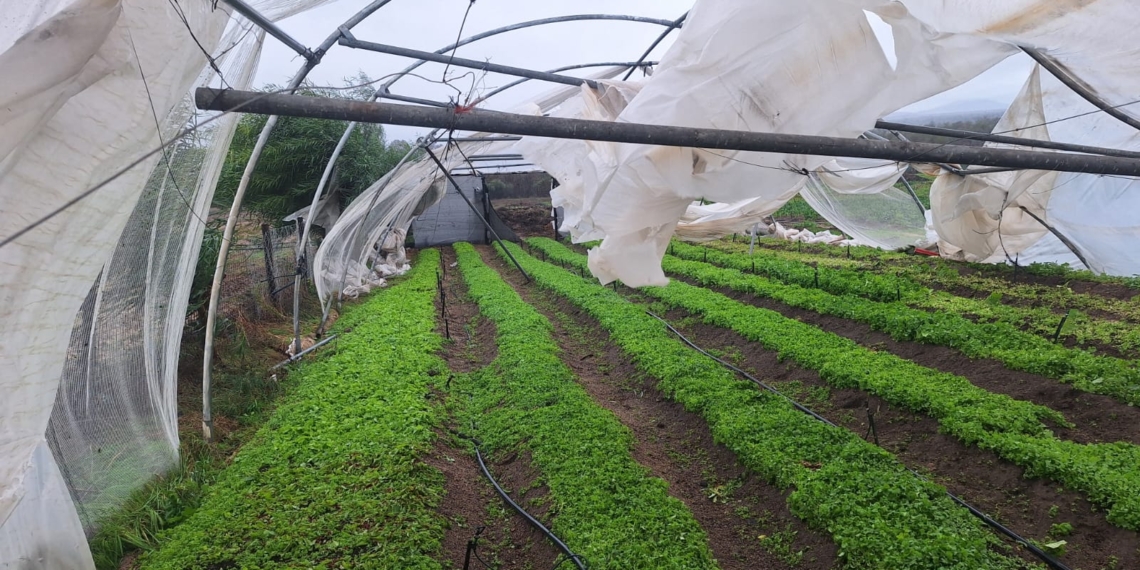
For smaller operations, the wind has proven just as destructive as the rain. Angelo Marman, co-founder of Abitz Farming in Riverlands near Malmesbury, reported significant damage after a tunnel was destroyed by the heavy storms yesterday.
Interestingly, Marman noted that his open-ground crops remained untouched, which he attributes to the natural layout of the land. “Maybe that’s probably due to the high level of the soil; the water is flowing through, but it’s staying in between the crops rather than flooding them,” he explained. However, with winter only beginning, Marman remains cautious about the months ahead.
In Khayelitsha, Thozama Sikiti, founder of Thuraniso Organic Garden, is also assessing the aftermath of the winds that swept through the Cape Flats. The pressure levelled the structured plots she uses to manage her farm’s sandy soil.
“The wind pressure was just too much,” Sikiti said. “We rely on those raised plots to manage the sand, but now they’ve been flattened.” Despite the structural damage, she noted that her open-ground crops fortunately escaped the worst of the storm.
Wine industry begins formal assessments
In the vineyards, the mood remains tense as the industry assesses damage to vines and agricultural infrastructure. Wanda Augustyn, South Africa Wine communications and brand manager, confirmed that the Western Cape department of agriculture has already activated a formal storm damage assessment process for May 2026.
Farmers across the province are being urged to log their damages via PC or mobile devices as soon as conditions allow.
Meanwhile, the Cape Winelands District Municipality yesterday reported that the Breede River has overflowed, closing the Worcester–Rawsonville route; and farm dams and mountain catchments were under close monitoring. While the worst of the storm has passed, mop-up operations will begin once conditions improve.
According to the South African Weather Service (SAWS), after days of widespread heavy rain and disruptive weather across the western interior of the country, conditions are finally beginning to improve as skies gradually clear from west to east.
While isolated showers may still linger over the eastern parts, a noticeable easing in rainfall, cloud cover, and cold conditions is expected throughout Thursday and Friday.
READ NEXT: Farmers battle floods, snow and damaged infrastructure