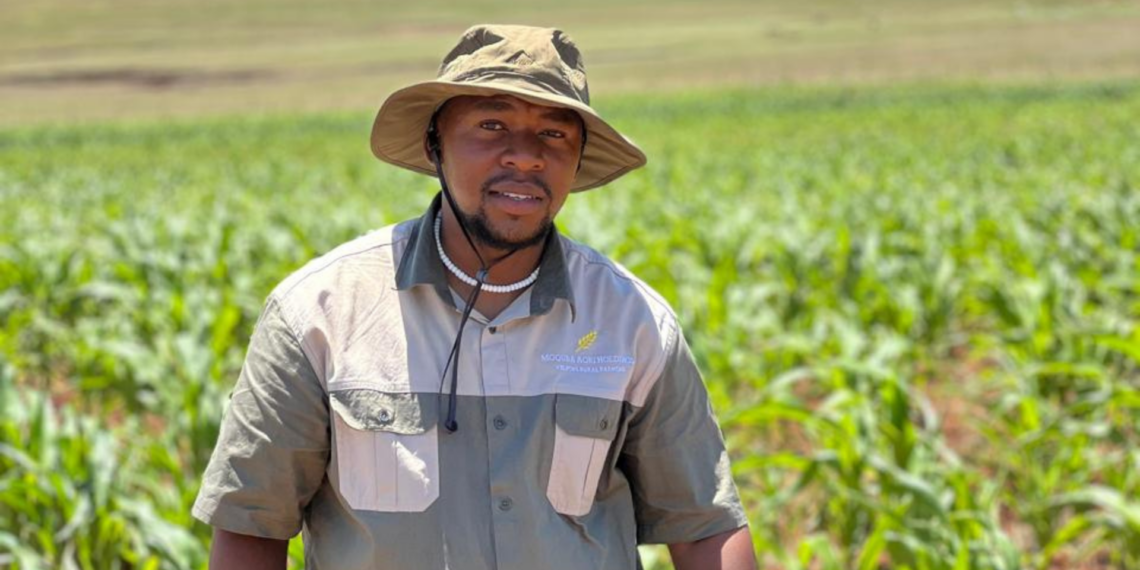
In the village of Mbilini in Engcobo, Eastern Cape, Aphiwe Poyo stands on a goldmine of ancestral land. While 100 hectares of rich history stretch out before him, a lack of resources means most of it remains untouched. But, where others might see a barrier, Poyo sees a beginning.
As the founder of Mgquba Agric, he is proving that even with just a fraction of his inheritance, a legacy can be reborn.
Poyo’s grandfather, Mabokoboko, and his ancestors long before him, were mixed farmers who survived off the land. They would sell their leftover produce to make a living, a practice that eventually funded the education of future generations.
Growing up, Poyo was surrounded by family gardens until grade 3, when he moved to Pietermaritzburg to continue his schooling at Prince Alfred Primary School, followed by Alexandra High School.
A return to the soil
After completing his schooling, he attended Pinetown College to study public management. Soon after, in 2021, he started a career in real estate by selling properties.
“It was something I really loved and always had an interest in; I wanted to have my own business within real estate in the future,” he recalls. However, this corporate ambition took an unexpected turn when the pandemic hit.
The passing of his grandfather due to Covid-19 brought Poyo back to the Eastern Cape to care for his grandmother, Nobandla, and to attend to his spiritual calling. Without his real estate job in the city, he looked at the idle family land and saw a solution to his new circumstances.
Related stories
- Big dreams on his ‘Tiny Farm’: Setjhaba’s 300-hectare success
- Jobless to boss: Sihle Petela grows jobs and crops in Mthatha
- Breaking new ground: Msibi trades marketing for mixed farming
- Eastern Cape scientist is breeding a better future for farmers
“I wanted to find something to do in order to make a living and change my community now that I was back home and no longer working,” he says.
“That is when the farming idea came to mind, after remembering what my ancestors and grandparents did to earn something even when they did not go to school. They managed to build their homes and had a living, which was simply by farming.”
Reviving the family legacy
Poyo set out to revive the dormant fields and continue a legacy that started way before his existence.
“What motivated me the most is knowing that land had a rich history,” he explains. “My ancestors and grandparents worked on that land and it produced graduates because from the leftover produce they used to sell, they were able to take us to school to become what we are today,” he says.
He used his savings from real estate and money from odd jobs around the community to fuel his operations. He began with just a half-hectare in his backyard, planting yellow maize and selling it to local community members, spaza shops, retailers, and other agripreneurs.

Scaling against the odds
In March 2025, he officially registered his business, Mgquba Agric. Operating without any outside funding, he paid for fencing and hired a tractor. His commitment drew the attention of a local NPO that assisted him with inputs for one hectare and technical inspections.
Today, Poyo has scaled to five hectares in total, three on the main ancestral land and two in his home garden. While the full ancestral land spans around 100 hectares, a lack of resources currently prevents him from using the full extent of it.
Despite this, he has already created seasonal employment for eight people and trained 40 people from a Tanager NPO project on land preparation, planting, dressing, and crop protection.

However, the journey from subsistence roots to commercial success is also marked by significant challenges. Without his own machinery, Poyo must hire tractors that often delay his planting schedule. A lack of irrigation and secure fencing remains a barrier to utilising the full 100 hectares, especially during seasons with difficult rainfall.
To mitigate this, he uses the skills he gained in real estate, like learning how to tailor information for different clients, to manage his new farming customers, all while constantly saving to mitigate his resource shortages.
A vision for the future
Poyo says his goal is to eventually see all 100 hectares in production. “I would love to go into a bigger scale of farming. I would love to employ more people so that they can work, and I also want to have machinery to plant and sell more things on the farm.”
For those hesitant to start, his advice is, “Start! Do not have fear; believe in yourself and let it be a dream that is going to live beyond and surpass all expectations. Even though it won’t be easy, as long as you know what you want, do not stop.”
READ NEXT: Fuel price shock deepens strain on agriculture sector