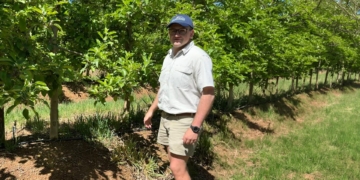
In the rolling hills of Ermelo, Mpumalanga, Simemo Nkosi is transforming a family legacy into a diversified agricultural powerhouse. As the manager of Umbambiswano Phambili, Nkosi has moved beyond the role of a traditional farmer, viewing his work as a vital service to his community and the country.
Nkosi’s connection to the land began at the age of 12, rooted in the modest beginnings of his father, Themba Nkosi. At the time, the family operated on communal land with a small, self-funded herd of just 15 cattle.
Even as a young boy, attending Peter Mabuza Primary and later Bashele Secondary, Nkosi was a fixture at his father’s side, spending his afternoons and weekends assisting with the livestock.
Around 2008, after a long application process, the family finally secured their 650-hectare farm from the department of land reform and rural development under a lease agreement with an offer to purchase.
Nkosi remained deeply involved. While he was finishing high school at Thafa Comprehensive School, focusing on commercial subjects, he spent every spare moment away from his books helping his family establish their new foothold on the land.
From the classroom to the kraal
His academic journey eventually took him to the Tshwane University of Technology (TUT) to pursue a diploma in accounting, but the distance only strengthened his resolve.
“In the small chances I got, I was always at the farm,” he recalls.
In 2020, upon completing his studies, Nkosi made the bold decision to bypass a traditional accounting career. Instead, he returned to the family business, taking over the full-time management of Umbambiswano Phambili.

“I did not look for a job after school; I went back straight to the farm,” he says. “My direction was that when I came back from school, the farm would be operational. I would deal with the finances of the family business, and I would open my accounting company on the other side,” Nkosi explains.
Related stories
- Books and broilers: Student builds poultry dream from scratch
- 100 ha of hope: Aphiwe revives family farming legacy in Engcobo
- Big dreams on his ‘Tiny Farm’: Setjhaba’s 300-hectare success
- Jobless to boss: Sihle Petela grows jobs and crops in Mthatha
“I didn’t know that the love of farming was within me, and also that I had to be hands-on when I came back. I am running the family business and preparing the finances. The one thing that is not there is the accounting company. I am very much happy that my life took this direction because, at the end of the day, God said His ways are higher than mine.”
In 2020, Nkosi became the full-time manager and was appointed as one of the company’s four directors, joining his father, Themba, his mother, Thuli Twala, and his grandmother, Nana Mndebele. He began applying his commercial knowledge to professionalise the operation.
Modernising the 650-hectare estate
When Nkosi took the lead, he saw untapped potential in the land. For years, the family had focused strictly on cattle and goats while the arable land was leased out.
Leveraging his accounting background, he persuaded the family to stop leasing and start investing in their own grain production, personally spearheading the planting of 30 hectares of maize in 2022.
Under his guidance, the operation has flourished into a diversified enterprise boasting 100 hectares of maize and soya beans, more than 100 cattle, a broiler unit, and a small holding of sheep and goats.
This led to the farm receiving land development support (LDS) from the department of rural development and land reform. The farm was provided with cattle, a tractor, and farmhouses, which helped Nkosi manage a team of one permanent and four part-time workers.

Their produce now has a steady market, with cattle sold at auctions and grains delivered to Afgri.
For Nkosi, the transition from accounting to agriculture was his most significant milestone.
“My greatest achievement is the moment I came back from university. I brought change to the farm and assisted with understanding the new ways of running it,” he says.
Leading and feeding a nation
Nkosi’s influence and leadership now extend far beyond his own farm gates. His dedication has seen him elected as the youth chairperson in Mpumalanga and the youth grain chairperson for the African Farmers Association of South Africa (Afasa) NEC.
Since last year, he has served as a resource mobiliser for the World Food Forum Youth Chapter, with his responsibilities expanding across various leadership positions this year.
However, Nkosi still grapples with the practical hurdles of a growing commercial enterprise. He currently has 30 hectares of land left unplanted due to a lack of sufficient farm equipment – resources he needs to eventually supply major players and break into the export market.
To those looking to start, Nkosi emphasises that the scale of the land matters less than the heart of the farmer. “Farming doesn’t need you to have big land or many livestock; just start with what you can, with what you have,” he advises.
He believes the true value of his work lies in the service it provides. “Farming is a responsibility. The moment you start, you are responsible for the food that people consume.
“The next generation should know that they have inherited a responsibility, not just a business. Farming is a shortcut to serve one’s community, province, and country.”
READ NEXT: SA’s apple industry marks 364 years with rare tree planting