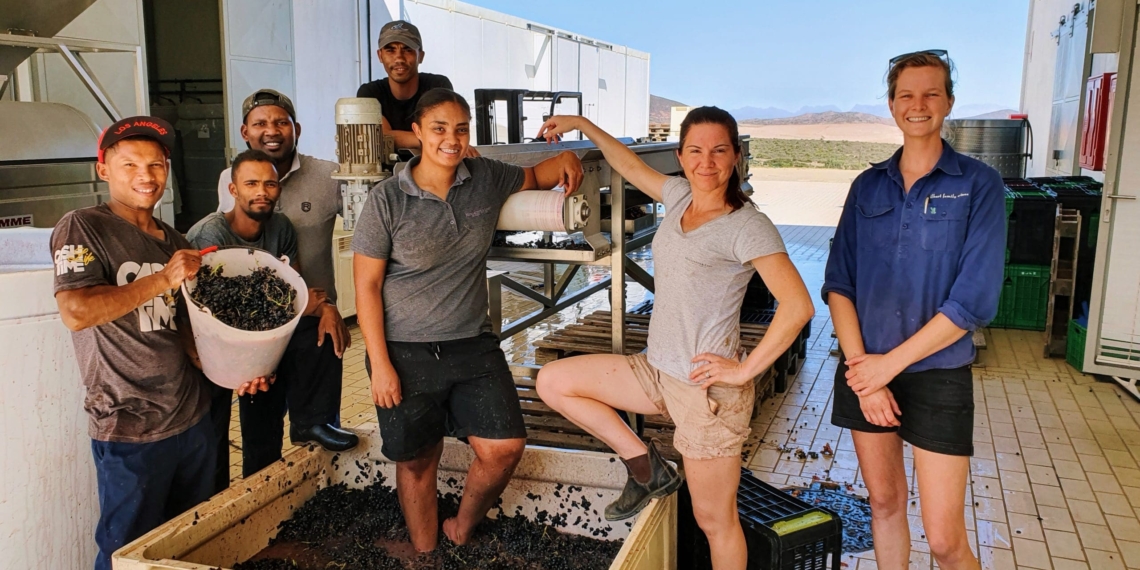
 Among the casualties of the covid-19 alcohol sales ban are the faceless farm workers. For many years – long before the pandemic hit – they already earned some of the lowest salaries in South Africa. Now they speak out in this interview with Food For Mzansi journalist Sinesipho Tom.
It is day 126 of the lockdown brought about by the novel coronavirus. Its rapid spread capsized our economy and effectuated a blood bath of job losses nationwide. Among the victims count the thousands of farm workers, who have been hit by government’s decision to ban alcohol sales in an attempt to curb the covid-19 spread.
As it stands, this is a battle without end. Within the next few days, South Africa will reach half a million infections. The country is already in the global top 10 for covid-19 infections.

An average farm worker earns R5 655 per month, according to Statistics South Africa. That is also approximately how much the 32-year-old Johan Waterboer from Riebeeck Kasteel in the Western Cape takes home before taxes.
For the last decade, Waterboer has been working on the Mullineux family winery, 60km north of Cape Town. He started working on the farm at the age of 22 – a stable job that has given him a head start in a country where the official unemployment rate now stands at 30,1%.
He tells Food For Mzansi that he is the sole breadwinner of a family of five. Also, he is recently engaged; a family man who, unlike the general trend, is committed to providing for his children in the best way possible. This is rare, though. According to a general household survey by Stats SA, nearly 62% of children under the age of 18 live without their fathers.
Waterboer’s boss, Chris Mullineux, the founder and winemaker of Mullineux & Leeu, says since the initial alcohol sales ban, he has had to make some retrenchments as some staff for instance in their tasting room couldn’t come to work and “everyone in the company took salary cuts”.
READ MORE: ‘World’s best restaurant’ begs Ramaphosa to allow wine sales
Things were looking up until the booze ban enforced by government – the only country in the world where alcohol sales are forbidden as part of the covid-19 regulations. Vinpro says the wine industry had suffered a loss of revenue of R4.5 billion over the past 14 weeks. Scores of people have already been laid off, and a further estimated 18 000 could soon be without a job.
“My children are still all in school and I have to take care of their basic needs, SUCH AS FOOD, ELECTRICITY, WATER, TOILETRIES AND CLOTHES. A lot has changed, and I am barely surviving.” – JOHAN WATERBOER
If only he could speak to government, Waterboer says. Maybe they would listen if he personally told them of the brutal impact of their decisions on his life and livelihood. “If I could speak to the government, I would ask the government to allow the businesses to open, but under stricter rules. Many people are suffering now that businesses are closed.”

Waterboer sees the casualties all around him. He says the alcohol sales ban has resulted in many surrounding businesses such as restaurants and wineries to close shop. “If we are not allowed to sell alcohol in South Africa it affects our company, our bosses and us, the workers.”

His colleague, Gynore Fredericks, has also been left disillusioned by the booze sales ban.She started working at Mulleneux as an intern in December 2018. She excelled, and after merely a year she became a permanent employee in a senior position.
Fredericks tells Food For Mzansi, “We are really going through a really tough time and I’m terrified. I can’t tell you what is going to happen to the wine industry. I’m in a managerial position, so my salary has been cut by 20%. It has been tough, but luckily it’s just me, so I’m not providing for a family or anything.”
Despite this, absorbing the shocks of a sudden salary cut has been extremely difficult because she has her own responsibilities to tend to. The uncertainty of her future is terrifying. “We actually retrenched a few people – a part of my team as well. It is stressful because nobody knows what is going on. Nobody knows if it is going to get better soon.”
Impact to be felt for years to come
In a heartfelt message she pleads with government not to punish the majority of its citizens for the wrong doings of a minority whose alcohol abuse is straining the healthcare system. Throughout the country, hospitals have seen a significant spike in trauma cases linked to booze abuse since government initially lifted a ban on alcohol sales on 1 June 2020.
“The people are losing their jobs. There’s no way around it. They are shutting the whole (wine) industry down for a few people that can’t behave. That’s how I see it. A few people are responsible and now there are thousands and thousands of people losing their jobs; (people) who can’t provide for their families because of what 5% of the population does. It’s horrible,” says Fredericks.
Mullineux says he is grateful that until now none of his employees have tested positive for covid-19. However, the reality is that based on the lockdown economic turmoil, he and his staff will most probably receive a reduced income until the situation returns back to normal.
“We were obviously not allowed to finish the harvest since the first alcohol sales ban, and we were also prohibited from selling any wine locally. So, that was challenging since we are winery that do not have any other income. Luckily, or thankfully, exports were allowed after a few weeks and we were able to export some wine.”
READ MORE: ‘Government treats us like kids,’ says top chef
Mullineux adds that in his operation wine exports only count for 50% of the normal income. It is not a given, though, because the entire world is experiencing economic difficulties due to the pandemic, and therefore people are spending less. “So, not being able to sell to the local market has been a massive challenge for everybody.”
At one stage, it looked like they could reverse salary cuts and they even tried to reshuffle their workers into different departments in an attempt to save their jobs, but then the second phase of the lockdown hit – bringing their plans to a grinding halt. “We had those in the company in a position where they were not able to work and everyone in the company has taken salary cuts. The future of our industry does not look promising due to the economic pressures of covid-19 and our government making it worse.”
Trade unions back wine industry
Meanwhile, trade unions have also reached out to Food For Mzansi to also share their concern about pending job losses in the wine industry.

Dominique Martin, media liaison of the Food and Allied Workers’ Union (FAWU) representing more than 22 000 members, including workers in the agriculture, wine and hospitality industries, says they want to have discussions with the minister of trade, industry and competition, Ebrahim Patel. They want to understand why government is not considering the workers that are affected by the alcohol sales ban.
Martin says, “We don’t understand why the government is sitting down with the education unions and transport unions, but agricultural unions are being side-lined at the moment. We have some issues with the alcohol sales ban. So many companies are busy with retrenchments and the agricultural sector is the backbone of our economy. We don’t understand why government is side-lining the sector.”
“They are shutting the whole (wine) industry down BECAUSE OF a few people that can’t behave.” – GYNORE FREDERICKS
They are calling on government to lift the alcohol sales ban in an attempt to save the jobs of workers who were vulnerable, even long before the covid-19 lockdown. “We expect the president to put the agricultural sector in the economic recovery plan that is currently pending. We also condemn the police brutality in the (recent) peaceful protest that took place in Cape Town in support of the restaurant, hospitality and wine industries.”

Nosey Pieterse, president of the Black Association of the Wine and Spirits Industry (BAWSI) and chief negotiator for the Rural Agriculture and Allied Workers Union (RAAWU), says they are limited in their attempts to fight government because they do not have deep pockets.
“Our actions in this is reactive. To a large extent, what happens is that farm workers get dismissed or retrenched during this time and often due process is not followed and then we take their case to the Commission for Conciliation, Mediation and Arbitration (CCMA) and fight their case.”
Job losses in the wine industry also has further implications for workers who, until now, were living on farms, often in free or heavily subsidised accommodation paid for by farmers.
Major delays with TERS payouts
Pieterse adds, “Obviously, what also happens after they have been dismissed or retrenched, they are then served with a notice (of eviction) and that’s why we take this case to the CCMA immediately. They cannot evict you if your case is pending at the CCMA or the labour court.”
He calls on wine farmers to not retrench their workers, but instead approach government for assistance. “Government provided the Temporary Employee/Employer Relief Scheme (TERS). They should apply for that assistance and keep their workers.”
Last week, government announced that it was extending TERS until the middle of August 2020. However, a survey among the 10 000 members of the National Employers Association of South Africa (NEASA) showed that 88% of companies still haven’t received TERS payments for June, and of the companies which did get money, only 68% were paid in full.
READ MORE: ‘Government should value wine industry more’