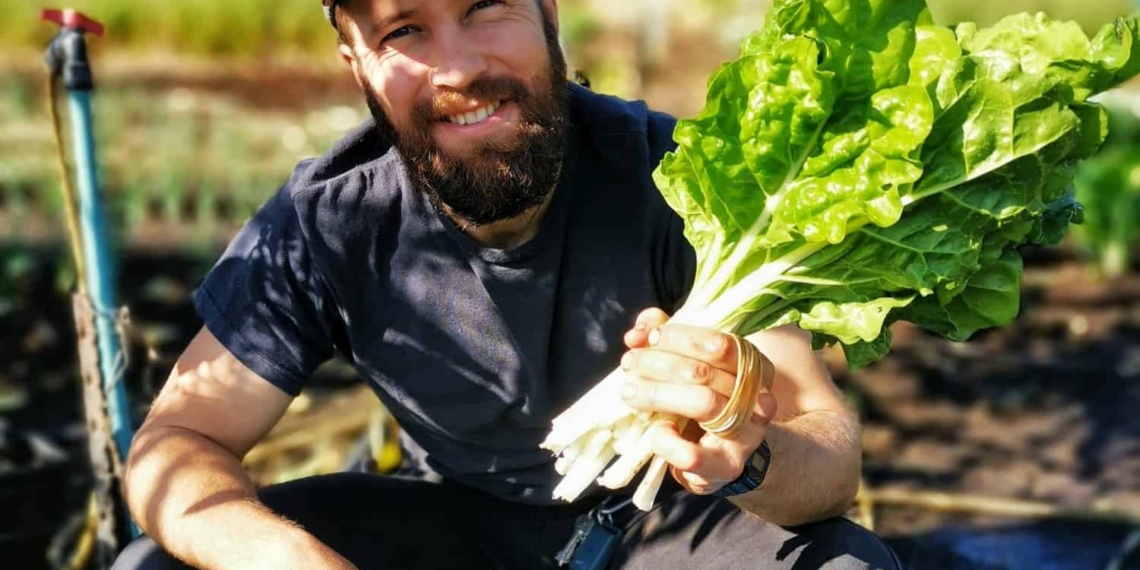
 As a budding scientist, a young Morgan Brand could never imagine that one day he would end up back on his father’s farm as, well, the farmer. His father, John, was a scientist himself, and Canaan, the family farm, has never been more than a place he’d visit over the school holidays.
Brand grew up in Adelaide in the Eastern Cape – almost a thousand kilometre drive to the farm in the KwaZulu-Natal countryside. Canaan in Alfred County near the breath-taking Mpenjati river – originally belonged to his paternal grandfather, a structural engineer, who bought it in 1936. It was in this year that John was born and, sadly, Frank, Brand’s grandfather, passed away too.
“My dad (who is a biochemist by profession) farmed as a hobby. I have been involved in the property my whole life, but I never thought I’d be a farmer. In fact, I was on track to be a post-doctoral researcher in a microbiology lab somewhere until the soil (on Canaan) interested me,” Brand recalls.
If it weren’t for the fact that Brand needed a quiet space where he could write up his doctoral thesis on aquaculture, he probably would never have ended up on the promised land. “In 2016, after I had completed by laboratory work for my PhD, I needed to get out of Cape Town to start writing my PhD up. I decided to go and spend that time on my dad’s family farm.”
Initially, he thought that it would be interesting to do a bit of farming to clear his mind while completing his studies, but he had no idea that it would engulf him. “I came to appreciate the complexity of the soil and realised that the microbial system held so many mysteries that people were unaware of. I am now in my fourth year on the farm and it has not been an easy journey, but I have grown and so has it.”
Brand’s father was an academic too, having lectured at the University of the Fort Hare for 28 years before retiring to the farm.
They say the apple doesn’t fall from the tree, and this has also been true for a five-year-old Brand who spend hours playing in the sand.
Unlike other children of his age, the future scientist was eager to learn more causing his mother, Kathleen, to take him out of primary school to instead teach him all about the natural elements from home.
“I remember the flashcards on my sisters’ doll house for the chemical formulas of water, carbon dioxide, and oxygen,” Brand recalls. Now, as a scientist himself, he says it’s specifically the mysteries of soil that attracts him to farming.

Studying science at Rhodes University in Makhanda (formerly Grahamastown) in the Eastern Cape introduced him to growing food in water and he figured that aquaculture “could be a solution to a global food crisis”. This was before Brand discovered his big love – soil. For him soil is the reason “we are here and has played significant roles in earth’s evolution”. He farmer and research says, “Farming is a very interesting science. The soil is the reason why I’m there.
However, he has always known that having a piece of land is not a matter of planting crops. According to Brand, as a farmer you need to understand your land’s potential and what goes into creating a healthy eco-system. This will help you to grow quality produce. Understanding the soil on which we grow our food is fundamental and today this is Brand’s focus area.
“What I’m particularly interested in is the soil health, soil ecosystems and soil food webs. (I’m) looking at improving that first before we start talking about yields and crops and potentials,” Brand adds.
He has always been optimistic, forward-thinking and drawn to science, but when Brand finished school in 2005, he was unsure of which career he wanted to take on. Instead, he decided to take a gap year and went to England where he worked in hospitality, construction, demolition and gardening.
Whilst abroad Brand applied at Rhodes. He was accepted and after living in England for a year he returned back to South Africa to begin with his studies. One of the subjects he took up was ichthyology (also known as “fish science”) that led him to discover aquaculture and all the possibilities that came with farming with water. He says, “I loved the idea of growing (food) in water and had thought it could be a solution to a global food crisis.”
In 2010, after completing an honours degree in ichthyology and fisheries science, Brand moved to Cape Town. His curiosity about how aquaculture can solve a global food crisis landed him at the University of Cape Town.
“I met an old seaweed biologist who had an interest in aquaculture, and so I started my master’s degree journey,” says Brand. He was eager to carve new territories and his aquaculture interest eventually led to a PhD.

So how did he go from aquaculture to his soil obsession? Well, he started farming with six hectares of bananas that have been planted on the farm about 20 years before he found his soil fascination. Brand discovered that this has been a great teacher for him thus far to test and work with the soil since the crop is old and not yielding the best produce. In 2019 he managed to also lease an additional 12 hectares of sugarcane from his father as well.
He says, “I’m in the process of developing a market garden for vegetable production. Each time I start to adjust the farm or expand into new area I aim to incorporate a regenerative approach to the farming systems, which creates topsoil and enhances biodiversity into the future.” Topsoil is the top layer of the soil that is filled with necessary supplements to help plants grow.
While his own father, John, has been a great source of inspiration, he found inspiration in other people too. When he first went to live on the farm, Brand started working under the wings of Besta Ntobela and her husband, Masheleni. The couple have been working on the family farm for many years and taught Brand everything he now knows about the banana fields.
“They knew the land intimately and without them I would not have been able to start this journey.”
Today, besides the father-and-son farmer duo, five other colleagues help with the banana, sugarcane and vegetable production. Brand says, “As an individual I am a soil steward and an educator, but as the collective we are farming. I am not a farmer and they are not my labourers. We are a team and we are learning together.”
To work in farming doesn’t necessarily mean you have to be a farmer though. Brand proves that there are many other agricultural careers besides farming, such as being a scientist and researcher.
Soil tips for fellow farmers
With his interest in soil, Brand’s aim is “to build topsoil while creating a healthy functional soil food web that has the potential to sequester (withdraw) carbon, while growing nutritious foods.”
According to Brand, to understand what you are farming, you need to take three aspects into consideration; climate, geography and water. “If you’ve got those three things figured out you can start to understand your crops and what you can grow.”
Cultivating your own food is important, but he reckons it is more important to look after the substance from which our food grow, and that is the soil. He quotes Indian independence icon Mahatma
Gandhi who once said, “To forget how to dig the earth and to tend the soil is to forget ourselves.”
This is a sentiment he wholeheartedly agrees with, adding that if we become detached from the land or demolish it, we will be on the road to forgetting ourselves. “The soil is a dynamic system and we are yet to understand its complexities. A living soil on planet earth is the reason we are here today and has played significant roles in earth’s evolution.”
The chairperson of Stellenbosch University’s soil science department, Dr Eduard Hoffman, says it is important that farmers should pay close attention to the soil on which they farm. “The soil properties will dictate what type of crops can grow on the soil. It will determine the fertilizer and soil water management programs that should be followed.”