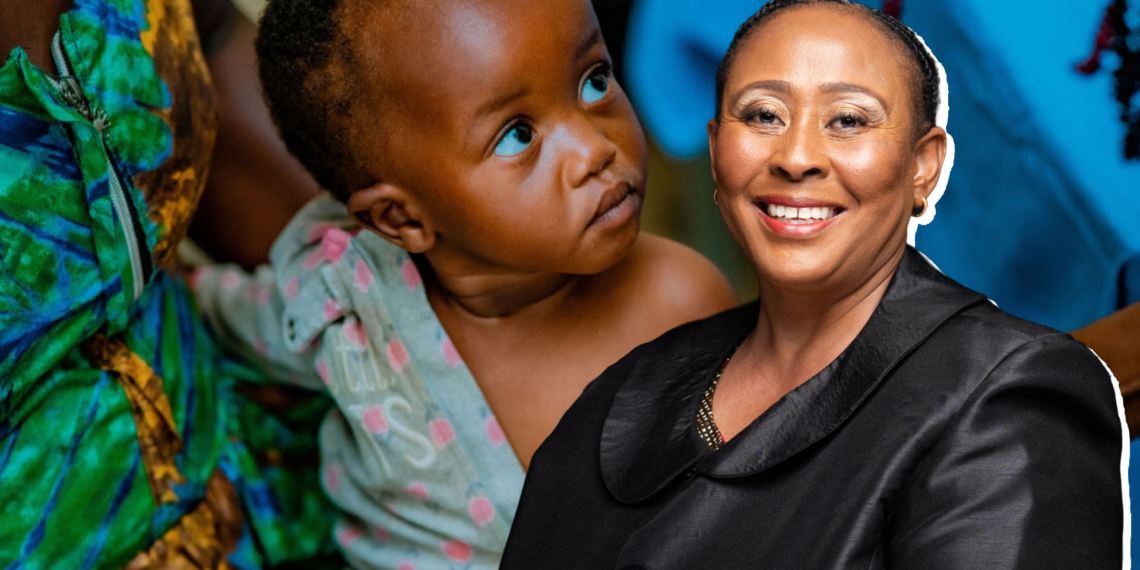
South Africa has made incredible strides in cutting child mortality, but a rising tide of malnutrition threatens to wash those gains away. With stunting affecting lifelong potential, Shadi Nyokong from the Nelson Mandela Children’s Fund is calling for urgent, community-led action to protect children and secure the nation’s future health.
Over the past 20 years, South Africa has done something remarkable. Through a range of healthcare and social interventions, we have cut child mortality dramatically, saving thousands of young lives in the process. But today, malnutrition threatens to undo all of our hard-earned gains.
South Africa’s own Child Death Review has shown that sustained investment in maternal and child health delivers results. We’ve seen a steady decline in under-five mortality to 28.6 per 1 000 live births in 2024.
This progress has been driven by improvements in healthcare quality and access, expanded vaccination coverage, stronger health data systems, and social protection measures such as the Child Support Grant. Community-based interventions by the likes of the Nelson Mandela Children’s Fund have also played a critical role in improving life outcomes for children under five.
In his 2026 State of the Nation Address, Cyril Ramaphosa recommitted the government to ending child stunting by 2030, tackling malnutrition among young children, and prioritising the critical first 1 000 days of life. He emphasised targeted nutritional support for pregnant women and low birth-weight infants, recognising that early intervention determines lifelong outcomes.
And yet, while progress is real, it is fragile.
Related stories
- Empower small-scale farmers to end SA’s hunger crisis now
- Protestors demand action against hunger at Social Justice Summit
- Soweto couple conquers hunger with community farm
- Foundation turns small-scale farmers into food security champions
Helping children thrive, not just survive
Child mortality rates remain unacceptably high. Poverty and inequality continue to shape life chances before a child is even born. The lingering effects of Covid-19, alongside preventable illnesses such as diarrhoea, pneumonia, and HIV-related infections, continue to threaten young lives. Above all, malnutrition remains the single greatest risk to reversing the gains of the past two decades.
The government and partners are strengthening the prevention and management of severe acute malnutrition (SAM). But policies alone do not save lives; systems do. And systems are only as strong as the communities that drive them.
Through its Child Survival, Development and Thriving (CSDT) programme, the Nelson Mandela Children’s Fund supports infants from birth to five years and pregnant women.
CSDT works at the family level, providing customised, need-responsive health services during the first 1 000 days of life. This includes support for growth monitoring, exclusive breastfeeding, maternal mental health, nutrition, pre- and post-natal care, and early childhood development. The aim is not only survival but thriving.
In 2025 alone, more than 15 000 children, mothers and caregivers were reached across five provinces. From farms to rural villages, community health workers are ensuring that immunisations are completed, growth is monitored, and vulnerable children are identified early.
Community-impact
At the heart of this model are 55 highly trained community healthcare workers (CHWs). They are not just programme staff. They are trusted neighbours who visit community members in their homes. They sit with young mothers and catch warning signs of a range of conditions early. They are the difference between survival and decline.
Evidence underscores the value of this approach. Recent research by the University of Zululand and Humana People to People shows how community-based health education strengthens both outcomes and accountability.
Community dialogue remains key. In Mpumalanga, mothers engaged in discussions on exclusive breastfeeding. In KwaZulu-Natal, community members examined the importance of father involvement in the first five years of life.
A third dialogue on family-level food insecurity brought together nearly 300 community members. These sessions are not symbolic; they inform programme design and strengthen local ownership.
The impact is visible. Families report greater stability, improved knowledge on nutrition and early learning, and stronger support networks for pregnant women and young mothers. Clinic committees are more engaged. Safety nets are gradually strengthening.
But this is not the end of the journey.
Putting children first
Over the first five years of its 30-year strategy, the Nelson Mandela Children’s Fund aims to move at least 5% of children below the food and intermediate poverty lines into the upper-bound poverty line. The focus is clear: reduce child poverty, combat malnutrition, prevent violence, and increase the percentage of healthy children under six.
Reducing child mortality is possible. What remains is the courage to scale what works, and to sustain it.
If we are serious about ending child stunting by 2030, then we must act accordingly.
Community health workers must be recognised and funded as an essential pillar of the health system. Nutrition must be treated as a social and economic imperative. Fathers must be part of the caregiving equation. And poverty must be confronted as the structural driver of ill health that it is.
We have already proven that child mortality can be reduced. The question now is whether we dare to protect those gains.
Children first. Not as a slogan, but as a measurable national commitment.
- Shadi Nyokong is the CSDT programme manager at the Nelson Mandela Children’s Fund. The views and opinions expressed in this article are those of the author and do not necessarily reflect the views or positions of Food For Mzansi.
READ NEXT: Youth in agriculture: The rise of South Africa’s agripreneurs