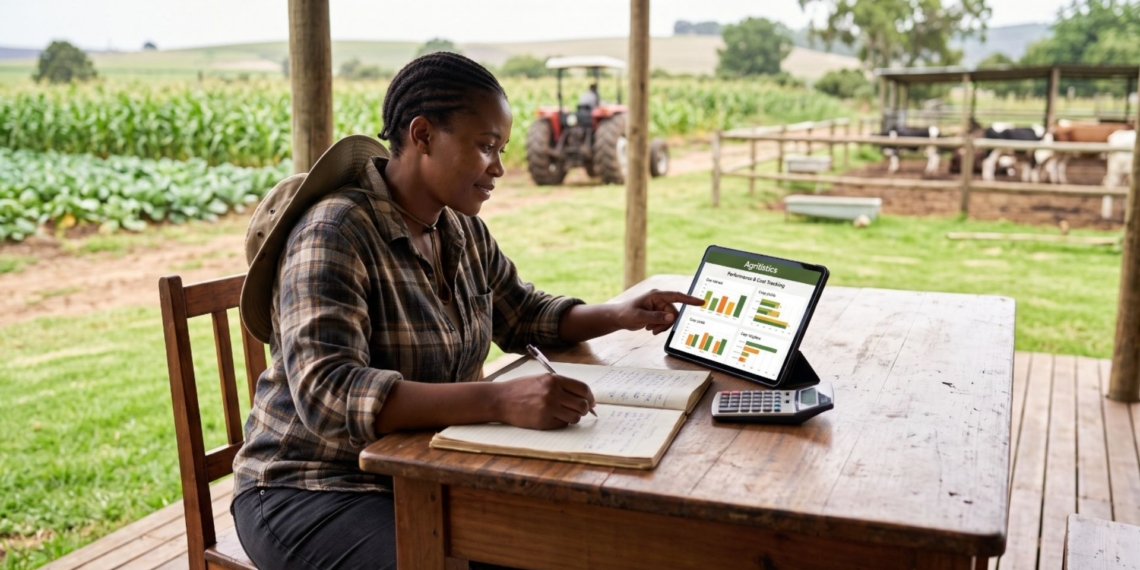
Good farming records are about more than paperwork; they’re about smarter decisions. Agritistics shows how tracking inputs, outputs, costs and losses helps farmers understand what drives performance and where improvements can deliver stronger returns.
Every farm produces data. Each bag of feed purchased, animal treated, hectare planted, and load of produce sold tells part of its story. The challenge is to identify what matters and record it in a way that helps the farmer understand production, costs, losses, and overall performance.
Most farmers already have more information than they realise. Invoices contain quantities, prices and dates. Abattoir statements show slaughter weights, classifications and income.
Crop delivery records provide yield and quality results, while breeding records, medicine registers and rainfall measurements describe what happened during production.
These records are valuable only when they can be linked. A feed invoice cannot explain poor growth unless the farmer knows which animals consumed the feed, over what period and how much weight they gained. Similarly, fertiliser use means little unless it can be linked to a specific field, season and yield.
Related stories
- Financial literacy: A gateway for farmers who dream big
- Farm inventory management systems – a tool to fuel growth
- Record-keeping: Know the ins and outs of your cattle
- Four simple records every smallholder livestock farmer should keep
Record the full production story
A useful record system should answer four basic questions:
- What went into the production system?
- How was it used?
- What effect did I observe?
- What was the financial result?
Inputs may include feed, seed, fertiliser, water, fuel, labour, medicine and genetics. Farmers should also record important management activities and conditions, such as planting dates, breeding, treatments, animal movements, rainfall, temperature and disease pressure.
These records must then be linked to outputs such as crop yield, animal growth, milk production, carcass weight, product quality and income. Losses are equally important. Mortality, disease, rejected products, feed wastage, theft and animals or crops falling behind target all reduce the farm’s potential return.
Production alone does not show whether the farm is performing well. A higher yield or heavier animal may require considerably more feed, fertiliser, labour or electricity.
The objective is not simply to produce more, but to produce profitably from the available land, animals, facilities and capital.
Give the numbers context
A record becomes useful when it is checked and compared with a meaningful target or previous result.
Consider a grower-finisher pig unit where pigs consume 10 tonnes of feed and produce 3.3 tonnes of live-weight gain. This gives a feed conversion ratio of 3 kilograms of feed per kilogram of gain.
If the target is 2.75 and the previous group achieved 2.82, the farmer can see that feed use has increased relative to production. The result does not yet explain why. The cause may be feed wastage, disease, temperature, stocking density, diet quality, genetics or inaccurate records.
The farmer must verify the information and investigate the possible causes before making a change. A record shows what happened; comparison provides context; investigation helps identify why it happened.
Start with a few reliable records
Farmers do not need to record everything from the beginning. Start by identifying the most important production and financial questions. Then select a few measures covering inputs, output, losses, costs and sales.
Each measure should have a clear definition, unit and time period. Responsibility must also be assigned so that everyone knows who records the information, when it must be captured and who checks it.
The first objective is not an advanced system or an impressive dashboard. It is a dependable record that the farmer and management team can trust.
Data cannot replace practical farming knowledge, but it can help test assumptions, identify trends and measure whether a management change achieved the intended result.
READ NEXT: Scrap sugar tax to save farmers and jobs, SA Canegrowers plead