The ARC’s Whitney Matli, Dr Walter Shiba, and Harold Weepener explain how shifting South African crop production to newly suitable areas could boost food security and economic returns as climate risks rise.



As temperatures rise and rainfall patterns become less predictable, some of South Africa’s established farming areas may become less suitable for the crops they currently support. New research suggests that carefully shifting production towards emerging suitable areas could deliver economic, employment and food-security benefits, but the right decision will differ from crop to crop.
A maize field, wheat farm or citrus orchard cannot simply pack up and move when the climate changes. Yet, over the coming decades, South African agriculture may have to reconsider not only how crops are produced, but also where they are produced.
Rising temperatures, changing rainfall patterns, water stress and more frequent extreme weather events are already increasing uncertainty for farmers. A production area that has supported a crop for generations may not offer the same growing conditions in 2055 or 2080.
This raises a difficult but increasingly urgent question: would it make economic sense to gradually shift some agricultural production towards areas that are expected to remain suitable or become more suitable under a changing climate?
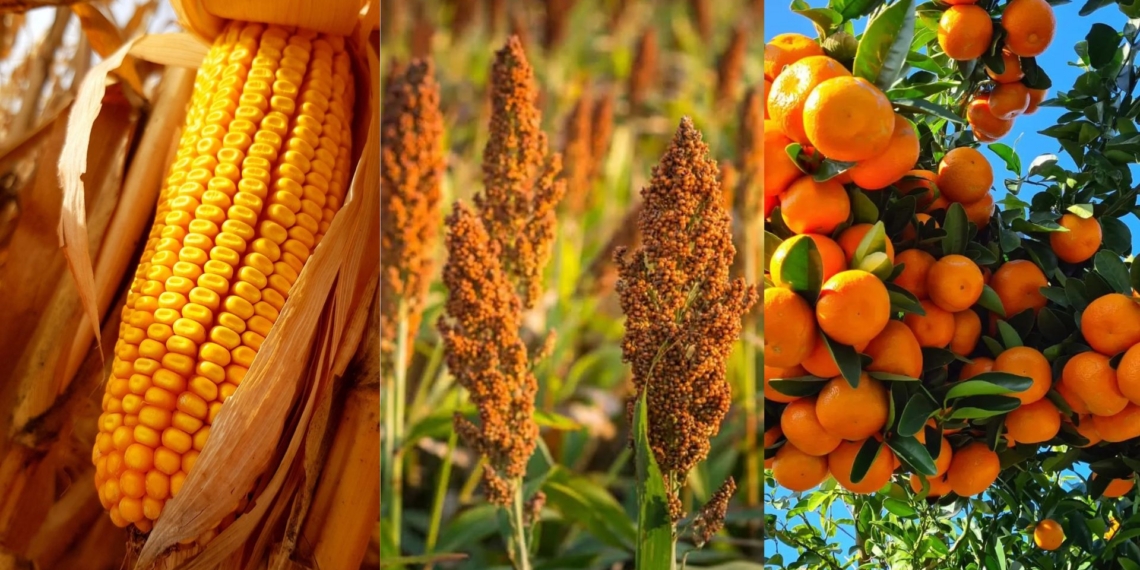
A study by researchers from the Agricultural Research Council examined this question for six important South African commodities: maize, wheat, sorghum, citrus, avocado and macadamia nuts. The study combined climate and crop-suitability modelling with a cost-benefit analysis.
Related stories
- Beyond maize: Why neglected crops are SA’s climate-smart future
- A super El Niño looms: Africa’s five lessons in climate resilience
- Early warning action essential as dry weather increases fire risk
In simple terms, it compared the long-term value that could be created by moving a portion of production with the costs of establishing and operating farms in new areas. The results offer both encouragement and a warning. Shifting production can be a worthwhile climate-adaptation strategy, but its feasibility depends on each crop’s climate requirements, water needs, production cycle, infrastructure requirements and market prospects.
What does ‘moving production’ mean?
Moving production does not mean abandoning South Africa’s established farming regions overnight. It means planning a gradual transition as climate suitability changes.
The study modelled a hypothetical scenario in which 10% of the current production area for each crop shifts towards newly suitable agroecological zones. The 10% is a modelling assumption used to test the potential economics of adaptation; it is not a recommendation that 10% of national production should be relocated.
The analysis considered future climate conditions centred on 2030, 2055 and 2080 under moderate- and high-emissions scenarios and evaluated the costs and benefits of adaptation over 30 years.
Depending on the crop and climate scenario, the modelling identified potential opportunities in cooler and higher-altitude areas, including parts of the Eastern Cape, KwaZulu-Natal, Limpopo and the Free State. These represent modelled opportunities rather than farm-level recommendations.
These broad areas should not be treated as farm-level planting recommendations. Local water availability, soil quality, infrastructure, market access and land-use conditions would still need to be investigated before any investment decision is made.
Further consideration is whether the receiving areas have the infrastructure, water resources, services and institutional capacity to support additional agricultural production. A shift in production could increase demand for irrigation water, roads, electricity, storage, processing facilities and agricultural services.
Planning therefore needs to be considered not only where crops can grow, but whether the surrounding agricultural system can support production on a scale.
Putting a rand value on adaptation
The researchers used a measure called the benefit–cost ratio, or BCR. A BCR above 1 means that the estimated benefits are greater than the costs. A ratio of 1.50, for example, means that every R1 invested is expected to generate about R1.50 in wider economic and social benefits.
The study did not look only at income earned by farmers. It also considered broader benefits such as food security, employment and export earnings. Under the study’s central estimates, maize and citrus produced some of the strongest returns, with benefit–cost ratios of about 1.50. Sorghum also performed well, with a ratio of approximately 1.41.
These findings matter because the crops play very different roles in the economy. Maize is central to South African food security, livestock feed and agricultural processing. Citrus is a major export earner and supports many jobs in rural communities. Protecting these industries from future climate risks would therefore have benefits far beyond the farm gate.
However, high-value crops are not automatically the safest adaptation investments.
Avocado and macadamia orchards require substantial establishment expenditure and take several years to reach full production. This creates a long period between the initial investment and the expected return. It also leaves producers exposed to future changes in water availability, temperatures, input costs, export prices and market access.
The lesson is clear: a crop may have a high market value and still carry considerable long-term adaptation risk.
Sorghum deserves another look
Sorghum is a much smaller industry than maize or wheat, but its ability to tolerate heat, drought and unreliable rainfall gives it strategic value in a changing climate. In the study, sorghum remained comparatively resilient under severe climate conditions, even as the outlook for several other crops weakened.
This does not mean that farmers can plant sorghum anywhere and expect an easy profit. The crop still faces challenges, including limited markets, low consumer demand and pressure on farm-level profitability.
Climate resilience alone will not create a successful industry. Sorghum needs functioning value chains. That means investing in seed systems, processing, product development, procurement opportunities and consumer awareness. Stronger demand for sorghum-based food, beverages and animal feed could help turn its climate advantages into real income for farmers.
For smallholder and emerging farmers in water-constrained areas, this could be particularly important. A more diverse crop system may reduce dependence on a small number of climate-sensitive commodities.
Waiting will make adapting harder
The modelling shows that the economic outlook generally becomes more difficult as climate change intensifies towards the middle and end of the century.
Under a high-emissions future, projected yields decline sharply for several crops. Maize, citrus, avocado and macadamia are particularly exposed to combinations of heat and water stress, while long-lived orchards face the additional risk that conditions may change substantially during the productive life of the trees.
This is why adaptation decisions cannot be based only on current growing conditions. An orchard planted today may still be producing decades from now. Infrastructure such as irrigation systems, packhouses, roads and storage facilities also represents a long-term commitment. If these investments are made without considering future climate suitability, producers and government may lock themselves into increasingly risky locations.
At the same time, shifting production is expensive. New areas may require roads, irrigation, electricity, storage, processing capacity, extension services and links to markets. Farmers may also need finance during establishment years when costs are high and income is limited.
Adaptation therefore requires coordinated planning. Individual farmers cannot carry the full burden of a national transition.
Build a crop-suitability early-warning system
South Africa needs a practical crop-suitability monitoring system that is updated regularly as new climate, soil, water and production information becomes available. Such a system could help farmers, financiers and government identify where risks are increasing and where new opportunities may emerge. It could also guide land-use planning, infrastructure investment, agricultural finance, insurance and extension support.
The information must be detailed enough to support local decisions and accessible enough to be useful outside research institutions. For farmers, the question is not simply whether the climate is changing. It is how quickly local conditions are changing, what that means for a particular crop and which adaptation options are financially realistic.
For policymakers, the challenge is to avoid blanket solutions. Maize, sorghum and macadamias do not have the same production cycles, water needs, markets or investment risks. Support measures must reflect these differences.
A planned shift, not a panicked retreat
South African agriculture has adapted to difficult conditions before. Farmers have changed cultivars, planting dates, irrigation methods, production systems and markets in response to drought, prices and new technology.
Climate change adds another layer of pressure, but it also strengthens the case for better information and earlier planning. The study shows that moving some production towards more suitable areas could generate meaningful economic and social returns. It could protect food supplies, sustain rural jobs and help important export industries remain competitive.
But successful adaptation will depend on choosing the right crop, in the right place, at the right time and understanding the full cost before the first seed or tree is planted. South Africa does not need to relocate its agricultural sector overnight. It does need to start preparing for a crop map that may look very different by the middle of this century.
The future of South African agriculture will depend not only on how farmers produce, but increasingly on where they produce, and whether those places will remain economically, environmentally and socially viable as the climate changes.
- Dr Walter Shiba, Whitney Matli, and Harold Weepener are researchers from the Agricultural Research Council. The views and opinions expressed in this article are those of the author and do not necessarily reflect the views or positions of Food For Mzansi.
READ NEXT: Fruit SA: Giving transformation a seat at the strategy table