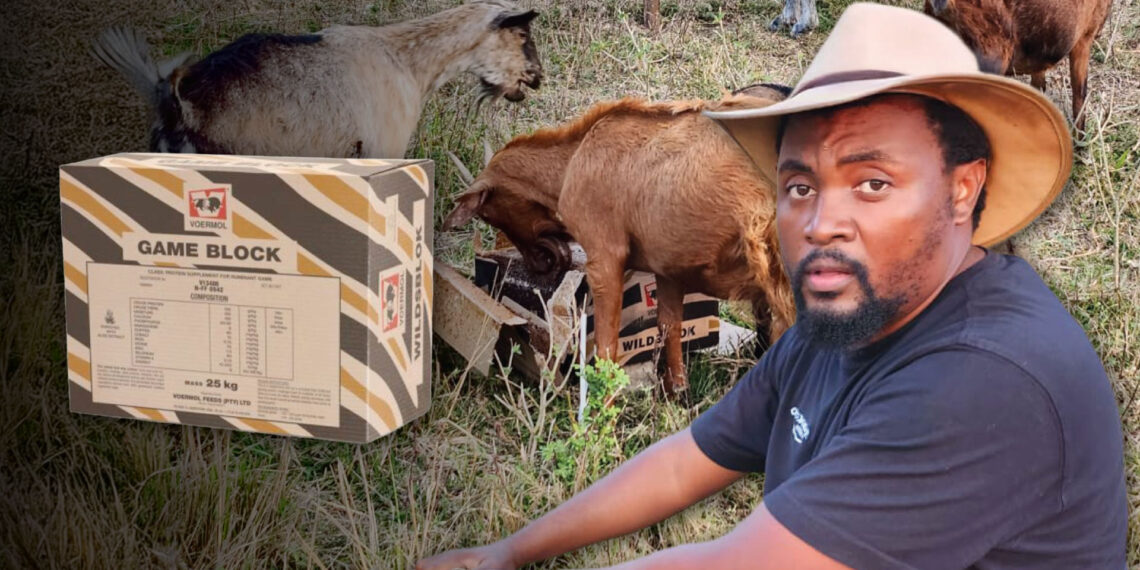
After losing more than R90 000 after moving his goats across provinces, Voermol’s Game Block (V13408) became part of Sizwe Thusi’s sustainability strategy.
In the heart of eMpangeni, KwaZulu-Natal, farmer and trainer Sizwe Thusi has built his goat operation around resilience and sustainability.
Thusi manages two farms and runs the Ndlebenkomo Animal Husbandry Academy. Looking back, Thusi remembers his early days farming in Nigel, Gauteng, where conditions were unforgiving. “It was a harsh area to farm goats,” he recalls.
“In winter, the veld was bare soil. My goats had to scratch the ground just to find roots. If I didn’t cough up money for feed, they wouldn’t eat.”
Worms, poor condition, and failed attempts
His biggest challenges with his goats were worms and a lack of condition after winter or kidding.
“The trick is always to get the animal back to a good body condition after birth and after winter so that it can mate again. But I struggled with that, and worms were a constant problem.”
He even tried making his own lick block to cut costs, but it wasn’t sustainable. “It was a lot of work because I was working in Joburg at the time. And even if I had all the ingredients, the challenge was that I wished I could have something that also dealt with worms, because worms are the biggest challenge when farming goats and sheep.”
The worm problem was both extensive and complicated. It wasn’t just a single type. He says using a broad-spectrum dewormer often wasn’t enough.
“By the time you realise it, sometimes it’s too late – you lose animals.”
Finding the solution
In 2018, during one of Nigel’s bitter winters, Thusi discovered Voermol Game Block.
“Through research, I learned about it. I checked my soil samples – whether acidic or alkaline – and the deficiencies that came with that. Then I looked at the block’s composition and realised it covered those gaps.”
A key advantage was that the block was formulated for game animals. Since Thusi’s indigenous veld goats are closely related to impala, he knew a product designed for game would suit his goats perfectly, complementing his natural browsing system.
He began introducing the block slowly in June and July, when grazing was scarce.
“At first, I only gave small amounts and took it away, because if you give too much, the goats can go into shock and digestion can stop. Within 45 to 60 days, I started to see changes. Normally, with feed, you only see differences after two or three months. But with the Game Block, it was quicker.”
Related stories
- How Voermol’s tailored nutrition boosts herd health year-round
- Thabo breeds success and herd quality with Voermol
- Why Kalahari Red goats are winning over SA farmers
- Goat and sheep farmers breed smarter to beat climate stress
The results: stronger goats, healthier kids, less deworming
Before, winters left his goats ribby and weak. Ewes often abandoned their kids because they couldn’t cope after birth.
“I knew my goats well. By April and May, after the rains stopped, you could see them struggling. By June, the ribs were showing, the bones were sticking out, and ewes were too weak to mate again,” explains Thusi.
The situation improved dramatically. With the Game Block, the goats maintained good condition, recovered faster after giving birth, and no longer required flushing before mating.
Thanks to the aloe in the block, worm infestations were also controlled, reducing deworming to just once every two months.
The block also delivered unexpected savings. Deworming isn’t just costly; it requires significant labour. Extra hands are needed to manage the animals, ensure they’re vaccinated against pulpy kidney, wait the required period, and then administer the dewormer.
“With the Game Block, everything runs like a well-oiled machine, and I’ve cut those costs significantly,” Thusi says.
Moving goats from Gauteng to KZN
In 2020, after Covid, Thusi moved his goats back to KwaZulu-Natal, where he had secured more suitable land. However, moving goats between regions is risky; they must adjust to new veld, new soils, and new conditions. He had learned this the hard way years earlier.
“I once bought goats from KZN and took them up to Nigel. I lost more than R90 000 worth of animals. They came from sweet veld, went into the truck, were stressed, then arrived to veld with no supplement. They couldn’t adapt.”
This time, he was ready. Since his goats were already familiar with the Game Block from Nigel, he was able to reintroduce it to them in KZN smoothly.
“It acted as a common feed between the two regions, making the transition easier. They acclimatised without losses. That block saved my goats,” he shares.
Today, Thusi’s goats browse freely on veld, with only the Game Block and molasses syrup as supplements. His breeding philosophy remains focused on resilience: selecting for fertility, mothering ability, and disease resistance.
“Before you start farming, teach your goats to use the block. It’s not like buying a 50kg bag of feed and trying to balance it yourself. The Game Block already has what your animals need, in the right ratios. It saves you from making mistakes, losing money, and animals.”
For Thusi, the product has been more than feed; it has been a strategy.
“Farming goats is tough,” he says. “But when you find something that works for both the farmer and the animal, that’s when you know you’re building something sustainable.”
READ NEXT: Add value to your small stock with Voermol SS 200