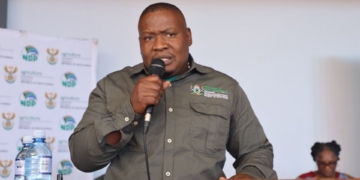
Long before a tragic accident claimed both his legs, Realeboga Marlon Mangwegape had already proven he would sacrifice anything for agriculture – even dropping out of school as a boy just to herd livestock.
Today, that unyielding drive powers his backyard enterprise, Temo Leruo Botshelo, turning a life-altering disability into an unstoppable story of grit and growth.
Mangwegape’s roots run deep into the soil of Chiefscourt, a small village in North West. His primary education began at Maranata Primary School, but his true classroom was outdoors among the livestock.
His grandfather, Gobusamang Mangwegape, and his uncle, Tebogo, kept livestock during his early childhood. By the age of nine, a young Mangwegape found himself captivated by the animals and particularly by the thrill of riding horses.
“I started falling in love with farming when I was a kid… because I loved and enjoyed riding a horse,” Mangwegape recalls. “Most elderly people in my community had different livestock, including horses, so I was helping them with their livestock just to ride a horse, and that’s where I learnt about livestock.”

Driven by a desire to work alongside the local herders, he dropped out of school for four years to work as a full-time herdman. Only after mastering the rhythm of the kraal did he return to his studies, eventually completing his matric at Mankuroane Technical and Commercial High School in 2010 before advancing his studies in Information Technology (IT) at PC Training.
Related stories
- 5 000 to 100 000 cabbages: EC co-op gamble pays off
- Mother’s legacy, neighbour’s grace: Venessa Simelane’s farm story
- Flying solo: FS farmer beats hurdles to scale poultry enterprise
- Simangele turns school lease into retail-supplying agribusiness
Saving for a dream
Despite finishing his formal education, Mangwegape waited more than ten years before landing a nine-month internship with the South African Social Security Agency (Sassa) as a disability grant administrator in 2018.
As he spent his days processing support for the disabled community, he used his modest stipend to lay the groundwork for his true calling: commercial farming.
In 2019, he officially registered his business under the name Temo Leruo Botshelo, a Setswana phrase meaning “farming is life”. Using his savings, he launched a backyard livestock operation and strategically selected Boer goats and Dorper sheep to build his foundation.
“I chose to farm with Boerbok goats because they are a meat goat and they adapt in harsh conditions,” he explains. “The chance of giving birth to twins is high, and they are good mothers, the same as Dorper sheep. They are good for business, plus they give birth twice a year. So one goat can give you four goats at the end of the year; the demand is high too.”
To complement the herd, he added indigenous chickens to clean parasites from the kraal while providing household consumption, alongside four working dogs.
A tragic detour changes his life forever
By 2021, he had acquired two female crossbred Boer goat ewes and secured a Producer Support and Input (Pesi) voucher from the department of agriculture, which he used to purchase a quality Boer goat ram.
Then came a crucial opportunity: the department of agriculture and rural development in Mahikeng invited him for an interview for a messenger position. To finalise the application, they required his fingerprints and a clearance certificate on short notice.
Mangwegape needed to travel to Pretoria, where the headquarters could issue it quickly enough for him to meet his interview deadline.
He travelled first to Johannesburg with his younger sister’s boyfriend, Oratile Motlhabane, who offered him a place to stay overnight. The plan was to head to Pretoria the next morning, collect the certificate, and return directly to Mahikeng for his interview.
He never made it to the interview room.
While in Johannesburg, Mangwegape was struck by a truck. The impact was catastrophic. He was airlifted to Milpark Hospital, where surgeons performed an above-the-knee amputation on both of his legs.
In an instant, the young farmer who had spent his childhood chasing livestock on horseback became a member of the very disabled community he once served.
Rising from the dust
Refusing to allow the loss of his limbs to halt his agricultural ambitions, he returned home to Chiefscourt and adapted.
Continuing operations from his grandmother’s backyard, he managed his animals with relentless determination, hiring one permanent herdman and one part-time assistant to execute the heavy physical manoeuvres.
His strategic approach to breeding paid off. Starting from just two female goats in 2021, Mangwegape has expanded his backyard operation to 72 goats, alongside a growing flock of Dorper sheep, indigenous chickens, and his security dogs.

He regularly trades his stock directly within his local community and at formal livestock auctions.
Breaking beyond the backyard
Despite his remarkable recovery and growth, Mangwegape’s ambition is severely constrained by spatial limits. Operating out of a residential backyard prevents him from scaling into the full commercial enterprise he envisions.
“Land is what I need most to expand my herd,” Mangwegape says. “Where I am right now is a backyard that doesn’t allow me to grow into the commercial farmer that I want to be.”
His vision requires a commercial footprint of 400 to 600 hectares. On that scale, he plans to introduce cattle, layer chickens, a Kalahari Red goat stud, and horses, while cultivating his own lucerne for feed. It would also allow him to increase his workforce and train others.
“I want to equip young farmers with farming skills and training and empower them with knowledge,” he asserts.
Reflecting on his journey, Mangwegape urges aspiring agriculturalists to anchor themselves in patience rather than social media trends.
“Know what you want. Don’t just be into farming because of only the beautiful side that you see on social media. Start with the little you have – that will allow you to make mistakes and learn from them,” he advises.
READ NEXT: Rooibos project turns classrooms into space labs