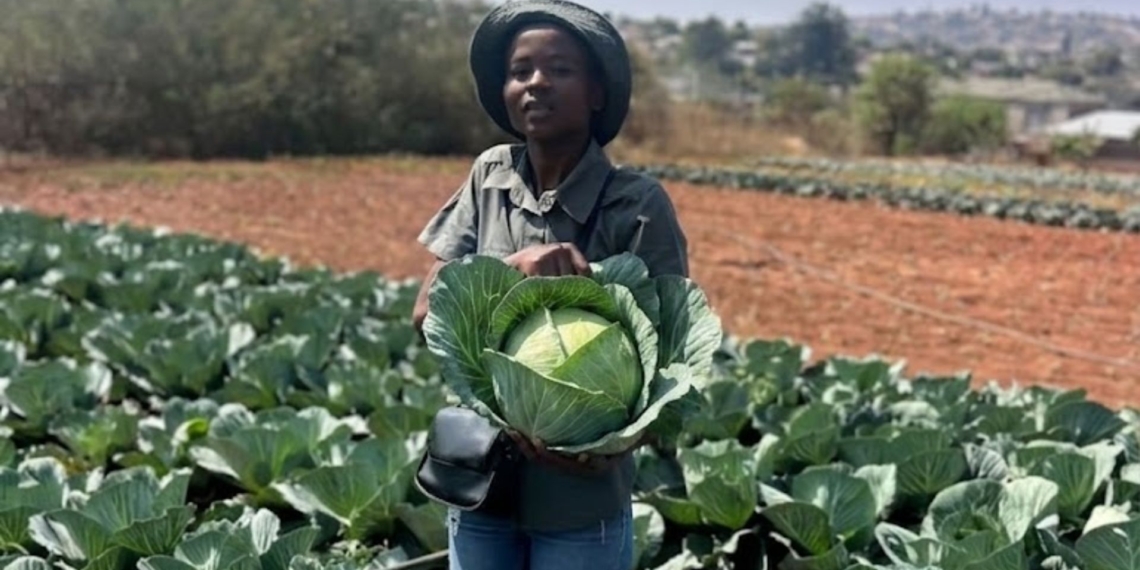
With money saved from NSFAS, a 15-year school lease and social media savviness, Simangele Makutu, owner of Kefentse Multipurpose Farming, turned cabbages and spinach into a retailer-supplying enterprise.
Makutu never pictured herself as a farmer. Growing up in Bushbuckridge in Mpumalanga, a pupil at Maviljan Primary and then Bushbuckridge Secondary, she had no farming lineage and no family roadmap into agriculture.
A practical in life science at high school about plants shifted her trajectory.
“I didn’t know that I would be a farmer in my school days, but there was this other practical we had about plants in life science, and it made me want to know more about farming. I just loved it, and I grew up liking farming,” she recalls.
After matric, she received NSFAS funding to study agriculture at Ehlanzeni TVET College. It would come in handy and become the start of her future.
Unlike many graduates who hunt for jobs first, Makutu went straight to the fields. She had saved R20 000 from her NSFAS funding; with money to start, all she needed was land.
Related stories
- Limpopo youth grows grain business from social grant savings
- Self-taught EC farmer builds 6-hectare agribusiness from scratch
- Ex-cop beats poisoning disaster to build growing livestock business
- ‘Cayenne Chilli Lady’ brings the heat with 8.5ha farming success
From pupil to leaseholder
Makutu reached out to her former high school, the very school where she got the spark for her love for farming, and it became the source of her land.
They granted her three hectares under a 15-year lease agreement. In July 2024, she began cultivating, and later that year, she formally registered her business as Kefentse Multipurpose Farming.
“I have never worked anywhere after my studies; I started my business,” she explains. “My family was shocked when I told them I wanted to start farming because there was no one who ever did farming at home, but after that, they supported me.”
With one employee at the start, she planted cabbage, spinach and tomatoes. To build a market, she turned to social media, using TikTok in particular to show her produce. The videos drew recognition and more customers. The business grew slowly but steadily.
By April 2025, she had secured the National Youth Development Agency (NYDA) funding, which helped her grow further. “The funding boosted me because after getting it, I managed to expand my farm.”

This year, she has also recently received the National Empowerment Fund (NEF) funding. Although the funds have not yet been released, she hopes they will boost her business even further.
Today, Kefentse Multipurpose Farming supplies not only the local community but also established retailers like Boxer, Spar and Roots, and contributes to school nutrition programmes.
Makutu’s growth has spilt over to job creation in the community, and she now employs nine permanent workers and 30 part-time workers during peak seasons.
Solving shortages while scaling up
However, her growth has not been without challenges, especially water shortages, which she is still working to solve. Even so, she remains focused on becoming a fully established commercial farmer in her neighbourhood.
“I want to see myself as big as some of the commercial farmers around my area,” she says.

To get there, she’s thinking long-term; plans are already in motion to purchase her own land. She’s paid the deposit for land in her province and will relocate the operation there after the 15-year lease is over.
That same clarity drives her advice to newcomers. “Whoever wants to start farming should know what they want and understand the meaning of being a farmer.”
READ NEXT: How SA’s new food labelling laws will impact food producers