
Vertical farming is one of the future farming methods that you can expect to see more and more. Thanks to its versatility, high yields and small space requirement, this form of agriculture is well suited to our 21st century needs and has been offering opportunities for crops to be farmed in big cities.
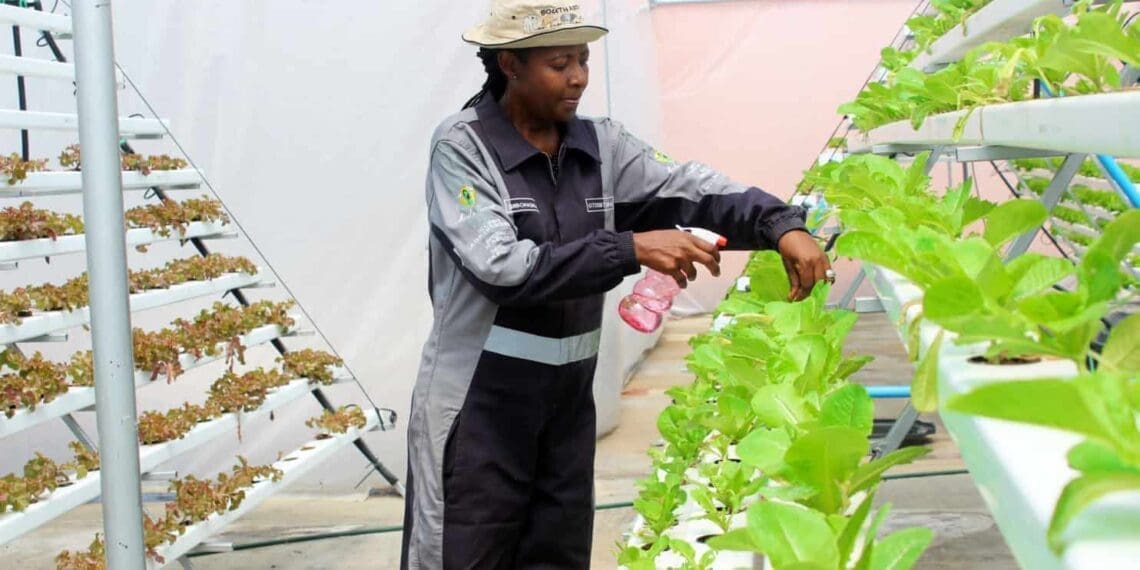
Sibongile Cele, vertical farmer at Mcebo Fresh Veggie Rooftop Farm, farms with organic veggies in the inner city of Johannesburg.

“Vertical farming has taught me to grow food in a new way, using a different system to a traditional farm system, and also producing large scale without a lot of loss,” says Cele of her vertical farming journey. “It’s been a great learning experience.”
This method of farming is also versatile, taking on many different forms and providing space for many different types of crops. This means you won’t easily get bored when you enter this sector.
Khaya Maloney, owner of Khaya, a controlled environment agriculture vertical farm on a rooftop in Constitution Hill, Johannesburg, has noticed that vertical farming is starting to become popular, and believes that it is the solution to food shortages and food insecurity, especially in growing urban areas.
“I myself did not have any agricultural experience, academic or otherwise,” Maloney says. “It is something that is easy to learn, and you learn as you go.”
Before we jump in to tell you how to start vertical farming, let’s have a look at what exactly it is and why this type of farming is becoming so popular.
What is vertical farming?
As mentioned above, vertical farming is a very versatile method. This means that there are many different types of vertical farms and there is not a one-size-fits-all definition. But, basically, vertical farming is the practice of food production that takes the form of vertically stacked layers and vertically inclined surfaces.

“Vertical farming is a technique of farming that makes it possible to have agriculture in cities in much smaller spaces,” says Maloney. “It’s a soilless form of agriculture that allows nutrients such as nitrogen, phosphorous and potassium to be directly dealt into the roots of the plants.”
This method of farming is executed inside a controlled environment, usually without soil and often without natural light, which means that vertical farming is mostly based around hydroponics.
The method of growing the crops in a vertical farm involves the following elements:
- Temperature control;
- Humidity control;
- Artificial lighting; and
- Control and monitoring of nutrients and fertiliser.
There are different systems that you can use in your vertical farming enterprise. These can be hydroponics, aeroponics or aquaponics. This will be dictated by preference, the growing area and the amount of start-up capital you have.
The future of farming
The amount of available arable land reduces every year, so there does need to be alternative methods of growing crops for the ever-increasing world population.
Vertical farming allows us to produce crops with 70% to 95% less water than required for normal cultivation. And because crops are produced in a well-controlled, indoor environment without the use of chemical pesticides, vertical farming allows us to grow pesticide-free and organic crops.
Adding to this, there are some quick benefits when using these vertical gardens with hydroponics:
- Higher yields per meter square;
- No need for pesticides or fungicides;
- Food can be grown all year round; and
- Food can be grown in regions where it wasn’t previously possible.
Vertical farms represent significant benefits to increasing food accessibility, especially in arid areas and in cities. Because farms can be located anywhere, more people can start growing their own crops and production moves closer to the consumer. Because farms are in controlled environments, farms are able to produce consistent value and volume all throughout the year.
Also read: Urban rooftop farmer making a difference in the sky
How to start your own vertical farm
When undertaking vertical agriculture as a small to medium business, planning is essential.
“The initial cost is the downside,” admits Cele. “Because you have to raise up a lot of capital as a start-up cost to set up your farm.”

You need to save up for enough funding for the setup. But then you are able to start farming and to scale up as soon as possible. To do that you need to ensure that you can sell what you grow, and that your production costs are not too high. The first step to ensuring this, therefore, is choosing the right crops.
1. Choosing crops for vertical farming

Any crop you plan to grow will have a growing method tailored to its needs. Determining the daily nutrient and light uptake each crop requires is crucial.
Unlike a regular hydroponic system, there are plenty more things to consider. Because many crops will be grown in layers, this means that there is not as much opportunity for taller plants in this system type.
“We farm with lettuce, spinach and herbs that we dry and sell,” Cele shares.
“For people who want to start using hydroponics and vertical farming – the advantage is that you are able to produce all year round, you save water and also you are maximising your space.”

Maloney, on the other hand, made use of the fact that he can manipulate the growing environment of his crops, and opted to grow a crop that is not suitable for the Jo’burg environment in order to fill a gap in the market.
“The crop I chose was hops, the main ingredient in beer, giving it the bitterness and fresh aroma,” says Maloney. “The thing about hops is, it is mostly grown out in George (in the Western Cape). So, I saw that as an opportunity that I could manipulate the environmental conditions of how they grow in George and recreate them in greenhouse tunnels.”
2. Choosing your vertical farming method
Different vertical farming methods each have their pros and cons, and will be more or less suitable, depending on things like crop type, business model, and location. Remember, there’s no one-size-fits-all vertical farm model.
The go-to method for vertical farming is hydroponics. Scalable in size and cost, hydroponic farming is highly adaptable to its farmers’ production goals and needs. It includes methods like drip irrigation, deep water culture, ebb and flow, nutrient film technique, and the wick system. These are all just different ways of supplying water to your crops.
“We don’t use soil, we use coconut,” says Cele about her hydroponic system that she uses in the vertical farm. “The water circulates and feeds the roots, the nutrients are put into the water.”
3. Deciding on the layout of your vertical farm

The goal of vertical farming is to make full use of the available space. It is here where farmers need to maximize the growing capacity per square meter. To do this easily, planning the layout for optimal space usage is the key.
4. Light sources
Farmers can use natural light sources, and supplement these with grow lights. If that is not sufficient, there may be a need for reflectors, rotating beds or another means of making sure the same amount of light falls on all the crops for the specified time.
There are some negatives for South Africa in that vertical farming can be electricity-intensive because lighting (and other electric powered equipment) plays a big part in crop yield and we have an unreliable and expensive supply.
5. Water and nutrients
Everything that the crops need to survive and produce a high yield needs to be supplied by the farmer, including all the basic light, water and nutrient requirements. If this isn’t done in the right manner, or the right amounts, then it won’t be possible to sustain the garden.
“We used water pumps to start with,” says Cele. But the pumps have to be connected to a reliable power supply. “Solar panels are necessary to connect the water supply to water the plants because load shedding can cause a lot of lost crops.”
If you use a circular hydroponic system you can reuse your water again and again, ensuring that your vertical farm is sustainable and water efficient. Nutrients and mineral fertiliser compounds can be dissolved into the water used to irrigate the plants, supplying them with everything they need.
6. Invest in agritechnology
Since this is a new, future-forward way of farming, embrace the novelty and the technology that comes with it! You are able to experiment in ways that you never could with traditional farming styles.
There are many new data, sensors, control and software technologies out there that can help you track the energy, water and other inputs going into your vertical farm, help you optimise your vertical farm and analyse the outputs your crops are yielding. It’s an exciting space to be in at this point in time, but you’ll have to work to keep up to date.
“I would encourage young ones who want to come in. Vertical farming is smart farming, it is a new way of helping with production and addressing the sustainable development goals of zero hunger and food security,” says Cele.
Advice for beginners:
“One lesson I can advise on: always secure your market first, even before you know anything about vertical farming,” says Maloney. “That’s the biggest challenge.”
“And be able to crunch your numbers, it’s a huge numbers game. If your overheads are higher than your money per harvest, then you are not in business.”
And if you feel like you don’t have enough experience or knowledge to start, just remember that Maloney got into the game without any prior agri knowledge, either! He recommends searching Google and YouTube, since both platforms contain multitudes of free resources and information on vertical farming.
“It is not difficult, I encourage people, especially people of colour, to test out and see what they can do in their backyards, on rooftops and in little containers on their shelves.”
ALSO READ: Rustenburg youngsters dream of running Mzansi’s largest hydroponics business
Want to learn more about hydroponic farming? Check out our full “How to start your own hydroponics farm‘ guide!