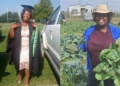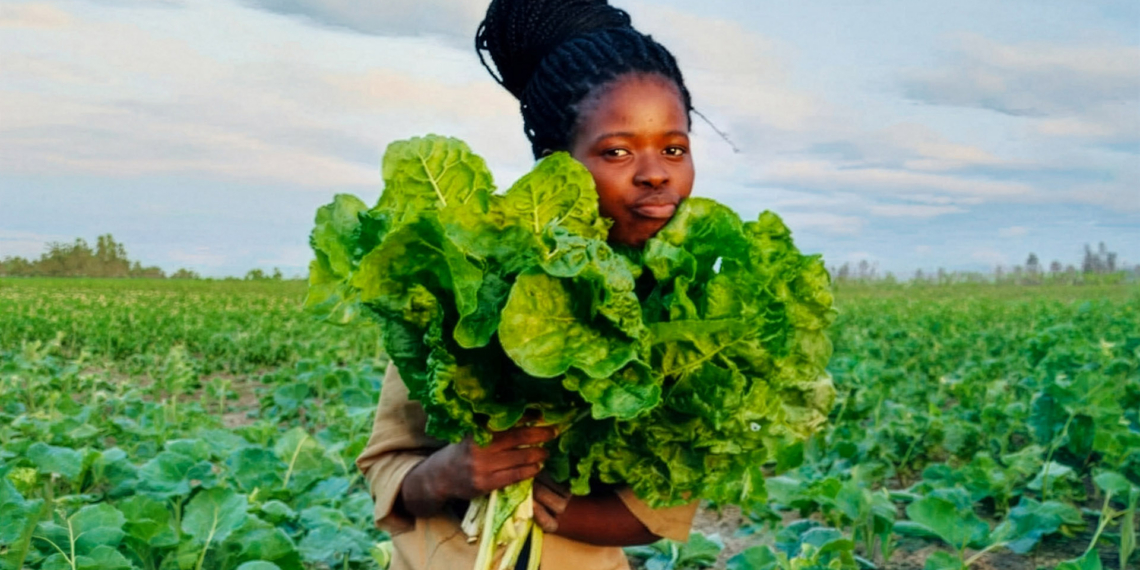
By transforming her student allowance and a 0.5-hectare family garden into a commercial farming operation, Eastern Cape entrepreneur Palesa Sotshongaye is proving how discipline, patience, and business acumen can turn small beginnings into a thriving enterprise.
Born and raised in Upper Nxaxa Village in Mount Fletcher, Sotshongaye completed her primary education at Upper Nxaxa Junior Secondary School before graduating with her matric from Kuyasa Senior Secondary School in 2018.
After taking a gap year in 2019 to reflect on her future, she enrolled at Ingwe TVET College’s Mount Fletcher Campus in 2020 to study business management, graduating in 2022.
While she originally chose business management to learn how to run a business, a pivotal conversation in 2021 changed her perspective. Her former high school teacher, Seshoba, reached out with advice that reframed how she viewed the sector.
“He always taught me that agriculture is not just about working in the field, but it is a business that can create employment and feed the community,” Sotshongaye recalls. “He encouraged me to use the small land we have at home to produce something… That is when I fell in love with farming.”

Related stories
- Rising from storm loss: Sinethemba Gebashe’s egg triumph
- Pivot to poultry: Jennifer Gazide swaps boardroom for broiler house
- Farming bootcamp propels Unicha Dladla’s path to growth
- Sinalo ditched his engineering degree to farm, and it paid off
Sacrifice, family backing, and enterprise launch
Turning that inspiration into reality required extraordinary financial discipline. From 2020 to 2022, while her peers spent their National Student Financial Aid Scheme (NSFAS) allowances on personal items, Sotshongaye saved her stipend to build start-up capital.
“It was not easy to save money. The most challenging experience was having to say no to myself,” she explains.
“While other students were buying clothes and enjoying their NSFAS money, I had to discipline myself and save from 2020 to 2022 for my start-up capital. It was not easy, but I kept reminding myself that I was investing in my future.”
In 2022, Sotshongaye relocated from Mount Fletcher to Godini Village in Qumbu, within the Mhlontlo Local Municipality. Initially, her family was surprised by her decision, expecting her to pursue a corporate office job with her business management qualifications. However, seeing her determination and self-funded start-up capital, they fully supported her and granted her access to a 0.5-hectare family garden.
Armed with her savings, she purchased her first seeds and chickens, planted spinach and cabbage while adapting a flat house on the property for poultry. In 2024, she formally registered her business as Iphiko-Lokhozi Multi Purpose.

Today, operating from her backyard in Godini, Sotshongaye has expanded production to include potatoes alongside spinach, cabbage, and poultry, while creating employment for local part-time workers.
“Since I started, my greatest achievement is being able to supply local schools, buying a water tank, and increasing production,” she reflects.
Overcoming hurdles and driving future growth
Operating in rural Qumbu comes with significant operational challenges, including water scarcity, unpredictable weather patterns, and crop pests. Sotshongaye manages through rainwater harvesting, organic composting, and ongoing technical guidance from the local agricultural extension officer.
A major hurdle has been financial support. Despite applying repeatedly to various government departments, she has received zero external funding and continues to finance her operations entirely through reinvested earnings.

“Today I am proud because that sacrifice bought my first seeds, chickens, and helped me start my business,” she says.
Her persistence has paid off in strong market access. Today, Iphiko-Lokhozi Multi Purpose supplies fresh produce and poultry to local community members, nearby schools, and major retail outlets in Qumbu, including Boxer and Spar.
Looking ahead, Sotshongaye plans to fence her accessible five-hectare land allocation to expand production, acquire a tractor, build a dedicated poultry house, enter agro-processing, and eventually pursue formal qualifications in agriculture to complement her business management background.
“My advice to people planning to start farming is: start small, be patient, learn the soil and chicken, visit your local agriculture office, and never give up.”

READ NEXT: High input costs drive SA grain farmers to rethink crop mix