As South Africa grapples with a severe foot-and-mouth disease (FMD) crisis, the KwaZulu-Natal government has declared the outbreak a disaster. Meanwhile, agricultural leaders launched a locally produced vaccine to contain the spread and rebuild the country’s biosecurity.
KwaZulu-Natal premier Thamsanqa Ntuli and MEC of agriculture Thembekile kaMadlopha-Mthethwa announced to the media today that 11 districts have been affected by FMD.
KaMadlopha-Mthethwa said the crisis in the province is threatening the province’s economy and already drained the livelihoods of farmers and communities that rely on livestock.
“We have our hands full and engaging our farmers to remain calm, and all spheres of government work together to ensure that we manage the outbreak as much as possible. We have, in the meantime, ensured that all the affected areas are in quarantine and disinfected thoroughly,” she said.
Call for national disaster
The MEC said the KZN government is ready to receive the vaccines from the national government, and her department will hit the ground running to ensure they reach every affected farmer.
Agriculture minister John Steenhuisen confirmed that the outbreak, which has its epicentre in KwaZulu-Natal, has escalated to the point where a national disaster declaration is being pursued to unlock additional resources.
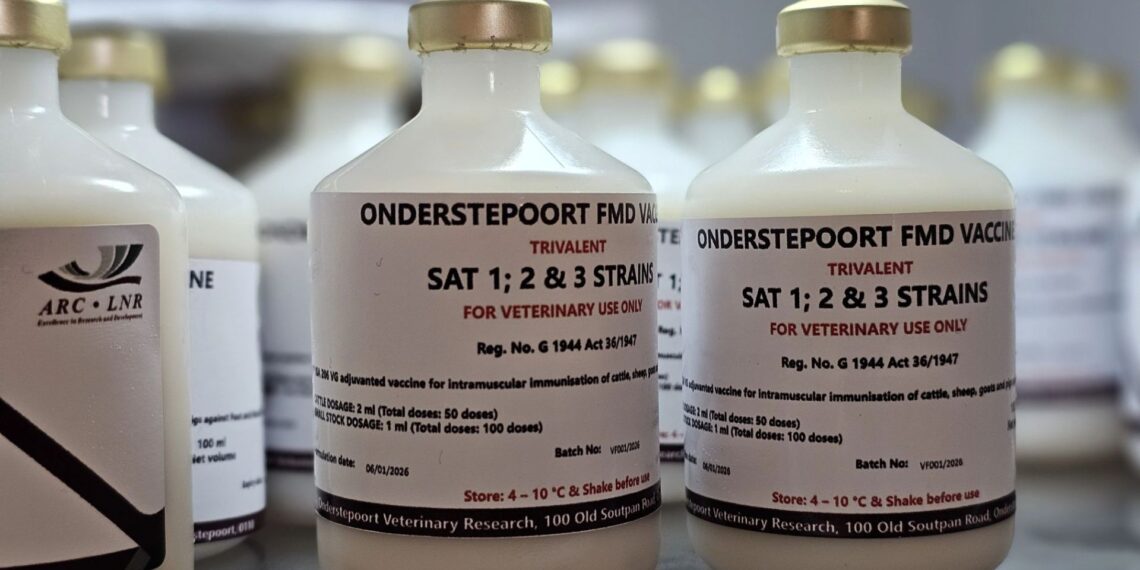
The minister was speaking at the Agricultural Research Council’s (ARC) Onderstepoort Veterinary Research campus, where the first doses of the locally manufactured vaccine were officially released.
“We will be going to the cabinet to have it declared a national disaster. The benefit of that would then be that we can get resources to assist us, particularly with movement control,” Steenhuisen said.
He emphasised that vaccination alone would not stop the disease and that it must be combined with strict movement control and adherence to regulations governing animal transport, auctions and trading activities. The immediate priority, he said, is to contain the outbreak within KwaZulu-Natal and prevent it from spreading to other provinces.
“It’s currently endemic as an epicentre in KwaZulu-Natal. We want to stop it spreading into other areas and turning them into KZNs,” Steenhuisen explained, noting that the Northern Cape remain disease-free.
Meanwhile, Agri Western Cape and the Red Meat Producers’ Organisation Western Cape (RPOWC) today announced that the Western Cape Department of Agriculture Veterinary Services has confirmed a positive case of FMD in Mbekweni, Wellington.
Related stories
- Steenhuisen quits DA leadership, pledges to end FMD
- An FMD-free future: Pipe dream or reality?
- A commercial farmer’s dismay: Steenhuisen faces FMD storm
- Govt steps up FMD fight with mass cattle vaccination plans
Local vaccine production resumes after two decades
The release of the vaccine marks the first time in nearly 20 years that South Africa is producing its own FMD vaccine.
The ARC will initially roll out about 20 000 doses per week while scaling up production. These doses will complement imported vaccines already secured by the government, including more than two million doses procured last year.
Over the next 12 months, the national strategy aims to vaccinate 80% of targeted herds and reduce the incidence of the disease by 70%. The longer-term goal is to regain official disease-free status with vaccination, allowing South Africa to reopen international markets for red meat exports.
The ARC chief executive, Dr Litha Maginxa, described the vaccine release as a milestone for South African agriculture. Maginxa said the vaccine was developed by South African scientists, in local facilities, specifically to address the strains affecting the country.
“Our scientists have produced a vaccine of high quality that meets all the required technical standards and regulatory requirements. It gives South Africa a powerful tool in controlling outbreaks now and in the future,” he said,
The vaccine was developed and produced at the ARC’s transboundary animal diseases (TAD) facility at Onderstepoort, one of the few high-containment laboratories of its kind in the region.
Facility principal Dr Paidamwoyo Mutowembwa explained that the unit is designed to handle highly infectious pathogens affecting livestock, including FMD, African swine fever and other transboundary diseases.
The laboratory operates under strict biosafety protocols, including negative-pressure systems, high efficiency particulate air (HEPA) filtration, on-site waste treatment and tightly controlled personnel access.
“All of this is designed to minimise or eliminate any risk of spreading the virus to the outside world,” Mutowembwa said.
Lead scientist Dr Faith Peta said the team has developed a highly efficacious vaccine that has been tested over several years and has demonstrated strong potency. She explained that it exceeds international potency requirements, meaning a standard 2 ml dose is sufficient to protect animals.
State to carry costs, not farmers
On the issue of cost, officials dismissed claims that the vaccine would cost as much as R300 per dose, describing such figures as inaccurate. Current estimates place the price closer to R45 per dose, with the possibility of lower costs depending on the supplier.
The government indicated that vaccination carried out as part of the national disease-control programme would be state-funded, although privately run or voluntary vaccination schemes may require producers to cover the costs themselves.
READ NEXT: How to choose the right farm insurance to protect your business