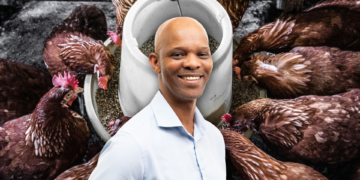
What started as a way to survive unemployment became a soaring commercial success. In this edition of Farmer Mentor, Lebo Mashigo, founder of Eggsellent, shares her story of navigating land challenges, securing grant funding, and mastering the technical demands of modern poultry farming.
Lebo Mashigo built her commercial egg business from a small survival initiative started in 2019 after the birth of her first child. Initially unemployed, she began by reselling eggs within her community, buying, repackaging, and selling them with minimal startup capital.
This laid the foundation for what later developed into a growing commercial layer farm through reinvestment and gradual expansion.
She intended to move into broiler production, but instead became increasingly interested in egg production as demand grew.
“The opportunity evolved. I found myself more interested in learning about egg production itself. I started researching, engaging with farmers, and gradually the idea of producing eggs in-house took shape.”
The Covid-19 pandemic became a major growth driver as consumers turned to local suppliers to avoid long supermarket queues. Increased demand, combined with Mashigo’s use of social media to share her journey, expanded her customer base and opened funding opportunities.
Scaling from backyard to commercial farm
Eggsellent started in Mashigo’s mother’s backyard with just 20 laying hens. Through reinvestment, the flock grew from 20 to 100, and later to 500 birds. She also entered business competitions and pitch platforms to secure support and visibility.
Key funding milestones included:
- A small Covid-19 relief grant
- A R50 000 NYDA grant
- A R250 000 investment through a Unilever business competition
“The Unilever programme was especially important because it not only provided funding. It trained me on compliance, bookkeeping, and formal business management,” she says.
Related stories
- Poultry farming: Tips to manage unpredictable weather patterns
- Poultry and potatoes power Fort Hare graduate’s farming vision
- Harvesting success: Inga Qeja’s journey from garden to grocer
- More than livestock: Lesedi’s legacy in the heart of the Kalahari
In 2024, Mashigo secured support from the department of agriculture, which funded infrastructure capable of producing up to 30 000 eggs a day.
Rather than scaling immediately, she adopted a phased approach, starting with 15 000 layers.
“We chose to operate at 50% capacity first so that we could understand the system and reduce risk. Growth must be controlled, not rushed,’’ she says.
Challenges of commercial farming
The farm is now preparing to expand further, with another 15 000 birds already procured.
Mashigo highlights several key challenges in commercial farming, starting with land ownership and financing. She explains that one of the biggest constraints is operating on land allocated by traditional leadership without holding a formal title deed, which limits access to broader funding opportunities.
She also points to the technical demands of modern, environmentally controlled production systems, which require constant oversight and increase both operational complexity and costs. In addition, market access remains a significant hurdle, as emerging producers must compete for shelf space against well-established brands with strong reputations and distribution networks.
Lastly, Mashigo notes the pressure of compliance requirements, explaining that regulatory standards are often the same for new entrants as they are for long-established commercial producers, creating a heavy burden for growing enterprises.
Mashigo stresses that farming must be treated as a business. “Farming is a business. Many people focus only on production and forget the business side entirely.”
She strengthens her business by surrounding herself with specialists who complement her areas of weakness, particularly in finance and technical systems.
Mashigo explains that, as she is not an accountant, she works with professionals who understand financial management, ensuring the business benefits from expertise she lacks.
Focus on quality and consistency
As Eggsellent grows, maintaining quality remains central to the brand.
She emphasises consistency across all customers, ensuring the same standard whether supplying small trays or bulk orders. Trust and reputation, she says, are key to long-term sustainability.
Beyond commercial success, Mashigo hopes her journey inspires others.
“I want to be remembered as someone who broke ground in spaces where women from rural backgrounds are often not expected to succeed,” she says.
READ NEXT: Poultry industry on edge as winter bird flu threat looms